
· For research use only. Not for human consumption.
For research use only. Not for human consumption.
HPLC testing is the standard analytical method for verifying peptide purity — and if you’ve ever seen “98% purity by HPLC” on a certificate of analysis, you’ve already encountered its output. But what actually happens when a peptide sample goes into one of these machines? The answer is more elegant than most people expect, and understanding it makes every COA you read dramatically more meaningful.
This article walks through how HPLC works, what it measures in a peptide sample, where it falls short, and what a reliable result actually looks like. It also covers why the lab running the test matters almost as much as the test itself. No jargon walls — just a clear look at a genuinely important analytical tool.
If you’re new to COAs entirely, it’s worth reading our guide to what a certificate of analysis actually contains before continuing here.
TL;DR: HPLC (high-performance liquid chromatography) separates a peptide sample’s components and measures the relative amount of each by the area under its detector peak. The purity percentage on a COA comes directly from this calculation. According to USP General Chapter <621>, HPLC is the reference method for pharmaceutical purity testing — but identity confirmation requires mass spectrometry in addition. For research use only.
What Is HPLC?
HPLC stands for high-performance liquid chromatography. It’s a separation technique used across pharmaceutical analysis, food science, and biochemistry research. According to Snyder et al. in Introduction to Modern Liquid Chromatography (Wiley, 2010), the technique separates compounds by pushing a liquid solvent — the mobile phase — through a tightly packed column under high pressure, exploiting each compound’s different affinity for the column material inside.
Here’s the analogy that makes it click. Imagine sending a crowd of people through a long corridor filled with mud. People who are stickier — more attracted to the mud — slow down and take longer to reach the exit. People who slide through easily arrive first. The column in an HPLC machine works the same way. Compounds that interact more strongly with the column material elute (exit) later. Compounds that don’t stick much elute early. Each compound arrives at the detector at a predictable, reproducible time — called its retention time.
The column itself is typically packed with silica particles coated with a nonpolar carbon chain (C18 is the most common in peptide analysis). The mobile phase is a mixture of water and an organic solvent, usually acetonitrile, whose ratio changes over the run to progressively pull even the stickiest compounds off the column. It’s a precisely choreographed push-and-pull between the column and the solvent.
What Does HPLC Actually Measure in a Peptide Sample?
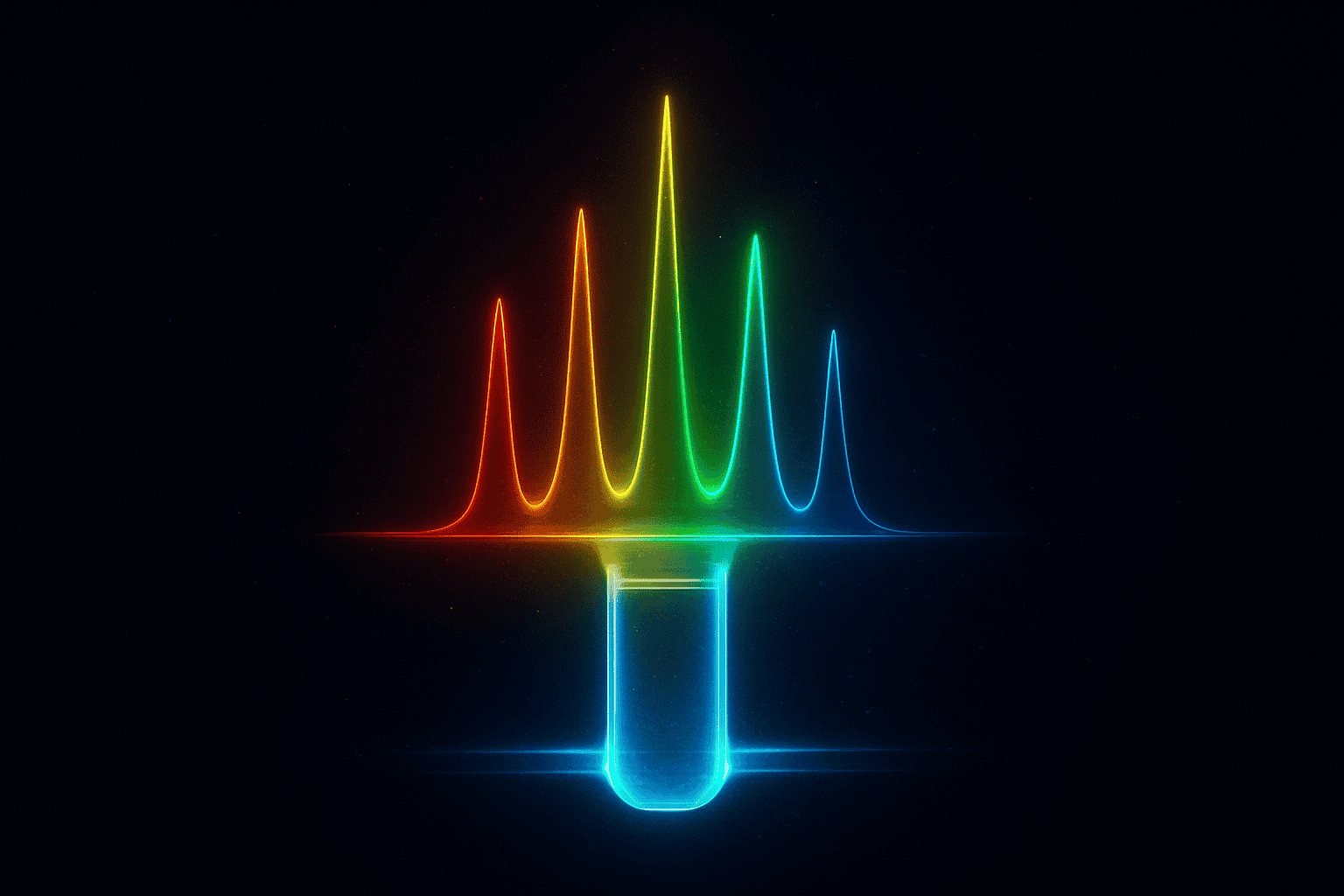
After separation, each compound exits the column and passes through a detector — almost always a UV (ultraviolet) detector for peptide analysis. Peptide bonds absorb UV light at 210–220 nm, so as each compound flows past, the detector records a spike in absorbance. That spike, plotted over time, produces a peak on the chromatogram. Aguilar (2004) in Methods in Molecular Biology Vol. 251 (Humana Press) describes peak area as the standard measure of compound quantity: the larger the area under a peak, the more of that compound is present in the sample.
The purity percentage you see on a COA is calculated directly from this. Take the area of the main peptide peak, divide it by the total area of all peaks on the chromatogram, multiply by 100, and you get the purity percentage. If the main peak represents 98.5% of the total signal, the stated purity is 98.5%. That’s it. Elegant and direct.
What shows up in the other peaks? Synthesis impurities, mostly. These include deletion sequences (where one amino acid was skipped during synthesis), oxidation products (where certain residues reacted with oxygen during or after synthesis), and truncated fragments (incomplete chains). They’re unavoidable at trace levels in solid-phase peptide synthesis. The question is how much of them there are — and HPLC answers that precisely.
The purity figure on a COA is not a subjective quality grade — it’s a mathematical ratio derived from detector signal areas. Two labs running the same sample on properly calibrated HPLC systems should produce extremely similar purity figures. If a supplier’s reported purity looks suspiciously round (exactly 99.0%, every batch, every compound), that can actually be a signal worth scrutinizing. Real measurements have decimal variation.
Why HPLC Alone Isn’t Enough: The Case for Mass Spectrometry Too
Here’s the limitation that every researcher should understand. HPLC tells you that 98% of your sample is one dominant compound. It does not tell you what that compound is. A well-synthesized version of the wrong peptide would look clean on an HPLC trace. Stults and Arnott in Methods in Enzymology Vol. 402 (2005) describe HPLC and mass spectrometry as complementary tools: HPLC for purity, MS for identity.
Mass spectrometry works differently. It ionizes the peptide molecules and measures their mass-to-charge ratio. The result is a molecular weight — specific enough to confirm whether the compound is actually what the label claims. Every peptide has a unique molecular weight based on its exact amino acid sequence. A COA that includes both HPLC purity data and a mass spec confirmation is saying two things: “this sample is mostly one compound” and “that compound is the right one.”
Think of it this way. HPLC is like weighing your luggage and confirming it’s mostly one heavy bag. Mass spec is like opening the bag and confirming it contains your clothes, not someone else’s. You need both pieces of information. A COA with only HPLC data is incomplete for serious research applications.
We’ve found that researchers who have worked with poorly characterized peptide samples — where only HPLC was reported — are often the most insistent about seeing mass spectrometry data on subsequent orders. The experience of running an experiment with a high-purity but mis-identified compound is a convincing lesson in why identity confirmation matters.
What Does a Good HPLC Chromatogram Look Like?
A clean chromatogram for a well-synthesized research peptide shows one thing above all others: a dominant, sharply defined main peak. Neue in HPLC Columns: Theory, Technology, and Practice (Wiley-VCH, 1997) identifies peak symmetry as a key quality indicator — a peak that rises and falls steeply with a flat baseline on either side indicates clean separation. USP General Chapter <621> specifies that a peak’s tailing factor should not exceed 2.0 for an acceptable pharmaceutical chromatographic result.
Reading the Main Peak
The main peak’s retention time should be consistent batch to batch for the same compound under the same method conditions. If retention time shifts significantly between batches, something has changed — the method, the column condition, or the compound itself. A reliable COA will report both the purity percentage and the retention time. That second number is often overlooked but carries real information.
What Small Side Peaks Mean
Small peaks flanking the main peak are impurities. At trace levels — say, under 1% each — they’re expected and acceptable in solid-phase synthesized peptides. The concern begins when multiple small peaks collectively add up to a significant portion of the total signal, or when a single impurity peak is larger than about 1–2% of the main peak area. Görög in Identification and Determination of Impurities in Drugs (Elsevier, 2000) describes individual impurity thresholds as a critical component of pharmaceutical purity specifications.
The Baseline Between Peaks
A truly clean chromatogram returns to a flat baseline between peaks. A rising or noisy baseline — sometimes called “hump” baseline — suggests a poorly resolved mixture or column contamination. It’s a visual signal that the separation wasn’t complete, which means the purity calculation may be less reliable than stated.
In our experience reviewing COAs across batches, the clearest differentiator between carefully synthesized and rushed peptide samples isn’t the headline purity number — it’s the baseline behavior and the symmetry of the main peak. A 97% purity result with a sharp, symmetric peak and clean baseline is more trustworthy than a 99% result with a noisy baseline and asymmetric peak shape.
Why Does Third-Party HPLC Testing Matter More Than In-House Testing?
When a supplier tests their own product and reports the result, there’s an inherent conflict of interest — not necessarily dishonesty, but a structural problem. The lab running the test has a financial stake in the outcome. Third-party testing removes that conflict entirely. An independent laboratory has no reason to report anything other than what the instrument actually shows. Mant and Hodges in High-Performance Liquid Chromatography of Peptides and Proteins (CRC Press, 1991) describe validated HPLC methods as requiring calibration and qualification performed under a documented quality system — conditions most easily guaranteed in an independent, accredited setting.
The accreditation standard to look for is ISO/IEC 17025. Labs certified to this standard have demonstrated, to an external auditor, that their instruments are calibrated, their methods are validated, their staff are trained, and their results are traceable. When a COA lists an ISO/IEC 17025-accredited lab, that’s meaningful. It means the purity number wasn’t produced by an anonymous in-house instrument with no external oversight.
What should concern you as a researcher? A supplier who won’t share the lab name. Vague language like “tested for purity” without specifying the method. COAs with no date or batch number. These aren’t minor omissions — they’re the equivalent of a food product with no ingredient label. For research where compound identity and purity are fundamental variables, unverifiable testing is a serious problem.
You can review third-party HPLC and mass spectrometry COAs for all Alpha Peptides products on our Certificates of Analysis page.
Frequently Asked Questions About HPLC Testing for Peptides
What does HPLC stand for?
HPLC stands for high-performance liquid chromatography. It’s sometimes also called high-pressure liquid chromatography — both names refer to the same technique. The “high-performance” or “high-pressure” part refers to the pressurized pump system that forces the liquid mobile phase through the tightly packed column. Earlier forms of liquid chromatography relied on gravity, which was far slower and less precise. Modern HPLC instruments operate at pressures up to several thousand psi, allowing for much faster, higher-resolution separations. (Snyder et al., Introduction to Modern Liquid Chromatography, Wiley, 2010)
Is UV detection enough, or should I expect other detectors on a COA?
UV detection at 210–220 nm is standard and sufficient for purity quantification in most peptide analyses — virtually all amino acids contribute to absorbance in this range because of the peptide bond. Some labs also use photodiode array (PDA) detection, which records the full UV spectrum at each point and adds a layer of peak confirmation. But the key addition isn’t a fancier UV detector: it’s mass spectrometry for identity. A UV-detected HPLC purity figure paired with a mass spec molecular weight confirmation is the minimum credible documentation for research-grade peptides. (Aguilar, Methods in Molecular Biology Vol. 251, Humana Press, 2004)
What purity does HPLC commonly show for research-grade peptides?
Research-grade peptides are typically sold at 98% purity or above by HPLC. Some suppliers offer a standard tier at 95% and a higher tier at 98%+. For preclinical research applications, 98% is the commonly cited threshold — below that, the proportion of impurities introduces more uncertainty into experimental results. USP General Chapter <621> provides the methodological framework for chromatographic purity testing in pharmaceutical contexts. Whether 95% or 98% matters for a specific application depends on the sensitivity of the assay and the research design.
For a deeper look at how purity figures are interpreted in research contexts, see our article on what 99% peptide purity actually means.
Where can I see HPLC results for research peptides?
Any credible peptide supplier should publish batch-specific COAs that include the full HPLC chromatogram or at minimum the purity percentage, retention time, and method details alongside mass spectrometry confirmation. Generic or undated COAs — especially those that don’t name the testing laboratory — provide no real assurance. You can view batch-specific HPLC and mass spec documentation for all products at alpha-peptides.com/coas/. Always review testing documentation before using any compound in a research context.
The Bottom Line on HPLC and Peptide Quality
HPLC is genuinely impressive analytical engineering. The fact that you can take a complex mixture of molecules, push it through a column under pressure, and precisely quantify what fraction of it is your target compound — all in under 20 minutes — is a remarkable piece of applied chemistry. It’s not magic. It’s physics and chemistry working together in a very controlled way.
But it’s also a tool with defined limits. Purity and identity are different questions. HPLC answers the first; mass spectrometry answers the second. A COA that reports both gives researchers something genuinely useful: confidence that the compound in the vial is what it claims to be, at the stated concentration of purity. A COA that reports only one of those things leaves a real gap.
The lab doing the testing matters too. Third-party, accredited testing isn’t a premium feature — it’s the baseline standard for any serious research application. When you see a COA from a named, accredited laboratory with both HPLC and mass spec data, you’re looking at documentation that was produced by someone with no stake in the result. That’s what independent verification actually means.
Related reading: What Is a Certificate of Analysis? A Plain-English Guide | What Does 99% Peptide Purity Actually Mean?
For research use only. Not for human consumption. All peptides referenced in this article are research chemicals intended exclusively for laboratory and preclinical research purposes. They are not dietary supplements, are not approved for human or veterinary use, and are not intended to diagnose, treat, cure, or prevent any disease or condition. All information on this page is provided for educational purposes relating to analytical chemistry and laboratory research methods only. It does not constitute medical advice of any kind.
Shop Research-Grade Peptides from Alpha Peptides
Alpha Peptides is a U.S.-based research peptide supplier providing HPLC-verified, third-party tested compounds with full Certificates of Analysis on every batch. All products are for research use only, not for human consumption.
- BPC-157 — 15-amino acid peptide, >98% HPLC purity
- TB-500 — Thymosin Beta-4 fragment, MS-confirmed identity
- Ipamorelin — Selective GHS-R agonist, research grade
- CJC-1295 (with DAC) — GHRH analog with full analytical documentation
Browse all 20+ research peptides → | View Certificates of Analysis →