
· For research use only. Not for human consumption.
For research use only. Not for human consumption.
The term receptor agonist shows up constantly in peptide research papers, but nobody ever seems to explain what it actually means in plain English. If you have tried reading a study abstract and hit a wall at “selective receptor agonist,” you are not alone. The concept is simpler than the jargon makes it sound.
A receptor agonist is a molecule that binds to a receptor on a cell and activates it. That is it. The receptor is like a lock on a door. The agonist is a key that fits the lock and turns it, opening the door and triggering a response inside the cell. Many research peptides work exactly this way — they are keys designed to fit specific biological locks.
This guide explains what a receptor agonist is, how it differs from an antagonist, and why the concept matters for understanding peptide research. For examples of specific peptides that act as agonists, see our guides on Tesamorelin and our overview of triple agonist research.
TL;DR: A receptor agonist is a molecule that binds to a cell receptor and activates it, triggering a biological response. An antagonist binds to the same receptor but blocks it without activating it. Full agonists produce a maximum response; partial agonists produce a weaker response. Many research peptides function as receptor agonists — they are keys that fit and turn specific cellular locks. For research use only. Not for human consumption.
Understanding the Receptor Agonist Concept: Locks and Keys
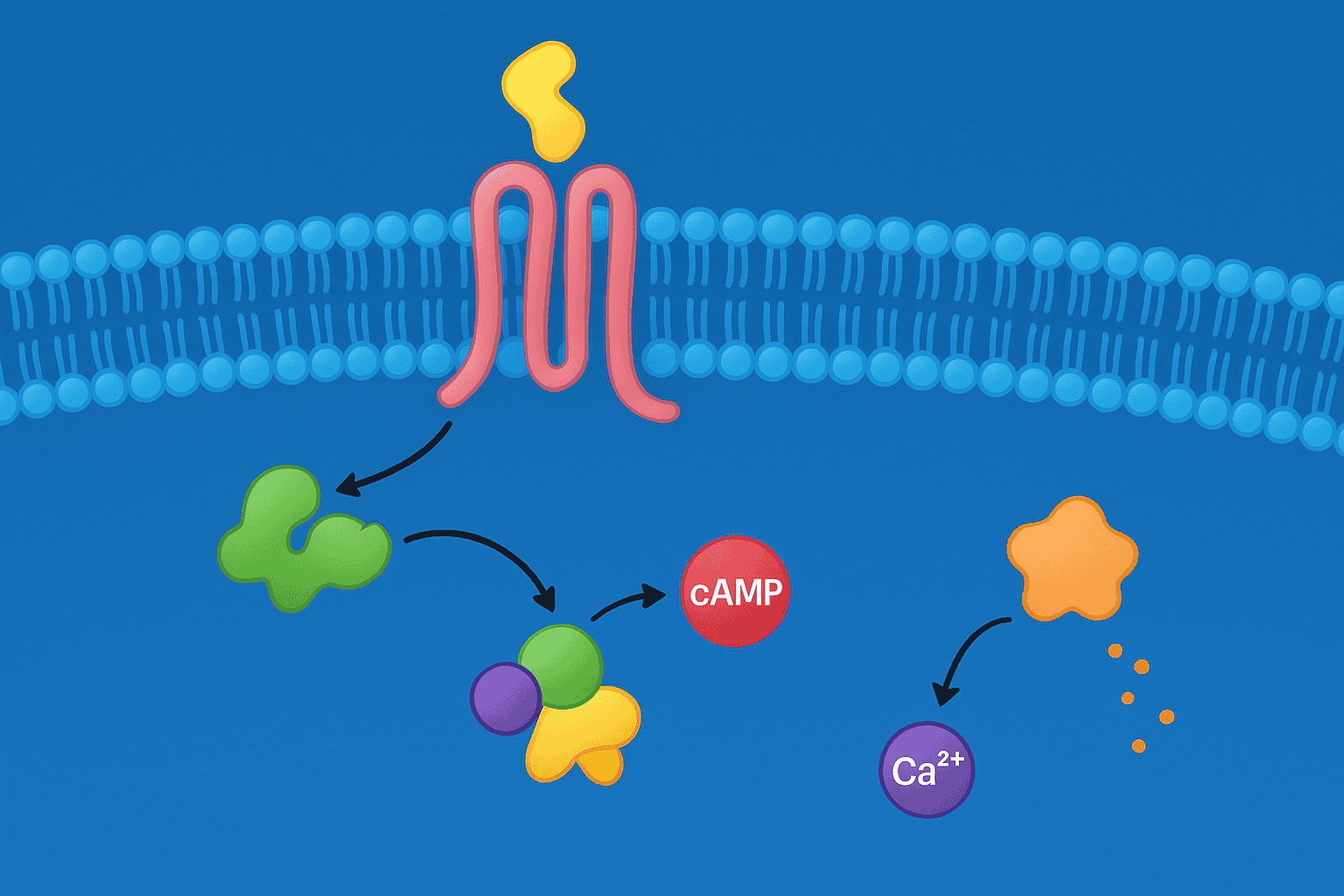
Every cell in the body has receptors sitting on its surface or inside it. These receptors are proteins that act like docking stations. When the right molecule comes along and fits into a receptor, it sends a signal inside the cell that tells it to do something — release a chemical, start a process, or change its behavior.
A receptor agonist is a molecule that fits into one of these docking stations and activates it. The word “agonist” comes from a Greek word meaning “one who contends” — in biology, it means “one who acts.” An agonist does something. It binds to the receptor and causes a response.
Here is the lock-and-key analogy in full. Your cell membrane is a wall full of locked doors (receptors). An agonist is a key that fits a specific lock, turns it, and opens the door. Once the door is open, things start happening inside the cell. Different keys open different doors, which is why different agonists produce different effects.
The body already produces its own agonists for most receptors. Hormones, neurotransmitters, and signaling peptides are all natural agonists — they are the body’s own keys. Research peptides that act as agonists are essentially lab-made keys designed to fit the same locks.
What Is the Difference Between an Agonist and an Antagonist?
If an agonist is a key that fits the lock and turns it, an antagonist is a key that fits the lock but does not turn. It sits in the keyhole and blocks anything else from getting in. The door stays locked. No signal gets sent inside the cell.

Antagonists are essentially blockers. They occupy the receptor so that the real agonist — the one that would normally activate it — cannot get in. Think of it like someone jamming a piece of metal into a keyhole. It does not open the door, but it prevents anyone with the real key from using it either.
Both agonists and antagonists are important research tools. Scientists use agonists when they want to see what happens when a receptor gets activated. They use antagonists when they want to see what happens when a receptor gets blocked. Together, these tools help researchers understand what each receptor actually does and how important it is for specific biological processes.
In peptide research, most compounds being studied are agonists rather than antagonists. Researchers are typically interested in what happens when a pathway is activated, not what happens when it is shut down — though both questions have scientific value.
Full Agonist vs Partial Agonist: What Is the Difference?
Not all agonists produce the same level of response. A full agonist activates a receptor to its maximum capacity. A partial agonist activates the same receptor but only produces a fraction of the maximum response, no matter how much of it you apply.
Back to the key analogy. Imagine one key turns all the way and opens the door completely (full agonist). Another key fits the same lock but only turns partway — it cracks the door open but does not fully swing it wide (partial agonist). Both keys work. Both interact with the lock. But the results are different in scale.
Partial agonists have an interesting property that makes them valuable for research. Because they cannot produce a full response, they can actually block full agonists from achieving their maximum effect. If a partial agonist is sitting in the receptor, a full agonist cannot get in and do its full job. This creates a ceiling on the response — a concept researchers find useful when studying receptor systems where too much activation might be problematic.
Understanding whether a peptide is a full or partial agonist matters because it determines how it behaves in experimental models. A full agonist and a partial agonist for the same receptor will produce different data, even if they are binding to the exact same site.
How Do Research Peptides Act as Receptor Agonists?
Many research peptides are studied specifically because they act as agonists at known receptors. Their amino acid sequences are shaped to fit particular receptor sites, just like a key is cut to match a specific lock. Here are a few examples from the preclinical literature.
Tesamorelin is a growth hormone-releasing hormone (GHRH) receptor agonist. It binds to the GHRH receptor on pituitary cells and activates it, which in preclinical models has been observed to stimulate growth hormone release. Tesamorelin is a modified version of natural GHRH with a trans-3-hexenoic acid group added for stability.
GLP-3 is studied as a triple receptor agonist, meaning it is designed to fit and activate three different receptor types simultaneously: the GLP-1 receptor, the GIP receptor, and the glucagon receptor. Single agonists interact with one lock. GLP-3 carries three different key shapes on the same molecule. This is why triple agonist research has generated significant scientific interest.
Selank has been examined in preclinical models for its interaction with GABAergic receptor systems. Kozlovskaya et al. (2003) studied Selank’s effects on anxiety-related behavior in animal models, observing interactions with GABA-mediated pathways (PMID: 14969422). The peptide’s receptor interactions illustrate how even short amino acid chains can engage with specific cellular signaling systems.
Kozlovskaya et al. (2003) examined Selank’s effects in animal behavioral models and observed interactions with GABAergic signaling pathways. The study illustrated how a seven-amino-acid peptide can engage with specific receptor systems to produce measurable changes in preclinical assays. (PMID: 14969422)
Why Understanding Receptor Agonists Matters for Research
Knowing whether a compound is a receptor agonist, antagonist, full agonist, or partial agonist is not just academic trivia. It determines how experiments are designed, what results mean, and which controls are needed. A researcher studying a GHRH receptor agonist like Tesamorelin needs different controls than someone studying a receptor antagonist.
The agonist concept also explains why some peptides are more specific than others. A highly selective agonist fits only one receptor type — like a key that opens only one door in the entire building. A less selective agonist might fit several receptors, producing a broader range of effects. In research, selectivity is often desirable because it makes results easier to interpret.

For researchers looking to explore these concepts with actual compounds, Alpha Peptides provides research-grade peptides with documented purity and identity verification. Browse the full research catalog or review third-party testing data on our Certificates of Analysis page.
Frequently Asked Questions
Can one peptide be an agonist at multiple receptors?
Yes. Some peptides are designed to bind and activate more than one receptor type. GLP-3, for example, is studied as a triple receptor agonist that targets three different receptor systems simultaneously. The number of receptors a compound activates depends on its structure and how many different “key shapes” it carries.
Is an agonist the same thing as a stimulant?
No. An agonist is a molecule that activates a specific receptor. A stimulant is a general term for something that increases activity. An agonist might activate a receptor that calms a system down — not all receptor activation leads to stimulation. The effect depends on which receptor is being activated and what that receptor’s job is.
How do scientists figure out which receptor a peptide activates?
Researchers use binding assays, which are laboratory tests that measure whether a compound physically attaches to a specific receptor. They also use functional assays that measure what happens inside the cell after binding occurs. By testing a peptide against panels of known receptors, scientists can map out which ones it interacts with and how strongly.
Does every peptide act as a receptor agonist?
No. Some peptides interact with receptors as antagonists (blockers). Others work through mechanisms that do not involve traditional receptor binding at all — they might interact with enzymes, structural proteins, or other non-receptor targets. The receptor agonist mechanism is common in peptide research but not universal.
For research use only. Not for human consumption. This article is intended for informational purposes and does not constitute medical advice, dosing guidance, or therapeutic recommendations.