
· For research use only. Not for human consumption.
For research use only. Not for human consumption.
You’ve probably heard mitochondria called the “powerhouses of the cell” — it’s one of those facts that sticks from biology class. But what exactly is a mitochondrial peptide? It’s a type of small protein that either comes from mitochondrial DNA or is designed to target mitochondria specifically. And it’s becoming one of the most active areas of peptide research.
This guide explains what mitochondrial peptides are, why they matter, and how they differ from other research peptides — all in plain English.
For specific compounds, see our guides on MOTS-c and SS-31 vs MOTS-c.
TL;DR: A mitochondrial peptide is a short protein chain that originates from mitochondrial DNA or is engineered to interact with mitochondria. MOTS-c is a naturally encoded mitochondrial peptide discovered in 2015 (Lee et al., 2015). SS-31 is a synthetic peptide designed to target the inner mitochondrial membrane (Mitchell et al., 2020). These represent two fundamentally different approaches to mitochondria research. For research use only. Not for human consumption.
Mitochondria: A Quick Refresher
Before diving into mitochondrial peptide research, let’s revisit what mitochondria actually do. Every cell in your body (except red blood cells) contains hundreds to thousands of tiny structures called mitochondria.
These organelles convert food into ATP — adenosine triphosphate — which is the energy currency cells use to do everything. Think of ATP as the electricity that powers every function in every cell. Without mitochondria, your cells would have no power.
What makes mitochondria unique is that they have their own DNA, separate from the DNA in your cell’s nucleus. This mitochondrial DNA (mtDNA) is much smaller — only 37 genes compared to about 20,000 in nuclear DNA — but it’s critically important. And some of those genes encode peptides.
Two Types of Mitochondrial Peptides
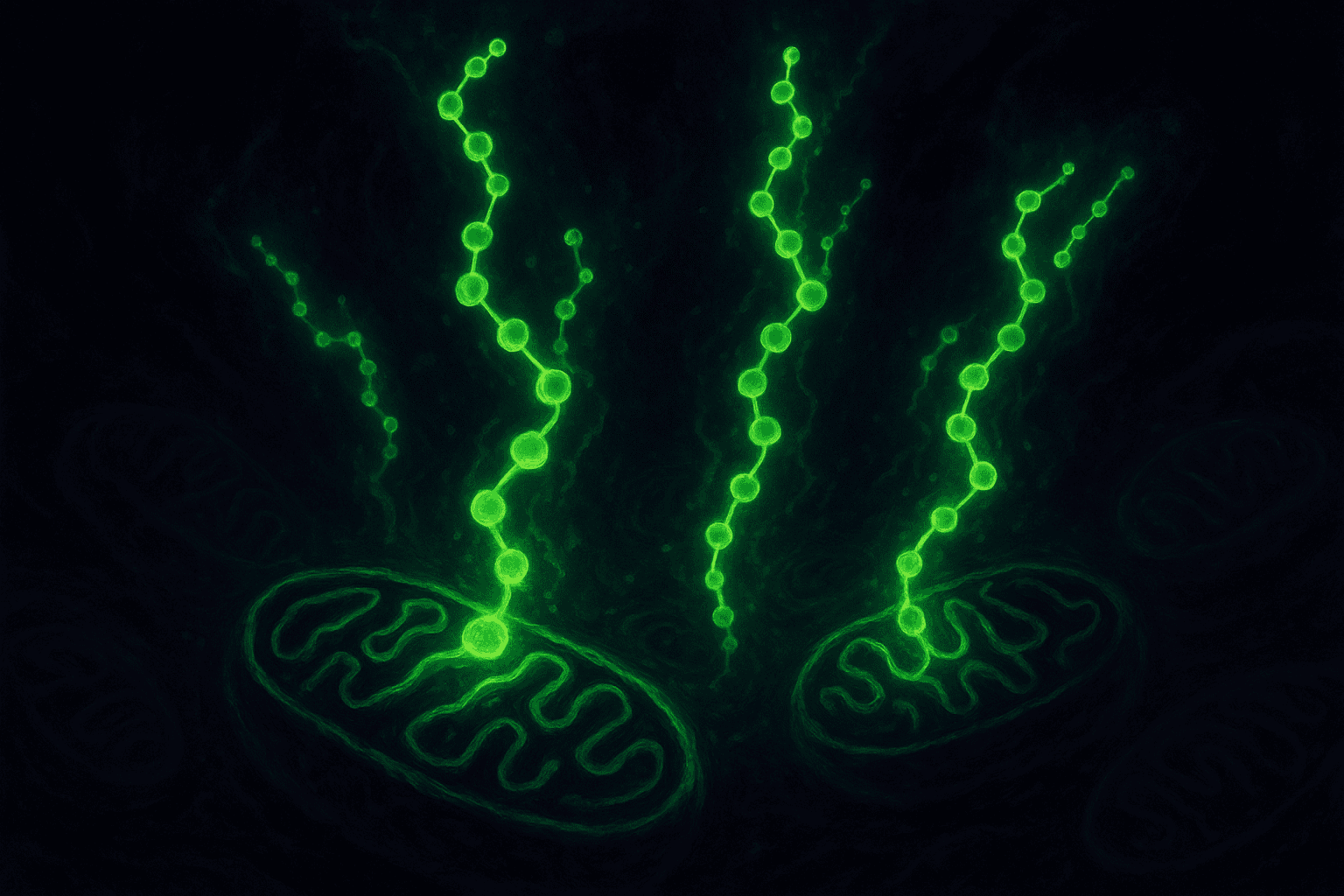
When scientists talk about mitochondrial peptide research, they’re usually referring to one of two categories:
1. Mitochondria-Derived Peptides (MDPs)
These are peptides encoded by mitochondrial DNA itself. They’re produced naturally by your own cells. The most well-known example is MOTS-c, discovered in 2015 by a team at the University of Southern California.
MDPs are exciting because they represent a previously unknown form of cellular communication. Until recently, scientists didn’t realize that mitochondrial DNA was producing signaling peptides. It’s like discovering that your car’s engine has been sending text messages to the rest of the vehicle.
Lee et al. (2015) identified MOTS-c as a mitochondrial-derived peptide encoded by the 12S rRNA gene of mitochondrial DNA, demonstrating its role in metabolic homeostasis in preclinical models. (PMID: 25738459)
2. Mitochondria-Targeted Peptides (MTPs)
These are synthetic peptides designed in a lab to reach and interact with mitochondria. They don’t come from mitochondrial DNA — they’re engineered to travel to mitochondria from outside the cell. SS-31 (also called Elamipretide) is the best-known example.
MTPs use specific chemical properties (usually a combination of positive charge and hydrophobicity) to penetrate cell membranes and accumulate specifically in mitochondria. It’s like designing a GPS-guided delivery drone that always flies to the same destination.
Mitchell et al. (2020) characterized how SS-31 binds to mitochondrial lipid bilayers, providing mechanistic insight into how this synthetic mitochondrial peptide reaches its target. (PMID: 32273339)
Why Mitochondrial Peptide Research Matters

Mitochondria are involved in far more than just energy production. They play roles in:
- Metabolism — How cells process nutrients and generate energy
- Cell signaling — Mitochondria communicate with the nucleus and other organelles
- Programmed cell death (apoptosis) — Mitochondria help decide when damaged cells should be retired
- Reactive oxygen species (ROS) — Mitochondria produce byproducts that can damage cells if not managed
When mitochondria malfunction, the effects can cascade throughout the cell. This is why researchers are interested in any mitochondrial peptide that could serve as a tool for studying these processes in controlled laboratory settings.
MOTS-c vs SS-31: Two Approaches to the Same Organelle
Alpha Peptides carries both MOTS-c and SS-31, representing the two approaches to mitochondrial research:
- MOTS-c — A naturally encoded mitochondrial peptide. Researchers use it to study how mitochondria communicate with the rest of the cell. It works “from the inside out.”
- SS-31 — A synthetic peptide engineered to penetrate mitochondrial membranes. Researchers use it to study what happens when you deliver a specific molecule directly to mitochondria. It works “from the outside in.”
For a detailed comparison, see our SS-31 vs MOTS-c guide. Both products come with batch-specific Certificates of Analysis.
Frequently Asked Questions
What is a mitochondrial peptide?
A mitochondrial peptide is a short protein chain that either originates from mitochondrial DNA (like MOTS-c) or is synthetically designed to target mitochondria (like SS-31). Both types are used as research tools to study mitochondrial biology.
How many mitochondrial peptides have been discovered?
Several mitochondria-derived peptides (MDPs) have been identified, including MOTS-c, Humanin, and SHLPs (small humanin-like peptides). The field is relatively young — MOTS-c was only discovered in 2015.
Are mitochondrial peptides approved for medical use?
No. Neither MOTS-c nor SS-31 is approved for human medical use. They are research compounds sold for laboratory investigation only.
Can I study mitochondria without these peptides?
Yes, there are many tools for mitochondrial research. Mitochondrial peptides are one category of research tool among many, including mitochondrial dyes, inhibitors, and genetic techniques.
For research use only. Not for human consumption. This article is intended for informational purposes and does not constitute medical advice, dosing guidance, or therapeutic recommendations.