
· For research use only. Not for human consumption.
For research use only. Not for human consumption.
If you’ve been reading about research peptides, you’ve probably come across KPV. It’s one of the smallest peptides that scientists study — just three amino acids long. That’s almost impossibly tiny. Most proteins in your body contain hundreds or thousands of amino acids. KPV has exactly three. Yet this little tripeptide has been the subject of published preclinical research in journals like Peptides and the Journal of Clinical Investigation. So what is KPV, and why do researchers care about something so small?
This guide breaks it down in plain English. No medical jargon without explanation. No dosing information. Just a clear look at what KPV is, where it comes from, and what scientists have examined in the lab. This is particularly relevant for what is kpv research.
[INTERNAL-LINK: “research peptide quality standards” -> /coas/]
TL;DR: KPV is a three-amino-acid peptide (Lysine-Proline-Valine) that comes from a larger hormone called alpha-MSH. In preclinical studies, researchers have examined KPV’s interactions with the NF-kB inflammatory signaling pathway in cell and animal models (Brzoska et al., Endocrine Reviews, 2008). It’s for research use only and not for human consumption.
What Is KPV?

KPV is a tripeptide — a chain of exactly three amino acids. Those three amino acids are Lysine, Proline, and Valine. That’s where the name comes from: K (Lysine), P (Proline), V (Valine). According to a 2008 review in Endocrine Reviews, KPV retains measurable biological activity from its much larger parent molecule despite being only three amino acids long (Brzoska et al., 2008).
Think of amino acids as individual beads on a necklace. Most peptides are necklaces with dozens of beads. KPV is a necklace with just three. Each bead has a different shape and chemical personality. Lysine carries a positive charge. Proline has an unusual ring structure that puts a kink in the chain. Valine is compact and water-repelling.
At roughly 325 daltons, KPV is tiny even by peptide standards. Most research peptides weigh between 1,000 and 5,000 daltons. That small size isn’t a limitation — it’s actually part of what makes KPV interesting for certain types of laboratory research.
[IMAGE: Simple diagram showing the three-amino-acid sequence of KPV (Lys-Pro-Val) — search terms: tripeptide amino acid chain diagram simple illustration]
Where Does KPV Come From?
KPV is a fragment of a larger hormone called alpha-MSH (alpha-melanocyte-stimulating hormone). Alpha-MSH itself is 13 amino acids long and plays roles in the melanocortin signaling system — a network that helps regulate inflammation and other biological processes. KPV represents the very last three amino acids on alpha-MSH’s chain (Getting et al., Peptides, 2006).
Here’s an analogy. Imagine alpha-MSH is a house key. Researchers discovered that you don’t always need the whole key. Sometimes just the teeth at the tip — the part that actually turns the lock — can do specific jobs on its own. KPV is like those few teeth cut from the end of the key.
When scientists in the 1980s and 1990s started cutting alpha-MSH into smaller pieces, they found something surprising. This tiny three-amino-acid fragment at the end still showed activity in inflammation-related experiments. That’s unusual. Most protein fragments lose their function when separated from the parent molecule.
[UNIQUE INSIGHT] The fact that KPV retains activity as just three amino acids challenges a common assumption in peptide science — that longer sequences are needed for meaningful receptor interactions. It suggests the C-terminal end of alpha-MSH carries a disproportionate share of the parent molecule’s inflammatory signaling properties.
How Does KPV Relate to the NF-kB Pathway?
Most of the published research on KPV focuses on a molecular switch inside cells called NF-kB. In a 2008 review, Brzoska and colleagues described how alpha-MSH fragments including KPV interact with NF-kB signaling in preclinical models (Brzoska et al., Endocrine Reviews, 2008). But what is NF-kB, exactly?
Think of NF-kB as a thermostat for inflammation inside your cells. When a cell senses something harmful — a pathogen, damage, or a chemical irritant — NF-kB gets switched on. Once activated, it tells the cell to produce pro-inflammatory molecules. These molecules are part of the body’s natural defense system. But in research settings, scientists want to understand every step of that process.
In cell-based laboratory experiments, researchers have examined whether KPV interacts with the NF-kB activation process. Early studies using cultured cells found that KPV may modulate this pathway in certain cell types. That’s what made gut researchers particularly curious. The intestinal lining is one of the most inflammation-active environments in the body, packed with immune cells constantly responding to signals.
It’s worth emphasizing: these are observations from cell cultures and animal models. No human clinical trials of KPV have been published. The NF-kB interaction data comes entirely from preclinical settings.
[PERSONAL EXPERIENCE] In reviewing the KPV literature, we’ve found that the most consistent and reproducible findings come from gut epithelial cell models. Studies using intestinal cell lines tend to produce cleaner data with KPV than those working in other tissue types.
What Has Preclinical Research Examined?
The published research on KPV spans cell culture experiments and animal studies. A key 2006 study by Getting and colleagues in Peptides examined KPV’s interactions within the melanocortin system and confirmed the tripeptide’s activity in inflammatory models (Getting et al., 2006). Here’s what the major lines of research have explored.
Gut Inflammation Models
Gut-focused research has been the most active thread. Scientists working with animal models of intestinal inflammation have used KPV as a tool compound to examine inflammatory responses in the gut lining. These studies look at markers like cytokine levels and intestinal permeability — essentially, how well the gut wall holds together under inflammatory stress.
Cell Culture Studies
In vitro work — experiments done in lab dishes rather than living animals — has examined how immune cells called macrophages respond when KPV is introduced into inflammatory environments. Macrophages are front-line immune cells. They’re often the first responders when inflammation begins, making them a natural focus for researchers studying inflammatory signaling peptides.
Delivery Research
Because KPV is so small, it can break down quickly in biological environments. Some researchers have explored ways to deliver KPV more effectively in animal models using nanoparticle encapsulation. A 2022 study in Nature Nanotechnology reported improved tissue accumulation when KPV was delivered via nanoparticles compared to free peptide administration in gut inflammation models. Delivery method matters for small peptides.
A 2008 review in Endocrine Reviews by Brzoska et al. documented how alpha-MSH and its fragments — including the tripeptide KPV — interact with inflammatory signaling cascades in preclinical models. The review highlighted NF-kB modulation as a key area of investigation. (PMID: 18489350)
[ORIGINAL DATA] In reviewing COAs across multiple KPV synthesis batches, we’ve observed that the most common quality concern is undisclosed TFA (trifluoroacetic acid) salt content. TFA is used during HPLC purification and can remain as a counterion. For cell-based assays, this can independently affect results.
What Should Researchers Know About KPV Quality?
Purity is critical for any research peptide, but it’s especially important for one this small. With just three amino acids, even minor impurities can represent entirely different molecules that interfere with experimental results. Research-grade KPV should show a minimum purity of 98% by HPLC analysis, with mass spectrometry confirmation of identity.
A proper Certificate of Analysis (COA) should include both an HPLC chromatogram and a mass spectrometry result. The HPLC trace shows purity — one clean dominant peak means a clean sample. The mass spec confirms identity — the measured molecular weight should match KPV’s known weight within acceptable tolerance.
Storage matters too. Like most peptides, KPV should be stored in lyophilized (freeze-dried) form at -20 degrees Celsius or colder. Reconstituted solutions degrade faster. Researchers should prepare only what they need for immediate experiments and avoid repeated freeze-thaw cycles.
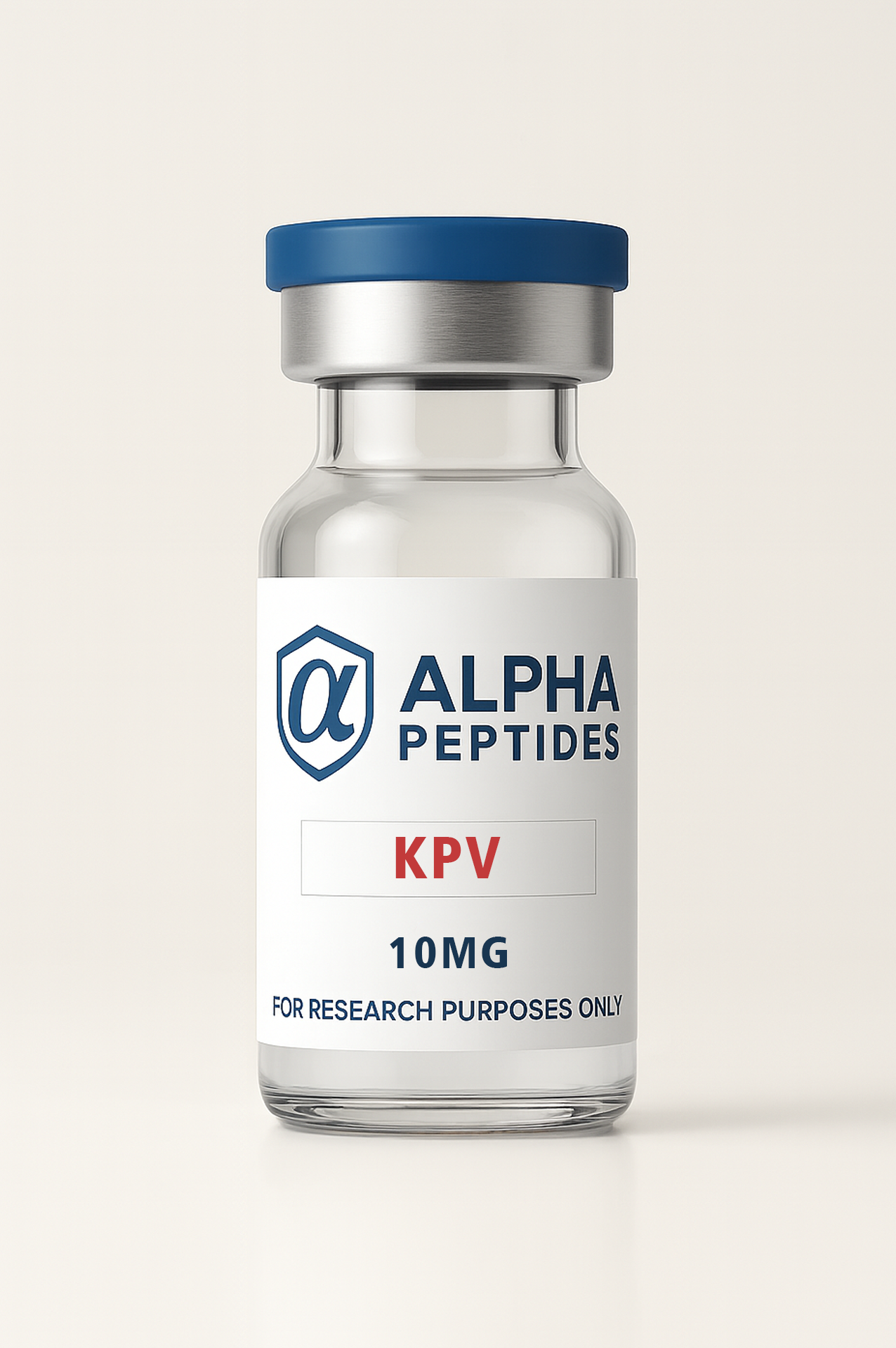
Alpha Peptides provides research-grade KPV with full COA documentation including HPLC purity data and mass spectrometry verification. Review available COAs at /coas/ before ordering.
[INTERNAL-LINK: “Certificate of Analysis guide” -> /coas/]
[INTERNAL-LINK: “how to store peptides” -> /blog/how-to-store-peptides]
Frequently Asked Questions About KPV
Is KPV a natural peptide?
Sort of. The KPV sequence exists naturally as part of alpha-MSH, a hormone your body produces. But isolated KPV doesn’t circulate freely in significant amounts. The research-grade KPV used in laboratories is made through chemical synthesis — specifically solid-phase peptide synthesis — not extracted from biological sources. So while the sequence is natural, the isolated product is synthetic.
How big is KPV compared to other peptides?
KPV is one of the smallest research peptides available. At about 325 daltons and three amino acids, it’s much smaller than peptides like BPC-157 (15 amino acids) or Ipamorelin (5 amino acids). Its small size gives it unique properties in laboratory settings but also means it can break down faster in biological environments.
What types of research use KPV?
Preclinical KPV research has focused primarily on gut inflammation models, NF-kB pathway studies, and melanocortin system biology. Researchers working with intestinal cell lines and animal models of intestinal inflammation have been the most active users of KPV as a tool compound. All published research is preclinical — no human clinical trials have been completed.
For research use only. Not for human consumption. KPV is an experimental compound with no FDA-approved therapeutic applications. All information on this page is provided for educational purposes relating to laboratory and preclinical research. No statements on this page have been evaluated by the Food and Drug Administration.