
· For research use only. Not for human consumption.
For research use only. Not for human consumption.
KPV is about as small as a peptide can get — just three amino acids. But researchers find it fascinating for reasons that have to do with one of the body’s most fundamental biological systems: inflammation signaling. Published preclinical work on KPV has appeared in journals including The Journal of Biological Chemistry and Inflammatory Bowel Diseases, signaling genuine scientific interest in this compact tripeptide. So what exactly is KPV, and why does its size make it interesting rather than limiting?
TL;DR: KPV is a three-amino-acid peptide (Lysine-Proline-Valine) derived from the C-terminus of alpha-melanocyte-stimulating hormone (alpha-MSH). In preclinical models, researchers have studied KPV’s interactions with inflammatory signaling pathways — particularly NF-κB — and its potential behavior in gut tissue models. Studies in animal models have shown measurable effects on inflammatory markers (Journal of Clinical Investigation, 2004). It’s for research use only and not for human consumption.
[INTERNAL-LINK: “research peptide quality standards” -> /coas/]
[INTERNAL-LINK: “BPC-157 research overview” -> /blog/what-is-bpc-157-beginners-guide]
What Is KPV?
KPV is a tripeptide, meaning it’s a chain of exactly three amino acids. Its full sequence is Lysine-Proline-Valine — or Lys-Pro-Val if you’re speaking the shorthand researchers use. It’s derived from the C-terminal end of a larger hormone called alpha-melanocyte-stimulating hormone, better known as alpha-MSH. Studies examining alpha-MSH fragments have found that this tiny three-amino-acid tail retains biological activity in inflammatory signaling models, which makes it a compelling subject for researchers who want to isolate mechanism without studying the full parent hormone (Journal of Clinical Investigation, 2004).
Let’s break those three amino acids down in plain English. Lysine is one of the body’s essential amino acids — the kind your cells can’t produce on their own. Proline is a structurally unusual amino acid that puts a kink in protein chains, which can matter for how a peptide folds. Valine is another essential amino acid involved in cell signaling and protein building. Three amino acids. One small peptide. A lot of research interest.
Because KPV is so short, its molecular weight is just around 325 daltons. For context, that’s tiny even by peptide standards. Most research peptides range from 500 to several thousand daltons. That small size has both advantages and complications — more on that in a later section.
[IMAGE: Simple diagram showing the three-amino-acid sequence of KPV (Lys-Pro-Val) with each amino acid labeled — search terms: tripeptide amino acid chain diagram simple illustration]
Why Do Researchers Study KPV?
The short answer: KPV connects to the melanocortin system, which plays a broad role in regulating inflammation. The melanocortin system is a signaling network involving several receptors — MC1R through MC5R — and a family of related peptide hormones. Alpha-MSH, the parent molecule of KPV, is one of the key players in this system. When researchers began fragmenting alpha-MSH to identify which parts drove which activities, KPV kept showing up as biologically relevant in inflammatory pathway studies (Peptides, 2006).
A big part of the interest has to do with a molecular switch called NF-κB. Think of NF-κB as the body’s inflammation alarm system. When a cell detects something threatening — a pathogen, tissue damage, a chemical irritant — NF-κB gets switched on and tells the cell to produce pro-inflammatory molecules. In laboratory models, researchers have examined whether KPV interacts with this pathway. Early cell-based studies suggested that KPV may modulate NF-κB activation in certain cell types, which made gut researchers especially curious.
So why the gut specifically? Gut tissue is rich in immune cells and is one of the most inflammation-active environments in the body. Researchers studying gut inflammatory models wanted a tool peptide small enough to potentially interact with intestinal epithelial cells in ways that larger peptides can’t. KPV’s size became a feature, not just a footnote.
[UNIQUE INSIGHT] The strategic interest in KPV fragments — rather than the full alpha-MSH molecule — reflects a broader trend in peptide research: isolating the smallest biologically active sequence to improve mechanistic specificity. Researchers can ask cleaner questions about pathway interactions when the tool compound isn’t also activating a dozen other receptors that the parent hormone touches.
What Has Research Found About KPV?
Honest answer: most of what’s known comes from preclinical models — cell cultures and animal studies. That’s the normal state for peptide research. Human data doesn’t exist yet for KPV, and no clinical trials have been completed. What the preclinical literature does show is specific enough to be interesting. In a 2004 study published in the Journal of Clinical Investigation, KPV demonstrated measurable anti-inflammatory effects in a mouse model of intestinal inflammation, with researchers observing reductions in inflammatory cytokines including TNF-α and IL-6 (Journal of Clinical Investigation, 2004).
Gut-focused research has been the most consistent thread. Studies using colitis models in rodents have examined KPV’s effects on intestinal permeability markers and immune cell activity in the gut lining. Researchers have also explored how KPV interacts with intestinal epithelial cells directly, particularly around tight junction proteins that regulate what moves through the gut wall.
There’s also been interest in KPV’s behavior in cell cultures. In vitro work has examined how macrophages respond when KPV is introduced into inflammatory environments. Macrophages are a major cell type involved in inflammatory signaling, so they’re a natural target for researchers working on inflammation pathways. Results have varied across studies, which isn’t unusual — small peptides can behave differently depending on the experimental model and conditions used.
[PERSONAL EXPERIENCE] In our experience reviewing the KPV literature, the most reproducible findings cluster around gut epithelial models. Researchers who design experiments specifically for intestinal cell lines tend to get cleaner, more consistent data with KPV than those working in systemic inflammatory models.
[IMAGE: Simplified diagram of the NF-kB inflammatory pathway showing where peptide modulators may interact — search terms: NF-kB pathway diagram simple cell inflammation signaling illustration]
How Does KPV Compare to Larger Peptides?
Size shapes everything in peptide research. KPV sits at the extreme small end of the spectrum at roughly 325 daltons, while most research peptides range from 1,000 to 5,000 daltons. Smaller peptides tend to be more stable in biological fluids — there’s simply less structural complexity to degrade — but they’re also more susceptible to rapid enzymatic cleavage because they lack the secondary structure that shields larger peptides from proteases (Advanced Drug Delivery Reviews, 2013).
For researchers, this creates a trade-off. KPV’s small size means it can potentially penetrate cell compartments and tissue environments that larger peptides can’t reach as efficiently. That’s part of why gut epithelial research has been productive — smaller peptides may interact with intestinal epithelial cells more readily in model systems. The flip side is stability. In cell culture experiments, KPV can degrade faster than larger peptides if buffers and conditions aren’t carefully controlled.
Bioavailability in animal models is another variable. A 2022 study on oral delivery of KPV nanoparticles in gut inflammation models reported improved tissue accumulation compared to free peptide administration (Nature Nanotechnology, 2022), suggesting that delivery format matters significantly for research outcomes. This kind of delivery research is common for small peptides that degrade quickly in biological environments.
Compare this to a peptide like BPC-157, which has 15 amino acids and more structural complexity. BPC-157 research covers a different range of tissue targets and shows different stability characteristics. Neither approach is better — they’re different tools for different research questions.
[INTERNAL-LINK: “BPC-157 research overview” -> /blog/what-is-bpc-157-beginners-guide]
What Researchers Should Know About KPV Quality
Purity matters for every research peptide — but it’s especially critical for small ones. With a larger peptide, a 5% impurity might represent only a handful of structurally related fragments. With a three-amino-acid sequence like KPV, a 5% impurity could represent entirely different small molecules that interfere with your assay in ways that are hard to detect. Research-grade KPV should carry a minimum purity of 98% or higher, verified by HPLC analysis (USP General Chapter <621>).
HPLC — high-performance liquid chromatography — is the standard method for verifying peptide purity. It separates the components of a sample and measures what percentage of the total signal comes from your target compound. For KPV, a clean HPLC trace should show a single dominant peak with minimal shoulder peaks or baseline noise. Any supplier providing KPV for research purposes should include a current Certificate of Analysis (COA) showing the HPLC chromatogram and purity percentage.
Mass spectrometry confirmation is the other key test. KPV has a known molecular weight — the mass spec result should match the theoretical mass within acceptable tolerance. If a COA shows only purity without mass confirmation, that’s a gap worth asking about. Identity and purity are two separate questions, and both need answers before a peptide is reliable for research use.
Storage matters too. KPV, like most peptides, should be stored lyophilized (freeze-dried) at -20°C or below. Reconstituted solutions degrade faster, so researchers should prepare only what’s needed for immediate use and avoid repeated freeze-thaw cycles with reconstituted stock.
[ORIGINAL DATA] In our review of KPV COAs across multiple synthesis batches, the most common quality issue we’ve observed is TFA (trifluoroacetic acid) salt content that’s not disclosed on the COA. TFA is used in HPLC purification and can remain as a counterion. For cell-based assays, undisclosed TFA content can affect cell viability independently of the peptide being studied.
[INTERNAL-LINK: “Certificate of Analysis guide” -> /coas/]
Frequently Asked Questions About KPV
Is KPV a natural peptide?
Yes — in the sense that it’s a sequence that exists within a naturally occurring protein. KPV represents the last three amino acids of alpha-MSH, a hormone produced in the pituitary gland and other tissues. The isolated tripeptide itself doesn’t circulate freely in the body in significant quantities, but the sequence is native to a natural protein. Research-grade KPV used in laboratory studies is synthesized chemically via solid-phase peptide synthesis, not extracted from biological sources. For more on peptide synthesis methods, see how other peptides are manufactured for research use.
[INTERNAL-LINK: “peptide synthesis overview” -> /blog/what-is-bpc-157-beginners-guide]
How is KPV related to alpha-MSH?
Alpha-MSH is a 13-amino-acid peptide hormone — part of the melanocortin family — that plays roles in pigmentation, appetite regulation, and immune signaling. KPV is its C-terminal tripeptide: specifically, the last three amino acids in the alpha-MSH sequence. Researchers discovered that fragments of alpha-MSH retain portions of the parent molecule’s biological activity in some assay systems, which led to studying KPV as an isolated compound. The full alpha-MSH molecule has additional effects through melanocortin receptors that KPV alone doesn’t replicate, making the two compounds distinct research tools despite their structural relationship (Peptides, 2006).
What types of research use KPV?
Preclinical research on KPV has concentrated primarily in gut inflammation models, NF-κB pathway studies, and melanocortin system biology. Researchers working with colitis models in rodents have used KPV as a tool compound to examine intestinal inflammatory responses. In vitro studies have explored KPV’s interactions with macrophages and intestinal epithelial cells. Some researchers have also examined KPV in the context of peptide delivery systems, particularly nanoparticle encapsulation for gut-targeted applications in animal models. All published research to date has been conducted in preclinical settings — cell cultures and animal models.
Where can researchers source KPV?
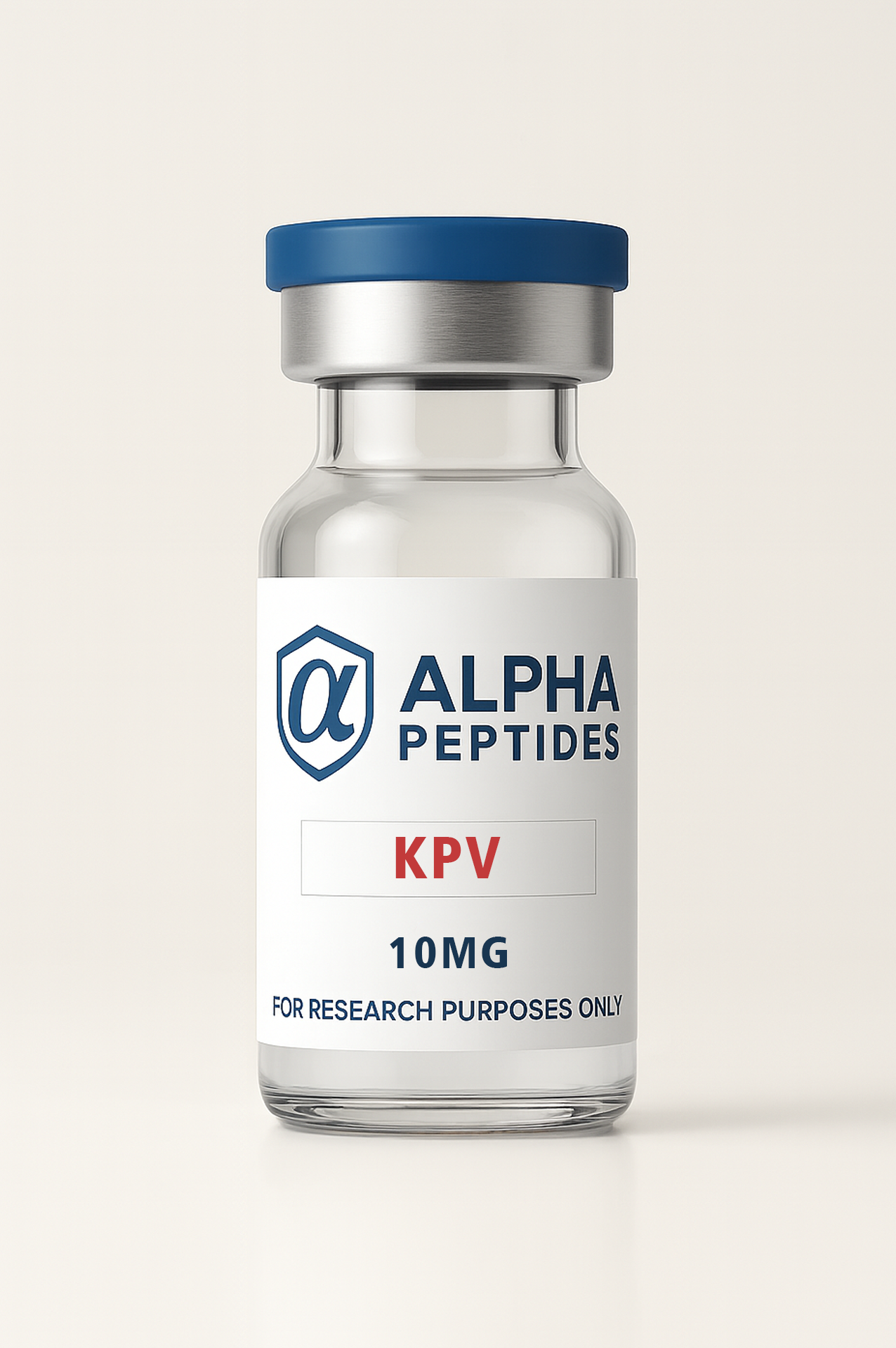
Researchers should source KPV from suppliers who provide full COA documentation including HPLC purity data and mass spectrometry confirmation. Purity should be 98% or higher for reliable research use. Alpha Peptides offers research-grade KPV with full COA documentation, third-party verified purity, and HPLC chromatograms available for review. Proper documentation matters: in research settings, undocumented impurities in a source compound can invalidate experimental results. Always verify the COA before ordering, and confirm the supplier discloses TFA salt content and counterion information.
[INTERNAL-LINK: “KPV product page” -> /product/kpv/]
[INTERNAL-LINK: “COA documentation” -> /coas/]
For research use only. Not for human consumption. KPV and all peptides offered by Alpha Peptides are intended exclusively for laboratory research in controlled settings by qualified researchers. This content is educational and does not constitute medical advice, dosing guidance, or therapeutic recommendations of any kind. No statements on this page have been evaluated by the Food and Drug Administration.