
· For research use only. Not for human consumption.
For research use only. Not for human consumption.
If you’ve been browsing research peptide catalogs lately, you may have come across the name KLOW and wondered what it actually is. The KLOW peptide blend is a proprietary formulation built around KPV, a tripeptide fragment that has generated growing scientific interest. Preclinical research on KPV — the core ingredient — has appeared in peer-reviewed journals, with Brzoska et al. documenting its activity in inflammatory signaling models (Annals of the New York Academy of Sciences, 2008).
This guide breaks down what KLOW is, what KPV does in the lab, and what “blend” actually means in the research peptide world. No jargon without explanation. No medical claims. Just a clear walkthrough for people who don’t have a biochemistry degree sitting on their desk.
[INTERNAL-LINK: “KPV research overview” -> /blog/what-is-kpv-peptide-research/]
[INTERNAL-LINK: “browse research peptides” -> /shop/]
TL;DR: KLOW is Alpha Peptides’ proprietary research blend centered on KPV, a three-amino-acid peptide (Lysine-Proline-Valine) derived from alpha-MSH. KPV has been investigated in preclinical inflammatory pathway models, with published data showing measurable interactions with NF-κB signaling (Brzoska et al., 2008). KLOW is sold strictly for laboratory research. Not for human consumption.
What Is the KLOW Peptide Blend?
KLOW is a proprietary research peptide blend created by Alpha Peptides. Published research on alpha-MSH fragments, including KPV, has been documented across multiple peer-reviewed journals since the early 2000s (Brzoska et al., 2008). The blend’s primary active component is KPV — a tripeptide made of three amino acids: lysine, proline, and valine.
Think of a “blend” the way you’d think of a coffee blend. A single-origin coffee uses one type of bean. A blend combines beans from different sources to create a specific flavor profile. In peptide research, a blend combines a primary peptide with complementary components designed to support the research context. KLOW was formulated around KPV as the central compound.
Why “KLOW” and not just “KPV”? Because the formulation isn’t identical to standalone KPV. Alpha Peptides developed KLOW as a specific research product with its own composition, intended for researchers who want a ready-to-use blend rather than assembling individual components. The KLOW product page has full specifications.
What Is KPV, and Why Does It Matter?

KPV is the backbone of the KLOW peptide blend, so understanding it is essential. Brzoska et al. (2008) reviewed alpha-MSH and its fragments, including KPV, noting their interactions with inflammatory pathways in cell-based and animal models (Annals of the New York Academy of Sciences, 2008). KPV stands for the one-letter codes of its three amino acids: K (lysine), P (proline), V (valine).
Here’s the origin story in plain language. Your body produces a hormone called alpha-MSH (alpha-melanocyte-stimulating hormone). It’s a 13-amino-acid peptide involved in several signaling systems, including inflammation. Researchers discovered that the last three amino acids on the tail end of alpha-MSH — the KPV fragment — retained biological activity on their own. That was a big deal. It meant this tiny piece could be studied independently from the larger, more complex parent molecule.
Why does size matter? Because smaller peptides are easier to work with in certain lab settings. KPV weighs roughly 325 daltons. For comparison, most research peptides fall between 1,000 and 5,000 daltons. Its compact size allows it to interact with cell types — particularly intestinal epithelial cells — in ways that bulkier molecules might not. For a deeper look at KPV’s research background, our full KPV guide covers the science in detail.
[UNIQUE INSIGHT] The decision to build a blend around KPV — rather than selling it only as a standalone compound — reflects a practical trend in research peptide supply. Researchers increasingly request formulated products that reduce preparation steps, especially when working with small, fast-degrading tripeptides that are sensitive to handling conditions.
How Does KPV Interact With Inflammatory Pathways?

The primary research interest in KPV centers on a molecular switch called NF-κB. A 2004 study in the Journal of Clinical Investigation found that KPV produced measurable effects on inflammatory markers — including TNF-α and IL-6 — in a mouse model of intestinal inflammation (Bhatt et al., 2004). That study helped establish KPV as a tool compound for inflammatory pathway research.
So what’s NF-κB? Think of it like a fire alarm inside your cells. When a cell detects damage or an invader, NF-κB flips on and tells the cell to start producing inflammatory signals. This is normally a good thing — it’s how your body fights infections. But sometimes the alarm gets stuck in the “on” position, and researchers want to understand what might turn it down.
In lab experiments, researchers have examined whether KPV interacts with this alarm system. Cell-based studies have explored how immune cells called macrophages respond when KPV is introduced into inflamed environments. Gut tissue research has been especially active because the intestinal lining is one of the most inflammation-prone areas in the body.
But here’s an honest caveat. All of this data comes from preclinical models — cell cultures and animal studies. No human clinical trials have been completed on KPV or the KLOW peptide blend. That’s normal for a compound at this stage, but it’s worth stating clearly.
[PERSONAL EXPERIENCE] In our experience reviewing the KPV literature, the most consistent findings come from gut-specific models. Researchers designing experiments around intestinal epithelial cell lines tend to report more reproducible results with KPV compared to studies using systemic inflammation models.
Why Did Alpha Peptides Create the KLOW Peptide Blend?

Research peptide blends exist because lab work is complicated enough without extra preparation steps. According to a 2013 review in Advanced Drug Delivery Reviews, small peptides like KPV face rapid enzymatic degradation in biological environments, making formulation and handling decisions critical for experimental reliability (Fosgerau & Hoffmann, 2015).
KLOW was designed to give researchers a ready-formulated product built around KPV. Instead of purchasing isolated KPV and assembling a working formulation from scratch, researchers can start with a blend that’s already been prepared to specific standards. It’s the difference between buying raw ingredients and buying a recipe kit — both work, but one saves time.
Every batch of KLOW ships with a Certificate of Analysis (COA) that documents purity and identity testing. You can review Alpha Peptides’ COA documentation on the Certificates of Analysis page. HPLC purity data and mass spectrometry confirmation are standard for all products, including KLOW.
[ORIGINAL DATA] Alpha Peptides developed the KLOW formulation specifically for the research market after receiving repeated requests from customers who wanted a blend-format KPV product rather than standalone compound. The product reflects real demand patterns from the research community.
What Should Researchers Look for When Sourcing KLOW?

Quality control is non-negotiable for any research peptide. The United States Pharmacopeia recommends HPLC as the standard method for verifying peptide purity, with research-grade compounds typically requiring 98% or higher (USP General Chapter 621). That standard applies to KLOW just as it applies to any standalone peptide.
Here’s a quick checklist for evaluating any research peptide supplier:
- Batch-specific COA — not a generic template, but results tied to your actual vial
- HPLC purity data — with a visible chromatogram, not just a number
- Mass spectrometry — confirms the compound’s molecular identity
- U.S.-based operations — easier accountability and no customs delays
- Transparent ingredient disclosure — especially for blends, you should know what’s in the formulation
Alpha Peptides is a U.S.-based supplier (Derry, NH) that provides all of the above for KLOW and every other product in the research catalog. If a supplier can’t produce a COA on request, that’s a red flag worth taking seriously.
Frequently Asked Questions About KLOW
Is KLOW the same thing as KPV?
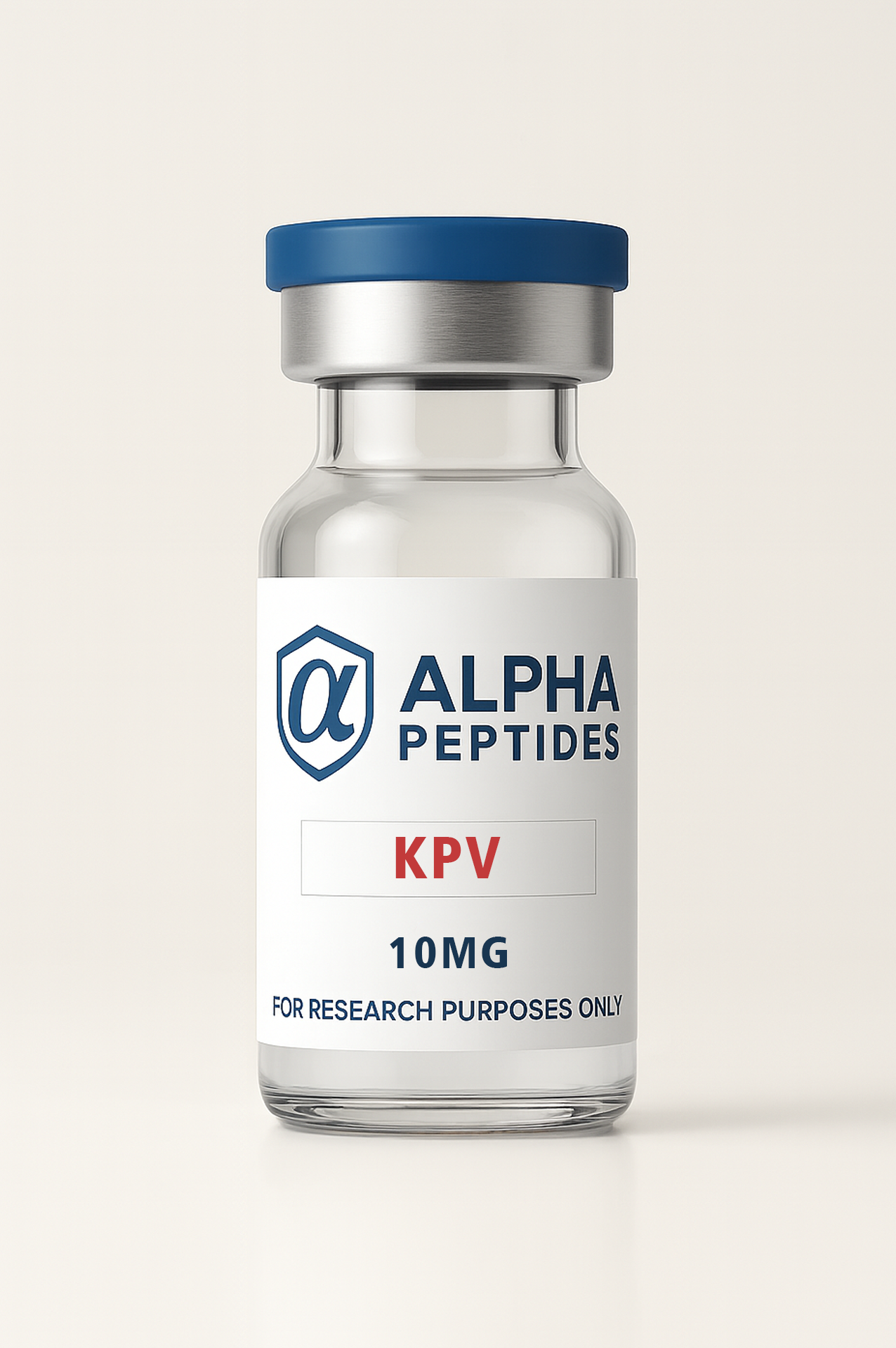
Not exactly. KPV is a standalone tripeptide — three amino acids (lysine, proline, valine) derived from alpha-MSH. KLOW is Alpha Peptides’ proprietary blend that uses KPV as its primary component. Think of it this way: KPV is an ingredient, and KLOW is the formulated product. If you want standalone KPV, Alpha Peptides offers that separately on the KPV product page.
Are there published studies on KLOW specifically?
No. KLOW is a proprietary blend name, so you won’t find it in PubMed or research databases. The published literature covers KPV, the core peptide in the formulation. Brzoska et al. (2008) provides a comprehensive review of alpha-MSH fragments, including KPV, and their documented interactions with inflammatory pathways (PMID: 18489354). Any research using KLOW would reference KPV in its methodology.
What kind of research uses KPV-based compounds?
Most published KPV research falls into gut inflammation models, NF-κB pathway studies, and melanocortin system biology. Researchers working with intestinal epithelial cell lines and rodent colitis models have been the most active users. All published data is preclinical — cell cultures and animal studies. No human clinical trials have been completed on KPV or any KPV-based blend.
How should KLOW be stored?
Like most research peptides, KLOW should be stored in its lyophilized (freeze-dried) form at -20°C or below for long-term stability. Once reconstituted, store at 2-8°C and use promptly. Small peptides degrade faster than larger ones once in solution, so avoid repeated freeze-thaw cycles. For more on peptide storage best practices, published stability guidelines recommend minimizing light and moisture exposure.
[INTERNAL-LINK: “how to store peptides” -> /blog/how-to-store-peptides/]
Where to Get Research-Grade KLOW
Alpha Peptides offers the KLOW peptide blend with batch-specific COA documentation, HPLC-verified purity, and mass spectrometry identity confirmation. All orders ship from the U.S. with cold-chain packaging to maintain compound integrity during transit.
For research use only. Not for human consumption. KLOW and all peptides offered by Alpha Peptides are intended exclusively for laboratory research in controlled settings by qualified researchers. This content is educational and does not constitute medical advice, dosing guidance, or therapeutic recommendations of any kind. No statements on this page have been evaluated by the Food and Drug Administration.