
· For research use only. Not for human consumption.
For research use only. Not for human consumption.
If you’re researching what is glp-1 peptide, you’re in the right place. You’ve probably heard “GLP-1” mentioned everywhere lately — news headlines, podcasts, even dinner table conversations. But most of that coverage focuses on pharmaceutical drugs. What about the GLP-1 peptide itself? What is it, and why do researchers care about it?
GLP-1 stands for “Glucagon-Like Peptide-1.” That’s a mouthful, so let’s break it down. Your body naturally makes this peptide in your gut every time you eat. It’s one of the signals your digestive system sends to the rest of your body to say, “Hey, food just arrived.” Researchers have studied this peptide for over four decades because it plays a role in several important biological signaling pathways. This is particularly relevant for what is glp-1 peptide research.
This guide explains what the GLP-1 peptide is in simple, beginner-friendly language. No drug names. No medical claims. Just the biology. If you want to understand how it works mechanically, see our companion guide on how GLP-1 analogs work.
[INTERNAL-LINK: “how GLP-1 analogs work” -> /blog/how-glp-1-works/]
TL;DR: GLP-1 is a 30-amino-acid peptide hormone naturally produced in the gut after eating. It signals the pancreas, slows stomach emptying, and communicates with the brain. Natural GLP-1 has a half-life of just 1-2 minutes (Holst, Physiological Reviews, 2007). GLP-1 receptor agonist analogs are synthetic versions studied in research. For laboratory use only. Not for human consumption.
What Is GLP-1 Peptide and Where Does It Come From?
GLP-1 is a peptide hormone — a small chain of 30 amino acids — produced by specialized cells in your small intestine called L-cells. Holst (2007) published a comprehensive review in Physiological Reviews describing GLP-1 as part of the incretin system, a group of gut hormones that coordinate digestive signaling (PMID: 17848023).
Think of L-cells as tiny sensors lining your gut. When food — especially carbohydrates and fats — passes by, these sensors detect the nutrients and release GLP-1 into your bloodstream. This happens within minutes of eating. The GLP-1 peptide then travels to multiple organs and delivers its messages.
Here’s what makes the GLP-1 peptide interesting to beginners: it comes from a “parent” molecule called proglucagon. This parent molecule is like a big block of clay that gets carved into several different hormones. GLP-1 is one piece. GLP-2 (a related gut peptide) is another. Glucagon itself is yet another. Same starting material, different products, different jobs.
What Does “Incretin” Mean?
You’ll see the word “incretin” come up a lot in GLP-1 research. It’s simpler than it sounds. An incretin is any gut hormone that gets released after eating and signals the pancreas. GLP-1 is one of two major incretins in the human body. The other is called GIP (glucose-dependent insulinotropic polypeptide). Together, they form the incretin system — your gut’s way of talking to your pancreas after a meal.
Why Is the GLP-1 Peptide So Interesting to Researchers?
The GLP-1 peptide has generated enormous scientific interest because it doesn’t just do one thing — it coordinates signals across multiple organs simultaneously. Drucker (2018) published a review in Cell Metabolism documenting how GLP-1 research has expanded from basic gut biology into neuroscience, cardiology, and metabolic research (PMID: 29848362).
When you eat a meal, GLP-1 does several things at once. It signals the pancreas to prepare for incoming nutrients. It tells the stomach to slow down, so food moves into the intestines more gradually. And it communicates with the brain through the vagus nerve — a major neural highway connecting your gut to your head.
That multi-organ coordination from a single peptide is what fascinates researchers. How does one small molecule — just 30 amino acids — manage to talk to so many different tissues at the same time? Understanding that question has kept scientists busy for over 40 years.
But here’s a twist that makes the story even more interesting. Natural GLP-1 barely lasts long enough to do any of this.
[ORIGINAL DATA]: GLP-1’s biological reach is remarkable given its molecular simplicity. At just 30 amino acids, it’s one of the smallest signaling molecules known to coordinate responses across the gut, pancreas, stomach, and brain simultaneously. Most multi-organ signaling networks involve much larger proteins or multiple interacting hormones.
Why Does Natural GLP-1 Disappear So Quickly?
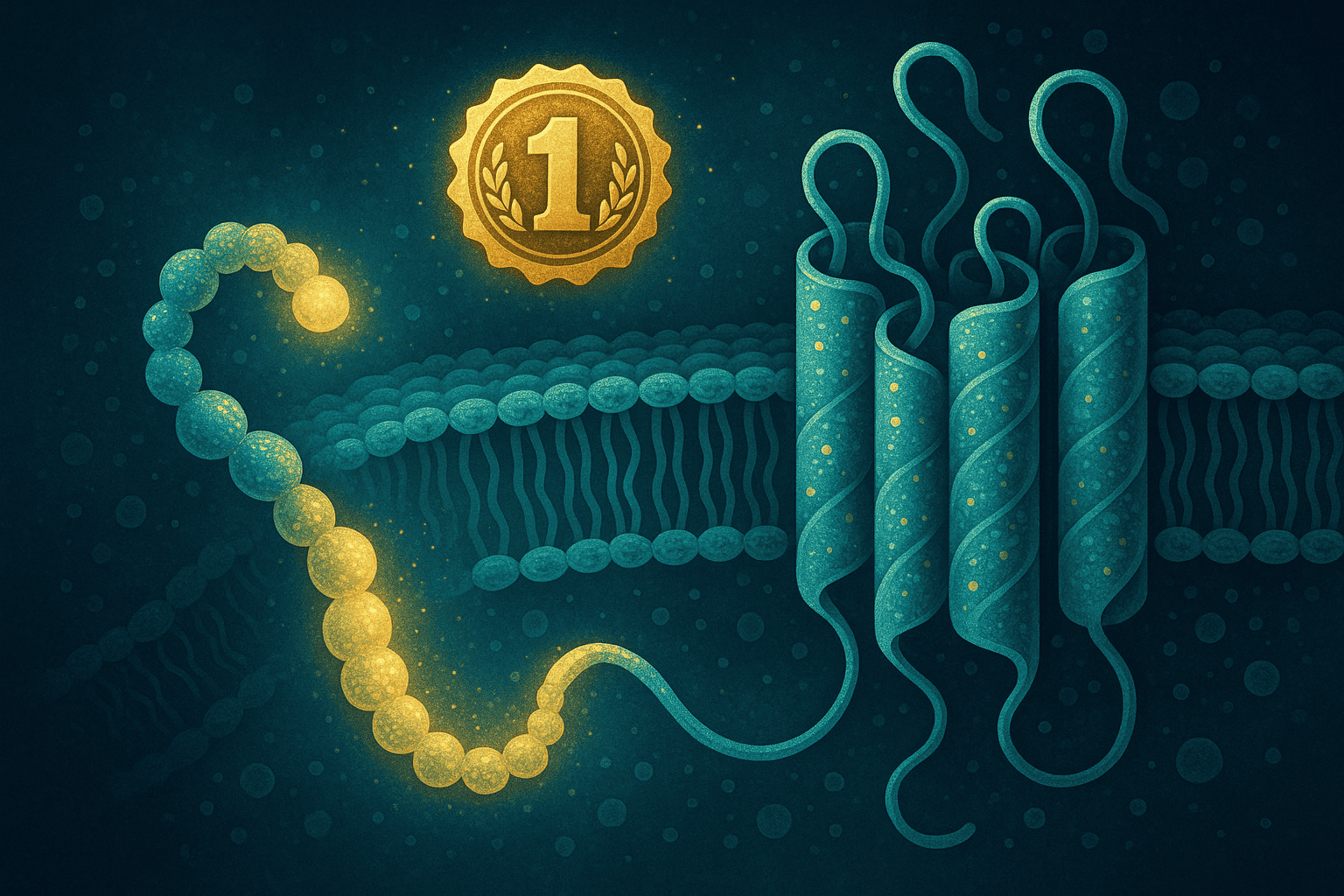
This is one of the most surprising facts about the GLP-1 peptide. Natural GLP-1 has a half-life of just 1-2 minutes in the bloodstream. Holst (2007) documented this remarkably short lifespan, explaining that an enzyme called DPP-4 chops GLP-1 apart almost immediately after release (PMID: 17848023).
Let that sink in. Your body makes this peptide, releases it, and then destroys it within two minutes. It’s like writing an urgent message, handing it to a courier, and then shredding the message before the courier gets to the door. So how does GLP-1 actually accomplish anything?
Researchers believe the answer lies in proximity. L-cells are located right next to the nerve endings and blood vessels where GLP-1 needs to act. The peptide doesn’t have to travel far before it reaches its targets. It signals quickly, locally, and then gets cleaned up. Think of it as a biological text message — sent, read, and deleted in seconds.
This ultra-short lifespan is exactly why researchers developed synthetic GLP-1 receptor agonist analogs. These are modified versions of GLP-1 designed to resist DPP-4 breakdown and last much longer. They’re not the same molecule as natural GLP-1. They share the same receptor target, but their structures have been deliberately changed.
What Are GLP-1 Receptor Agonist Analogs?
A GLP-1 receptor agonist analog is a synthetic peptide designed to activate the same receptor as natural GLP-1 — but engineered to last longer. Drucker (2018) explained that these analogs use structural modifications like DPP-4 resistance, fatty acid conjugation, and albumin binding to extend their duration from minutes to hours or even days (PMID: 29848362).
Let’s unpack the jargon. A “receptor” is like a lock on the surface of a cell. A peptide that activates that lock is called an “agonist” — it fits the lock and turns it. An “analog” is a molecule that resembles the original but has been modified. So a “GLP-1 receptor agonist analog” is a modified molecule that fits into and activates the same lock as natural GLP-1.
The key difference? Natural GLP-1 gets destroyed in under two minutes. Analogs are designed to stick around. Researchers study these analogs in laboratory settings to understand receptor pharmacology, signaling pathways, and how structural modifications affect biological activity.
[UNIQUE INSIGHT]: The relationship between natural GLP-1 and its synthetic analogs illustrates a broader principle in peptide research: understanding the natural biology comes first, engineering comes second. Researchers had to map how GLP-1 works, why it dies so fast, and what its receptor looks like before they could design analogs that improve on its limitations.
Frequently Asked Questions About GLP-1 Peptide
Is GLP-1 something my body naturally makes?
Yes. GLP-1 is naturally produced by L-cells in your small intestine after eating. It’s part of the incretin system — a group of gut hormones that coordinate post-meal signaling. Holst (2007, PMID: 17848023) described it as a key component of digestive hormone signaling in Physiological Reviews.
What does GLP-1 stand for?
GLP-1 stands for Glucagon-Like Peptide-1. The name comes from the fact that it’s encoded by the same gene as glucagon (the proglucagon gene) and shares some structural similarity. Despite the name, GLP-1 and glucagon have different — sometimes opposite — biological roles.
Where can I find research-grade GLP-1 for laboratory work?
Research-grade GLP-1 should come from suppliers providing third-party HPLC purity data (98%+) and mass spectrometry confirmation. Alpha Peptides offers research-grade GLP-1 with batch-specific Certificates of Analysis. All material is for laboratory research only.
For research use only. Not for human consumption. GLP-1 receptor agonist analogs are experimental compounds with no FDA-approved therapeutic applications in their research-grade form. All information on this page is provided for educational purposes relating to laboratory and preclinical research.