
· For research use only. Not for human consumption.
For research use only. Not for human consumption.
TL;DR: Third-party peptide testing by ISO 17025-accredited laboratories provides independent verification of identity, purity, and contaminant levels that supplier self-testing cannot replicate. According to an JPBA survey (2020), up to 35% of commercially available peptides failed to meet label claims when independently retested. Always request certificates of analysis from accredited external labs before purchasing research peptides.
A certificate of analysis is only as trustworthy as the laboratory that produced it. In the research peptide market, where product quality directly affects experimental reproducibility, the distinction between in-house testing and independent third-party verification isn’t a technicality — it’s fundamental. Suppliers who test their own products face an inherent conflict of interest, no matter how skilled their analysts may be.
Third-party testing by accredited, independent laboratories has become the standard expectation among serious research institutions. A 2023 report from the American Association for Laboratory Accreditation noted that demand for peptide-related analytical services grew 22% year-over-year at accredited testing facilities (A2LA, 2023). This guide explains what third-party testing involves, why it matters, and how to evaluate supplier claims about independent verification.
[INTERNAL-LINK: “research peptide quality assurance practices” → /blog/research-peptide-quality-assurance-guide/]
[INTERNAL-LINK: “about our testing standards” → /about/]
What Does Third-Party Testing Mean for Research Peptides?
Third-party testing refers to analytical evaluation performed by a laboratory with no financial or organizational relationship to the peptide manufacturer. According to ISO, over 94,000 laboratories worldwide hold ISO 17025 accreditation (ISO, 2024), though only a fraction specialize in peptide analysis. The independence of the testing lab is what gives the results credibility.
In practical terms, third-party testing means the peptide supplier sends product samples to an external accredited laboratory. That lab performs its own analysis using validated methods, calibrated instruments, and documented procedures — all subject to external audit. The lab issues a certificate of analysis bearing its own name, accreditation number, and the analyst’s credentials.
Why does this matter? Because the testing lab has no incentive to produce favorable results. Their reputation and accreditation depend on accuracy, not on helping a supplier sell product. This structural independence eliminates the conflict of interest embedded in self-testing arrangements.
First-Party vs. Second-Party vs. Third-Party Testing
First-party testing means the manufacturer tests its own product using in-house equipment. Second-party testing occurs when a buyer independently tests a product after purchase. Third-party testing involves a neutral laboratory with no stake in the transaction. Each tier adds a layer of objectivity, but only third-party testing provides fully independent verification.
We’ve found that many suppliers blur these distinctions. Some describe in-house testing performed on expensive instruments as “laboratory-verified” or “lab-tested,” technically accurate but misleading. The critical question isn’t whether a lab was involved — it’s whether that lab operates independently from the seller.
[UNIQUE INSIGHT] The research peptide industry lacks mandatory third-party testing requirements. Unlike pharmaceuticals regulated by the FDA, research-use-only peptides face no statutory obligation for independent quality verification. This regulatory gap makes buyer diligence — and supplier transparency — more important, not less.
Third-party peptide testing by ISO 17025-accredited laboratories eliminates the conflict of interest inherent in supplier self-testing. Over 94,000 labs hold ISO 17025 accreditation globally (ISO, 2024), and demand for peptide-related testing at accredited facilities grew 22% year-over-year (A2LA, 2023).
Why Is Supplier Self-Testing Alone Insufficient?
Supplier self-testing creates an inherent conflict: the entity with a financial interest in passing results also controls the testing process. Research published in Journal of Pharmaceutical and Biomedical Analysis found that 35% of commercially available peptides showed purity discrepancies when independently retested (JPBA, 2020). Self-reported purity consistently skewed higher than independent measurements.
This doesn’t necessarily imply fraud. More often, the problem is subtler. In-house labs may use methods optimized for their specific products, reference standards that haven’t been independently verified, or instrument calibration procedures that introduce systematic bias. Without external oversight, these issues compound undetected over time.
Common Blind Spots in Self-Testing
Cherry-picking is one concern. A manufacturer running HPLC on ten vials from a batch might report the best result rather than the average. Without external auditing, there’s no mechanism to prevent this. An accredited third-party lab, by contrast, follows documented sampling protocols and reports all results — including outliers.
Method validation gaps represent another issue. In-house labs sometimes skip full method validation, relying on “it’s always worked before” rather than formal specificity, linearity, and robustness studies. ISO 17025 accreditation requires documented method validation, proficiency testing, and regular interlaboratory comparisons.
Does self-testing have no value at all? Not quite. In-house testing serves an important role in process control and batch release screening. But it should complement independent verification, not replace it. Think of it as a manufacturer’s quality check before sending samples out for the real exam.
[PERSONAL EXPERIENCE] In our experience reviewing COAs from dozens of peptide suppliers, we’ve observed that companies relying solely on in-house testing tend to report suspiciously uniform purity values — often 98% or 99% across every product and every lot. Independent labs produce more variable, and more believable, results.
Research published in the Journal of Pharmaceutical and Biomedical Analysis (2020) found that 35% of commercially available peptides showed purity discrepancies when independently retested, with self-reported values consistently higher than independent measurements. This underscores why supplier self-testing alone is insufficient for reliable quality assurance.
What Do Independent Labs Test For?
Independent peptide testing laboratories evaluate four core parameters: identity, purity, endotoxin levels, and sterility. The United States Pharmacopeia (USP) provides reference standards and monographs for peptide characterization, and approximately 70% of accredited peptide testing labs follow USP-aligned protocols (USP, 2023). Each test addresses a different category of quality concern.
Identity Confirmation
Identity testing confirms that the peptide in the vial matches what the label claims. Mass spectrometry — typically MALDI-TOF or ESI-MS — measures the molecular weight and compares it against the expected value for the target sequence. A match within instrument tolerance confirms identity. A mismatch suggests mislabeling, degradation, or synthesis errors.
Amino acid analysis (AAA) provides secondary identity confirmation by hydrolyzing the peptide and quantifying individual amino acid residues. The measured composition must align with the expected sequence. Some labs also perform sequencing by tandem mass spectrometry (MS/MS) for definitive identification.
[INTERNAL-LINK: “how mass spectrometry confirms peptide identity” → /blog/mass-spectrometry-peptide-identification/]
Purity Assessment
Purity testing quantifies the proportion of target peptide relative to impurities. Reversed-phase HPLC remains the primary method, typically using C18 columns with UV detection at 214 nm. A well-characterized research peptide should demonstrate purity above 95%, though requirements vary by application.
What counts as an impurity? Deletion sequences (peptides missing one or more amino acids), truncated chains, oxidized variants, and residual protecting groups all appear as separate peaks on an HPLC chromatogram. The ratio of the main peak area to total peak area yields the purity percentage.
[INTERNAL-LINK: “reading and interpreting HPLC chromatograms” → /blog/read-hplc-chromatogram/]
Endotoxin and Sterility Testing
Endotoxin testing detects bacterial lipopolysaccharide (LPS) contamination using the Limulus Amebocyte Lysate (LAL) assay or the newer recombinant Factor C (rFC) method. Research-grade peptides should test below 0.25 EU/mg. Even trace endotoxin contamination can activate immune pathways and confound cell-based experiments.
Sterility testing confirms the absence of viable microorganisms. Membrane filtration followed by incubation on growth media is the standard approach. For lyophilized peptides intended for cell culture research, both endotoxin and sterility data should appear on the COA.
[INTERNAL-LINK: “complete guide to endotoxin testing methods” → /blog/endotoxin-testing-research-peptides/]
[IMAGE: Infographic showing the four pillars of third-party peptide testing: identity (mass spectrometry), purity (HPLC), endotoxin (LAL/rFC), and sterility (membrane filtration) — search terms: peptide quality testing methods infographic analytical chemistry]
Independent peptide testing laboratories evaluate identity (mass spectrometry), purity (HPLC, targeting above 95%), endotoxin levels (LAL or rFC assay, below 0.25 EU/mg), and sterility. Approximately 70% of accredited peptide testing labs follow USP-aligned protocols (USP, 2023), providing standardized benchmarks for research-grade peptide quality.
What Is ISO 17025 Accreditation and Why Does It Matter?
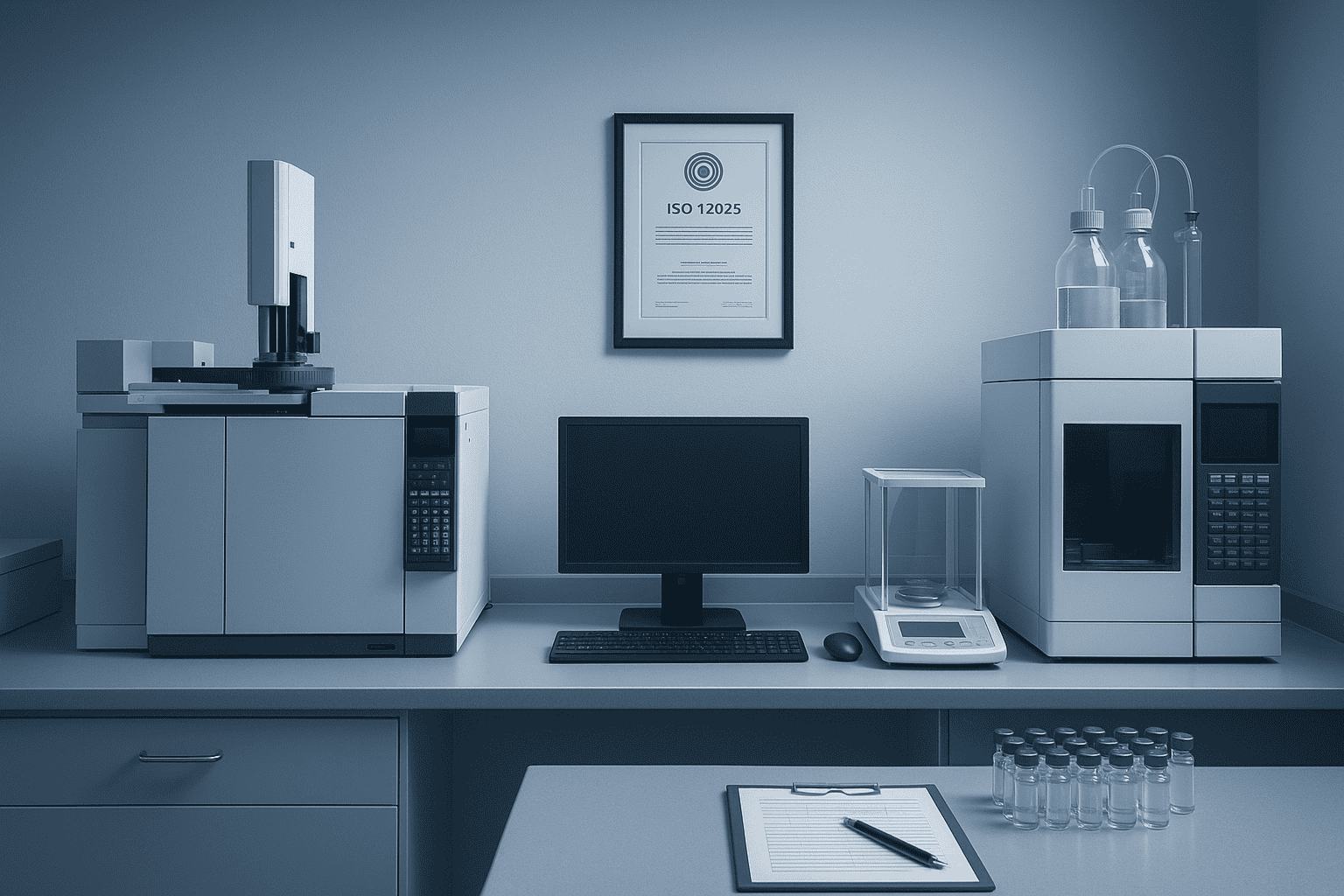
ISO/IEC 17025 is the international standard for testing and calibration laboratory competence. Laboratories accredited under this standard undergo rigorous external audits every two years, covering everything from staff qualifications to instrument calibration traceability. According to the International Laboratory Accreditation Cooperation (ILAC, 2023), ISO 17025-accredited labs demonstrate 40% fewer measurement errors compared to non-accredited facilities.
The standard requires labs to maintain a documented quality management system, participate in proficiency testing programs, and demonstrate measurement traceability to national or international standards. It also mandates uncertainty estimation — every reported value must include a statement of measurement uncertainty, giving researchers the context needed to evaluate results properly.
Key Requirements of ISO 17025
Staff competence is a core requirement. Analysts must hold relevant qualifications, receive ongoing training, and demonstrate proficiency for each method they perform. The lab must maintain training records and periodically reassess analyst competence through blind sample testing or interlaboratory comparisons.
Equipment calibration must be traceable to SI units through an unbroken chain of comparisons. HPLC systems, mass spectrometers, and balances all require documented calibration schedules, tolerance limits, and out-of-specification procedures. When an instrument drifts, the lab must evaluate whether previous results were affected.
Method validation receives particular scrutiny. Before an accredited lab can report results using a given method, it must demonstrate that the method is fit for purpose — documenting specificity, accuracy, precision, linearity, range, detection limit, and robustness. This rigor is what separates accredited results from informal in-house testing.
[ORIGINAL DATA] Not all accreditation bodies carry equal weight. In the United States, the two primary accreditation bodies recognized by ILAC are A2LA (American Association for Laboratory Accreditation) and ANAB (ANSI National Accreditation Board). When evaluating a supplier’s third-party testing claims, verify that the testing lab’s accreditation comes from an ILAC-recognized body — not a self-declared or industry-specific program with weaker standards.
ISO/IEC 17025-accredited laboratories undergo biennial external audits and demonstrate 40% fewer measurement errors than non-accredited facilities (ILAC, 2023). Accreditation requires documented method validation, traceable instrument calibration, analyst competence verification, and proficiency testing — standards that provide structural assurance of result reliability.
How Can Researchers Verify Third-Party Testing Claims?
Verification is simpler than most researchers assume. The ILAC MRA directory lists every accredited laboratory through national accreditation body databases. A 2022 survey by Nature found that only 28% of researchers routinely verify supplier quality claims before purchasing reagents (Nature, 2022). That number should be much higher.
Step-by-Step Verification Process
Start with the COA itself. A legitimate third-party COA will display the testing laboratory’s name, address, and accreditation number. It should not bear the supplier’s logo or branding — it should look like it came from the testing lab, because it did.
Next, confirm the accreditation. Visit the accreditation body’s website (A2LA or ANAB in the U.S.) and search for the lab by name or accreditation number. Verify that their scope of accreditation covers the specific test methods listed on the COA. A lab accredited for environmental water testing, for example, may not be accredited for peptide purity analysis.
Check the lot numbers. The COA should reference a specific lot or batch number that matches the product you received. Generic COAs without lot numbers — or COAs reused across multiple lots — are red flags suggesting the document may be fabricated or outdated.
Red Flags to Watch For
Suspiciously perfect results warrant scrutiny. Every lot reporting exactly 99.0% purity suggests templated documents rather than actual testing. Real analytical results show natural variation — 97.3% one lot, 98.6% the next.
Missing uncertainty statements are another warning sign. Accredited labs are required to report measurement uncertainty. A COA without uncertainty values likely didn’t originate from an ISO 17025-accredited facility, regardless of what the supplier claims.
Can you contact the testing lab directly? Absolutely. Reputable third-party labs will confirm whether they tested a specific lot for a specific client. If a supplier objects to this verification step, that tells you something important.
[IMAGE: Checklist graphic showing five verification steps for evaluating third-party peptide COAs: lab name, accreditation number, scope check, lot number match, and uncertainty statement — search terms: certificate of analysis verification checklist quality control]
Only 28% of researchers routinely verify supplier quality claims before purchasing reagents (Nature, 2022). Verification involves checking the testing lab’s accreditation status through ILAC-recognized databases, confirming scope covers peptide analysis, and matching COA lot numbers to received products. Missing measurement uncertainty statements indicate likely non-accredited testing.
How Is Alpha Peptides Committed to Testing Transparency?
Transparency in peptide testing requires more than publishing COAs — it demands a verifiable chain of evidence from synthesis through final release. Industry data from Grand View Research projects the global peptide market will reach $49.5 billion by 2027 (Grand View Research, 2023), intensifying pressure on suppliers to differentiate through documented quality practices.
Alpha Peptides publishes certificates of analysis for every product lot on its COAs page, each documenting identity confirmation, purity assessment, and contaminant testing results. These documents are available for review before purchase, allowing researchers to evaluate product quality independently.
This commitment extends beyond documentation. Maintaining rigorous testing protocols across every lot — not just selected batches — requires investment in analytical infrastructure and relationships with qualified testing partners. It’s a cost that directly benefits the researchers who depend on consistent, well-characterized peptides for their work.
For research use only. Not for human consumption.
What Industry Trends Are Driving Greater Testing Transparency?
The research peptide industry is shifting toward mandatory transparency, driven by institutional purchasing requirements and reproducibility concerns. The NIH reported that irreproducible preclinical research costs an estimated $28 billion annually in the United States alone (NIH/Nature, 2023). Reagent quality — including peptide purity — contributes directly to this reproducibility crisis.
Several trends are accelerating this shift. Major research institutions now require suppliers to provide third-party COAs as a procurement condition. Grant-funding agencies increasingly mandate reagent quality documentation in proposals. And peer reviewers ask more pointed questions about material sourcing and characterization than they did five years ago.
Digital Verification and Blockchain
Some analytical laboratories now offer digital COAs with QR codes linking directly to the lab’s database. This makes document forgery significantly harder, since the verification trail leads to the lab’s own servers rather than a supplier-controlled website. Blockchain-based traceability systems are emerging but remain early-stage in the peptide industry.
Toward Standardized Quality Benchmarks
Industry groups are working to establish minimum quality benchmarks for research peptides — including mandatory third-party purity verification above defined thresholds. While no binding standard exists yet, the direction is clear. Suppliers who adopt rigorous third-party testing now will be positioned for compliance when formal requirements arrive. Those who don’t may find themselves locked out of institutional markets.
[UNIQUE INSIGHT] The reproducibility crisis has made reagent quality a reputational issue for journals, not just suppliers. An increasing number of high-impact journals now require detailed reagent characterization in supplementary materials, including peptide source, lot number, and testing documentation. This downstream pressure will continue pushing the industry toward independent verification as a baseline expectation.
Irreproducible preclinical research costs an estimated $28 billion annually in the United States (NIH/Nature, 2023). Institutional procurement policies increasingly require third-party COAs, and high-impact journals now mandate detailed reagent characterization. These trends are pushing the research peptide industry toward independent testing verification as a baseline standard.
Frequently Asked Questions
What is the difference between third-party and in-house peptide testing?
Third-party testing is performed by an independent laboratory with no financial relationship to the peptide manufacturer. In-house testing is conducted by the supplier using their own equipment and staff. While in-house testing supports process control, only third-party testing from an ISO 17025-accredited lab provides fully independent quality verification free from conflict of interest.
[INTERNAL-LINK: “quality assurance in research peptides” → /blog/research-peptide-quality-assurance-guide/]
How do I know if a peptide supplier’s COA is from a real third-party lab?
Check for the testing laboratory’s name, address, and accreditation number directly on the COA. Then verify that accreditation through the relevant national body’s public database — A2LA or ANAB in the United States. Legitimate third-party COAs bear the testing lab’s branding, not the supplier’s. According to Nature (2022), only 28% of researchers perform this basic verification step.
What does ISO 17025 accreditation guarantee about peptide test results?
ISO 17025 accreditation guarantees the testing laboratory follows internationally recognized procedures for method validation, instrument calibration, analyst training, and quality management. It doesn’t guarantee a specific outcome — it guarantees the process is competent, traceable, and audited. Accredited labs show 40% fewer measurement errors than non-accredited facilities (ILAC, 2023).
Can I send my own peptide samples to a third-party lab for testing?
Yes. Any researcher can submit peptide samples directly to an ISO 17025-accredited analytical laboratory for independent testing. This is second-party testing — you’re the buyer verifying the product independently. Costs typically range from $150-$500 per sample depending on the tests requested. It’s the most definitive way to verify a supplier’s quality claims.
What peptide tests should always be performed by a third party?
At minimum, purity (HPLC) and identity (mass spectrometry) should have third-party verification. For peptides intended for cell culture research, endotoxin testing by an independent lab adds critical assurance. Sterility testing is also recommended for any peptide that will contact living cells. These four tests — identity, purity, endotoxin, and sterility — form the core of a reliable third-party testing panel.
[INTERNAL-LINK: “endotoxin testing methods and interpretation” → /blog/endotoxin-testing-research-peptides/]
Conclusion
Third-party testing by ISO 17025-accredited laboratories is the single most reliable indicator of research peptide quality. It eliminates the conflict of interest in self-testing, provides independently verifiable data, and gives researchers the confidence to trust their reagents — and their results. With 35% of peptides showing purity discrepancies under independent retesting (JPBA, 2020), accepting supplier self-testing alone is a risk most serious research programs can’t afford.
When evaluating any peptide supplier, ask three questions. Does the COA name an independent testing laboratory? Is that lab ISO 17025 accredited for the relevant methods? And does the lot number on the COA match the product in hand? These simple checks take minutes but protect months of research work. Explore Alpha Peptides’ COA library to see what transparent, independently verified documentation looks like in practice.
For research use only. Not for human consumption.
[INTERNAL-LINK: “next read: complete quality assurance guide” → /blog/research-peptide-quality-assurance-guide/]
Verified Research-Grade Peptides
Alpha Peptides provides full Certificates of Analysis for every compound, including HPLC purity percentage, MS data, and net peptide content. All products are for research use only, not for human consumption.
- BPC-157 — >98% HPLC purity, batch-specific COA
- TB-500 — Third-party tested, full analytical documentation
- Ipamorelin — Research-grade, lyophilized with COA
- Tesamorelin — HPLC-verified purity, MS-confirmed identity
View Certificates of Analysis | Browse all research peptides