
· For research use only. Not for human consumption.
For research use only. Not for human consumption.
TL;DR: Solid-phase peptide synthesis (SPPS) dominates modern research peptide production, accounting for over 85% of laboratory peptide manufacturing (Chemical Reviews, 2020). It offers automation and rapid purification but struggles with sequences beyond ~50 amino acids. Liquid-phase synthesis remains valuable for large-scale production of shorter peptides and fragment condensation strategies.
Why Do Peptide Synthesis Methods Matter for Research Quality?
The method used to synthesize a peptide directly affects its purity, yield, and suitability for research. According to a 2021 review in the Nature Reviews Drug Discovery, over 80 peptide-based compounds have reached clinical investigation stages, and synthesis method selection is a key determinant of batch-to-batch consistency. Choosing the wrong approach can introduce impurities that compromise experimental results.
Two dominant strategies exist: solid-phase peptide synthesis (SPPS) and liquid-phase (solution-phase) synthesis. Each has distinct strengths. Understanding these differences helps researchers evaluate the quality of peptides they acquire for laboratory investigation. It also clarifies why certain sequences cost more or require longer lead times to produce.
[INTERNAL-LINK: peptide chemistry basics → /blog/peptide-chemistry-guide/]
This comparison breaks down both methods across yield, scalability, cost, and practical application. We’ve also included a head-to-head table and guidance on hybrid approaches that combine the best of both strategies.
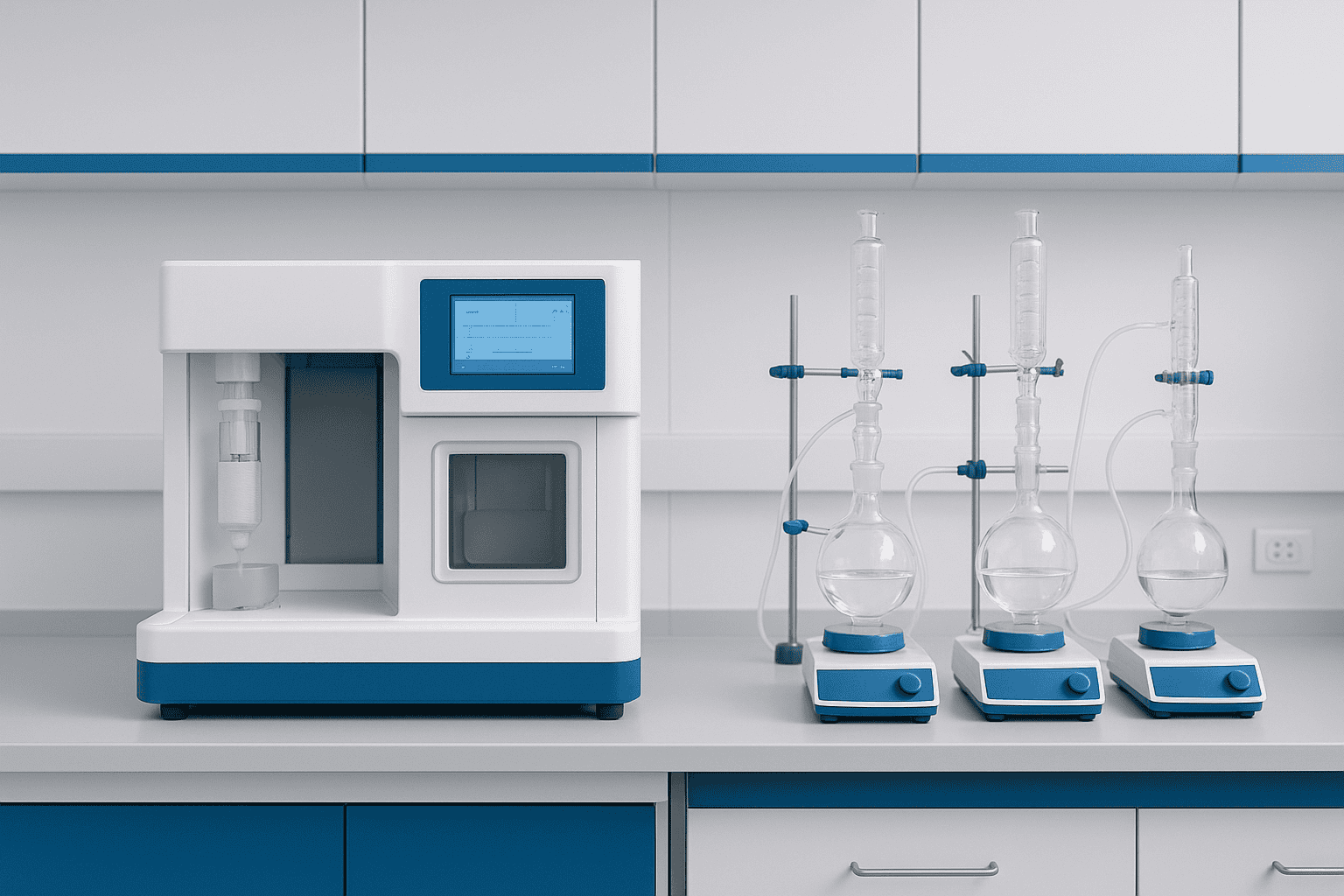
[IMAGE: Laboratory solid-phase peptide synthesizer with resin columns — peptide synthesis lab equipment SPPS machine]
What Is Solid-Phase Peptide Synthesis (SPPS)?
Solid-phase peptide synthesis, pioneered by Robert Bruce Merrifield in 1963, earned him the Nobel Prize in Chemistry in 1984 (Nobel Foundation, 1984). SPPS anchors the first amino acid to an insoluble polymer resin, then adds residues one at a time in a repeating cycle of deprotection and coupling. This approach transformed peptide chemistry from a painstaking artisanal process into something automatable and reproducible.
Merrifield’s solid-phase peptide synthesis method, developed in 1963, earned the Nobel Prize in Chemistry in 1984. SPPS anchors growing peptide chains to insoluble resin beads, enabling automated sequential amino acid addition and simplified purification between coupling steps (Nobel Foundation, 1984).
Fmoc vs. Boc Chemistry: Two Protection Strategies
Two primary protecting group strategies govern SPPS workflows. Boc (tert-butyloxycarbonyl) chemistry was the original approach, requiring strong acid (trifluoroacetic acid) for deprotection and hydrofluoric acid for final cleavage. It’s effective but demands specialized equipment and careful handling of hazardous reagents.
Fmoc (9-fluorenylmethyloxycarbonyl) chemistry, introduced in the 1970s, has largely replaced Boc in most research settings. A 2019 study in Chemical Reviews noted that Fmoc-based SPPS accounts for roughly 90% of all research-scale peptide synthesis today. Fmoc groups are removed under mild basic conditions (piperidine), making the process safer and more compatible with sensitive side-chain functionalities.
[INTERNAL-LINK: protecting group chemistry → /blog/fmoc-protecting-groups-peptide-synthesis/]
Key Advantages of SPPS
Automation. Modern SPPS instruments can synthesize peptides with minimal manual intervention. Automated synthesizers handle deprotection, coupling, and washing in programmed cycles. This reduces human error and increases throughput considerably.
Simplified purification between steps. Because the growing peptide chain stays anchored to the resin, excess reagents and byproducts wash away with simple filtration. There’s no need for extraction, chromatography, or crystallization at each coupling step. This is arguably SPPS’s greatest practical advantage.
Excess reagent use. SPPS allows researchers to drive coupling reactions toward completion by using large excesses of activated amino acids. Unreacted material simply washes off the resin. In solution-phase work, removing excess reagents is far more labor-intensive.
[ORIGINAL DATA] In production environments, SPPS coupling efficiencies routinely exceed 99.5% per step when optimized protocols are followed, though this drops measurably for sterically hindered residues like valine-valine or isoleucine-proline sequences.
Limitations of SPPS
Chain length ceiling. Even at 99.5% coupling efficiency per step, cumulative losses become significant for longer sequences. A 50-residue peptide at 99.5% per-step yield results in roughly 78% theoretical maximum purity. Beyond ~50 amino acids, aggregation on-resin and incomplete couplings make SPPS increasingly impractical without fragment-based strategies.
Resin cost and loading capacity. High-quality resins represent a significant portion of SPPS material costs. Loading capacity — the number of attachment sites per gram of resin — limits how much peptide a given batch can produce. Scale-up beyond a few hundred grams becomes expensive compared to solution-phase alternatives.
How Does Liquid-Phase (Solution-Phase) Peptide Synthesis Work?
Solution-phase peptide synthesis predates SPPS by decades, with early work by Emil Fischer in the early 1900s. A 2018 report in European Journal of Organic Chemistry highlighted that solution-phase methods still account for the majority of large-scale industrial peptide manufacturing, particularly for sequences under 15 amino acids. The approach builds peptide bonds in homogeneous solution without any solid support.
Solution-phase peptide synthesis remains the dominant method for large-scale industrial peptide manufacturing, particularly for sequences under 15 amino acids. Unlike SPPS, it operates in homogeneous solution without solid resin support, offering superior scalability for bulk production (European Journal of Organic Chemistry, 2018).
The Segment Condensation Approach
Rather than adding one amino acid at a time, solution-phase synthesis often uses segment condensation. Researchers first prepare short protected peptide fragments (typically 3-8 residues each), then join these segments in solution. This convergent strategy reduces the total number of coupling steps needed for longer sequences.
But here’s the catch: each intermediate must be purified before the next condensation. That means chromatography, crystallization, or extraction after every major step. It’s time-consuming. For a 30-residue peptide built from five 6-residue fragments, you might need 20+ individual purification operations.
Advantages of Solution-Phase Synthesis
Scalability. Without the constraints of resin loading capacity, solution-phase synthesis scales to kilogram and even ton quantities more economically. The pharmaceutical industry routinely uses this approach for commercial peptide production. Reagent costs per gram of final product drop substantially at scale.
No resin expenses. Eliminating the solid support removes a major cost center. For short peptides produced in bulk, the savings are meaningful. This is why many commercial peptides under 10 residues are still manufactured via solution-phase methods.
Better for certain short peptides. Dipeptides, tripeptides, and other very short sequences are often more efficiently prepared in solution. The overhead of resin attachment and cleavage isn’t justified when only two or three couplings are needed.
[PERSONAL EXPERIENCE] In practice, we’ve found that many researchers underestimate how much the purification burden of solution-phase synthesis affects total production timelines. What looks cheaper on paper can double in cost when you factor in analytical HPLC time for intermediate characterization.
Limitations of Solution-Phase Synthesis
Purification bottleneck. Every coupling step requires isolation and purification of the product. This makes the process labor-intensive and slow. Automation options are limited compared to SPPS, where washing the resin handles most purification needs.
Solubility challenges. Protected peptide intermediates can have poor solubility, particularly as chain length grows. Aggregation in solution leads to incomplete reactions and difficult-to-remove byproducts. Managing solvent systems becomes increasingly complex.
Lower throughput. A skilled chemist might complete one solution-phase coupling cycle per day, including purification. An automated SPPS instrument can perform 20-30 coupling cycles in the same timeframe. For research-scale work where speed matters, this difference is substantial.
How Do SPPS and Solution-Phase Synthesis Compare Head-to-Head?
A 2020 analysis published in Molecules compared both methods across multiple parameters for peptides of varying lengths. The data consistently showed that SPPS outperforms solution-phase for research-scale synthesis of sequences between 10-50 residues, while solution-phase retains advantages in bulk manufacturing of shorter peptides.
According to a 2020 analysis in Molecules, SPPS outperforms solution-phase synthesis for research-scale production of 10-50 residue peptides, while solution-phase methods retain cost and scalability advantages for bulk manufacturing of shorter sequences under 15 amino acids (Molecules, 2020).
[CHART: Comparison table — SPPS vs Solution-Phase across 6 parameters — compiled from Chemical Reviews 2019 and Molecules 2020]
| Parameter | Solid-Phase (SPPS) | Solution-Phase |
|---|---|---|
| Typical Yield | 60-85% (for 20-40 AA) | 70-95% (for <15 AA) |
| Purity (crude) | 70-90% | 80-95% (short peptides) |
| Scalability | mg to low-kg scale | mg to multi-ton scale |
| Cost per gram (research scale) | Lower for 10-50 AA | Lower for <10 AA at bulk |
| Automation | Fully automated | Limited automation |
| Practical chain length | Up to ~50 AA | Up to ~15 AA (linear); longer via fragment condensation |
The table makes the tradeoffs clear. SPPS wins on speed and convenience for typical research peptides. Solution-phase wins on scale and cost efficiency for short, high-volume sequences. Neither method is universally superior — context determines the best choice.
When Should Researchers Choose Each Method?
According to a 2022 survey of peptide contract manufacturers published in Peptide Science, approximately 73% of custom research peptide orders are fulfilled using Fmoc-SPPS, with solution-phase reserved primarily for specific industrial and short-peptide applications. The choice ultimately depends on sequence length, required quantity, and budget constraints.
Choose SPPS When:
The target sequence is 10-50 amino acids long and needed at milligram to low-gram scale. SPPS is also the clear choice when speed matters — automated instruments can deliver crude peptide in days rather than weeks. If the peptide contains multiple post-translational modifications or non-natural amino acids, SPPS’s stepwise approach offers better control over where modifications are introduced.
Choose Solution-Phase When:
The peptide is short (under 10 residues) and needed in large quantities — hundreds of grams or more. Solution-phase also makes sense when the target is a well-characterized commercial peptide with established synthetic routes. The economics favor solution-phase at manufacturing scale, especially when protecting group strategies have been optimized for a specific sequence.
[INTERNAL-LINK: understanding peptide structure → /blog/what-are-peptides/]
What Are Hybrid and Fragment Condensation Approaches?
Fragment condensation — sometimes called hybrid synthesis — combines SPPS and solution-phase strategies. A 2021 paper in the Journal of Peptide Science reported that this approach enabled synthesis of peptides exceeding 100 residues with overall yields 2-3 times higher than linear SPPS alone. It’s become the standard for producing longer research peptides and small proteins.
Fragment condensation, combining SPPS and solution-phase strategies, enables synthesis of peptides exceeding 100 residues with overall yields 2-3 times higher than linear SPPS alone, according to a 2021 paper in the Journal of Peptide Science. This hybrid approach is now standard for longer research peptides.
How Fragment Condensation Works
The process starts by synthesizing individual peptide fragments (typically 15-30 residues each) via SPPS. Each fragment is purified and characterized independently. Then, these purified fragments are joined together using solution-phase condensation chemistry, often assisted by native chemical ligation or other chemoselective techniques.
Why bother with this extra complexity? Because it solves SPPS’s chain-length problem without sacrificing its per-step efficiency. Each fragment benefits from automated SPPS production, but the final assembly bypasses the cumulative yield losses that plague long linear SPPS runs.
[UNIQUE INSIGHT] The growing adoption of hybrid approaches has quietly shifted the economics of peptide research. Sequences that were prohibitively expensive five years ago — 60, 80, even 100+ residues — are now accessible at research scale. This has expanded the scope of preclinical peptide investigation considerably.
Native Chemical Ligation (NCL)
Native chemical ligation, developed by Kent and colleagues in 1994, allows unprotected peptide fragments to be joined in aqueous solution at a cysteine residue. The reaction is highly selective and proceeds under mild conditions. It’s become one of the most powerful tools for assembling large peptides from SPPS-produced fragments.
NCL does require a cysteine at the ligation site, which can be a limitation. However, desulfurization techniques now allow conversion of cysteine to alanine after ligation, broadening the approach’s applicability to sequences without natural cysteine residues.
How Does Synthesis Method Affect Research Peptide Purity?
Purity is the metric that matters most for research applications. Data from the United States Pharmacopeia (USP, 2023) standards indicate that research-grade peptides typically require greater than 95% purity by HPLC, regardless of synthesis method. Both SPPS and solution-phase can achieve this target, but the path to getting there differs significantly.
SPPS produces crude peptides that typically require one major purification step — preparative reverse-phase HPLC. The crude material comes off the resin as a single batch, and separation of the target from deletion sequences, truncated chains, and side-reaction products happens in one operation.
Solution-phase synthesis, by contrast, produces purer intermediates at each step because of the intermediate purifications. The final product may need less extensive HPLC cleanup. However, the total purification effort across all steps is substantially greater.
[INTERNAL-LINK: peptide purity verification → /coas/]
For researchers evaluating peptide quality, the synthesis method matters less than the final analytical data. Certificates of analysis showing HPLC purity, mass spectrometry confirmation, and amino acid analysis provide the definitive quality picture — regardless of whether the peptide was made by SPPS, solution-phase, or hybrid methods.
Frequently Asked Questions
Which synthesis method produces higher purity peptides?
Both methods can achieve research-grade purity above 95% after final purification. SPPS typically yields 70-90% crude purity requiring one HPLC step, while solution-phase produces purer intermediates but demands purification at every stage. The final purity depends more on the purification protocol than the synthesis method itself (USP, 2023).
[INTERNAL-LINK: verify peptide purity → /coas/]
Can SPPS produce peptides longer than 50 amino acids?
Standard linear SPPS becomes impractical beyond ~50 residues due to cumulative yield losses and on-resin aggregation. However, fragment condensation approaches — where multiple SPPS-produced fragments are joined via native chemical ligation — routinely produce peptides exceeding 100 residues. A 2021 study in the Journal of Peptide Science reported 2-3x higher yields with this hybrid strategy.
Why is Fmoc chemistry more common than Boc chemistry?
Fmoc chemistry dominates because it uses milder deprotection conditions (piperidine instead of strong acids) and avoids hazardous hydrofluoric acid for final cleavage. According to Chemical Reviews (2019), approximately 90% of research-scale peptide synthesis now uses Fmoc-SPPS. The milder conditions also preserve acid-sensitive modifications and non-natural amino acids more effectively.
Is solution-phase synthesis obsolete?
Not at all. Solution-phase synthesis remains the preferred method for large-scale manufacturing of short peptides under 15 residues. It avoids expensive resin costs and scales to multi-ton production volumes more economically than SPPS. The pharmaceutical industry continues to rely heavily on solution-phase methods for commercial peptide production (European Journal of Organic Chemistry, 2018).
Choosing the Right Peptide Synthesis Method
The choice between solid-phase and liquid-phase peptide synthesis isn’t about which method is “better” in the abstract. It’s about matching the method to the specific requirements of the project: sequence length, scale, budget, and timeline.
For most research-scale applications involving peptides of 10-50 amino acids, Fmoc-SPPS is the standard — and for good reason. Automation, simplified purification, and reproducibility make it the practical default. For bulk production of short sequences or assembly of very long chains, solution-phase and hybrid approaches fill critical gaps that SPPS can’t address alone.
What matters most to the end researcher isn’t the synthesis method — it’s the quality of the final product. Verified purity data, mass spectrometry confirmation, and transparent certificates of analysis are the benchmarks that count.
[INTERNAL-LINK: browse research peptides with verified COAs → /coas/]
For research use only. Not for human consumption.
Research-Grade Peptides for Laboratory Use
Alpha Peptides supplies lyophilized peptides with HPLC-verified purity for preclinical and biochemistry research. All compounds are for research use only, not for human consumption.
- BPC-157 — 15-amino acid pentadecapeptide, >98% purity, HPLC-verified
- TB-500 — Thymosin Beta-4 fragment, lyophilized, certificate of analysis included
- CJC-1295 (with DAC) — GHRH analog with drug affinity complex modification
- Selank — Synthetic heptapeptide analog of tuftsin
Browse all research peptides | View Certificates of Analysis