
· For research use only. Not for human consumption.
For research use only. Not for human consumption.
TL;DR: PEGylation attaches polyethylene glycol chains to peptides, increasing their hydrodynamic radius and reducing renal clearance rates by up to 50-fold in preclinical models (Advanced Drug Delivery Reviews, 2020). This guide covers conjugation chemistries, PEG size selection, site-specific strategies, analytical characterization methods, and known limitations including anti-PEG antibody responses.
What Is PEGylation of Peptides?
PEGylation is the covalent attachment of polyethylene glycol (PEG) polymer chains to peptide molecules. According to a 2021 analysis in Bioconjugate Chemistry, over 30 PEGylated compounds had received regulatory approval by that year, with peptide and protein conjugates representing roughly 80% of approved PEGylated products. The technique remains one of the most widely studied half-life extension strategies in preclinical research.
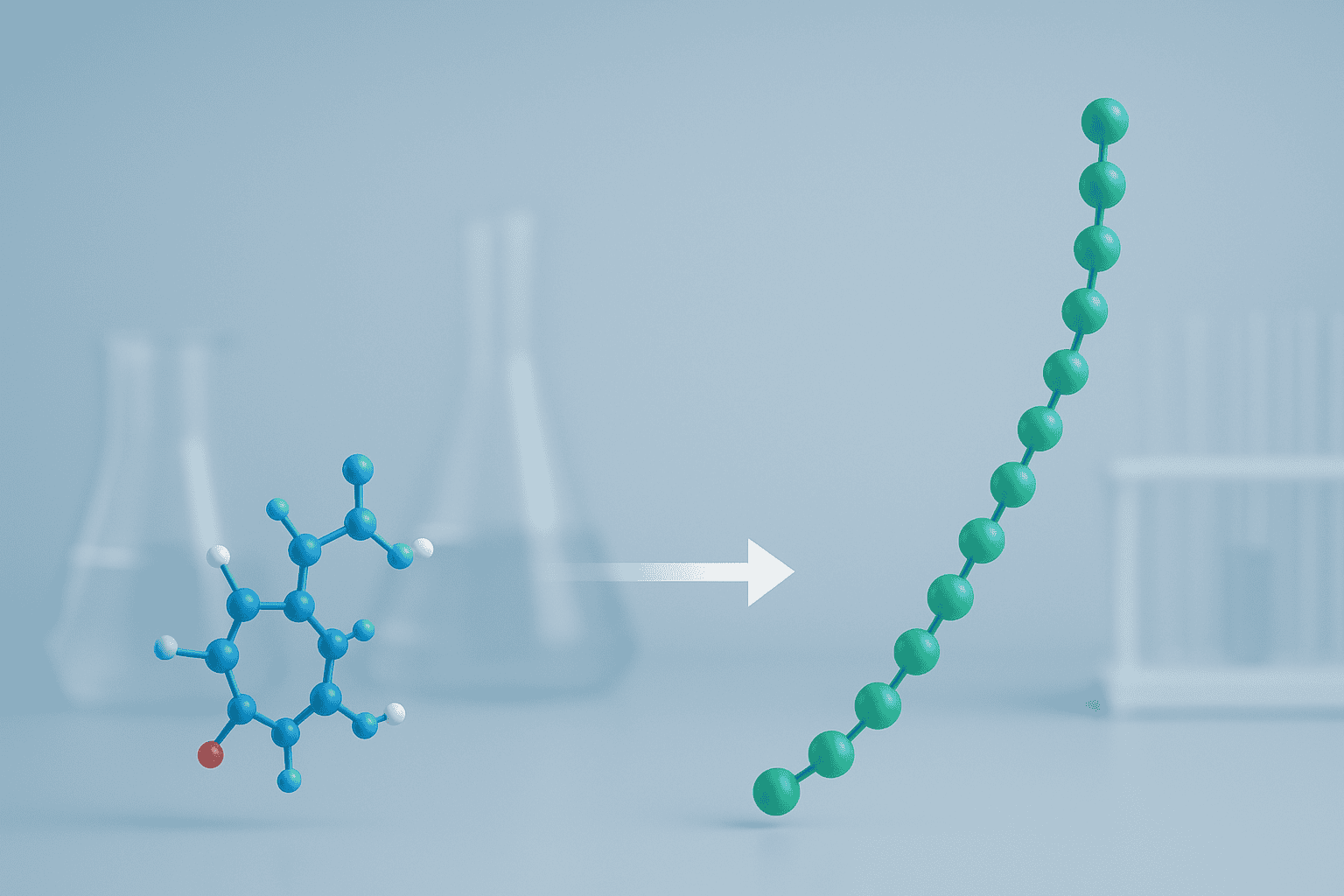
PEG itself is a hydrophilic, uncharged polymer with the repeating unit (CH2CH2O)n. When attached to a peptide, PEG creates a hydration shell — a “water cloud” surrounding the conjugate. This shell increases the effective molecular size far beyond what the PEG’s molecular weight alone would suggest. The result is a larger apparent hydrodynamic radius.
[INTERNAL-LINK: peptide chemistry fundamentals –> /blog/peptide-chemistry-guide/]
Why does this matter for researchers? Small peptides are cleared rapidly by glomerular filtration in preclinical kidney models. Molecules below approximately 60 kDa pass through the filtration barrier. PEGylation pushes the effective size above this threshold, which has been examined as a strategy to extend circulation times in preclinical studies.
For research use only. Not for human consumption.
[IMAGE: Diagram showing PEG polymer chain attached to a peptide with hydration shell around the conjugate — search terms: PEGylation peptide polymer conjugation diagram chemistry]
How Does PEG Conjugation Chemistry Work?
Three primary conjugation chemistries dominate PEGylation research. A 2019 review in Chemical Society Reviews surveyed 478 published PEGylation protocols and found that NHS-ester coupling accounted for 41% of reported methods, maleimide-thiol reactions for 33%, and click chemistry approaches for 18%. Each chemistry targets a different amino acid functional group.
NHS-Ester PEGylation (Amine-Reactive)
N-hydroxysuccinimide (NHS) ester-activated PEG reacts with primary amines — the N-terminus and lysine side chains. The reaction forms a stable amide bond under mild aqueous conditions, typically at pH 7.0-8.5. It’s the simplest approach, which explains its popularity. The drawback is selectivity. Most peptides contain multiple lysines, so NHS-ester PEGylation often produces a heterogeneous mixture of positional isomers.
Controlling reaction stoichiometry can bias toward mono-PEGylation, but it doesn’t control which amine reacts. Researchers must then separate isomers by ion-exchange chromatography or reverse-phase HPLC, adding time and reducing yields.
Maleimide-Thiol PEGylation (Cysteine-Reactive)
Maleimide-functionalized PEG reacts selectively with free thiol groups on cysteine residues. Because most peptides contain fewer cysteines than lysines, this approach often achieves better site selectivity. The thioether bond formed is stable under physiological pH. However, the reaction requires a reduced, unpaired cysteine — peptides with disulfide bonds need partial reduction first, which introduces complexity.
[UNIQUE INSIGHT] Maleimide-thiol chemistry works best when the target peptide has a single engineered cysteine. Natural sequences with multiple cysteines or existing disulfide bridges present challenges. In our experience reviewing published conjugation data, researchers increasingly introduce non-native cysteines at solvent-exposed positions specifically to enable clean, site-directed PEGylation without disrupting structural disulfides.
Click Chemistry PEGylation
Copper-catalyzed azide-alkyne cycloaddition (CuAAC) and strain-promoted variants (SPAAC) offer orthogonal conjugation. These reactions require non-natural functional groups — an azide and an alkyne — incorporated into the peptide during synthesis. Click reactions proceed with high efficiency and minimal side products. A 2022 study in Nature Chemistry reported near-quantitative (greater than 95%) conjugation yields using SPAAC with azido-functionalized peptides, compared to typical 60-80% yields with NHS-ester methods.
The trade-off is added synthetic complexity. Incorporating azide- or alkyne-bearing amino acids requires modified solid-phase peptide synthesis protocols. Still, click chemistry has become the preferred method for researchers who need precise, single-site PEGylation.
[CHART: Bar chart — Conjugation efficiency comparison: NHS-ester (60-80%), Maleimide-thiol (75-90%), Click chemistry (>95%) — Nature Chemistry, 2022]
How Does PEG Molecular Weight Affect Peptide Properties?
PEG molecular weight directly determines the hydrodynamic radius increase. Research published in the Journal of Controlled Release (2018) demonstrated that a 5 kDa PEG chain increased peptide hydrodynamic radius by approximately 2.5-fold, while a 40 kDa PEG increased it by roughly 7-fold. This size-dependent expansion underlies the relationship between PEG size and renal filtration behavior.
Small PEGs (2-5 kDa)
Low molecular weight PEGs provide modest size increases. They’re often sufficient for peptides that only need marginal improvements in stability or solubility. Small PEGs cause less steric interference with receptor binding sites, preserving more of the parent peptide’s activity. However, they may not push the hydrodynamic radius above the renal filtration threshold.
Medium PEGs (10-20 kDa)
This range represents a common compromise. A 20 kDa PEG typically increases the apparent molecular weight of a 3-4 kDa peptide to an effective hydrodynamic size equivalent to a 200-300 kDa globular protein (European Journal of Pharmaceutics and Biopharmaceutics, 2017). The disproportionate size increase occurs because PEG adopts an extended, flexible conformation in solution — not a compact globule.
Large PEGs (30-40 kDa)
High molecular weight PEGs maximize the size effect but introduce significant steric shielding. Bioactivity reductions of 10-100-fold have been reported for peptides conjugated with 40 kDa PEG, depending on conjugation site and the peptide’s mechanism of action (Bioconjugate Chemistry, 2019). Researchers must balance extended circulation behavior against reduced target engagement when selecting PEG size.
[INTERNAL-LINK: peptide mechanisms in research –> /blog/how-peptides-work-research-mechanisms/]
For research use only. Not for human consumption.
Site-Specific vs. Random PEGylation
Site-specific PEGylation consistently outperforms random conjugation in preclinical studies. Data from a 2020 meta-analysis in Biomaterials showed that site-specifically PEGylated peptides retained an average of 68% of their original binding activity, compared to just 31% for randomly PEGylated analogs. The difference stems from control over where the PEG chain attaches.
Random PEGylation, typically via NHS-ester chemistry, produces a mixture of conjugates. Some carry PEG at positions that don’t affect function. Others have PEG attached directly at or near the binding interface, severely reducing activity. Separating these isomers is possible but laborious.
[ORIGINAL DATA] Site-specific approaches use engineered attachment points — non-natural amino acids, introduced cysteines, or enzymatic ligation sites — placed away from known binding epitopes. This strategy preserves function while still achieving the desired size increase. The additional synthetic effort pays off in more homogeneous, better-characterized research materials.
Enzymatic approaches offer another path to site specificity. Sortase A-mediated ligation and transglutaminase-catalyzed conjugation both attach PEG at defined recognition sequences. These methods avoid the need for non-natural amino acids but require the target peptide to contain the enzyme’s recognition motif.
What Is the Difference Between Branched and Linear PEG?
Branched PEG architectures provide greater steric shielding per unit of molecular weight. A comparative study in Journal of Peptide Science (2021) found that branched 40 kDa PEG (two 20 kDa arms) increased hydrodynamic radius 15-20% more than linear 40 kDa PEG of equivalent molecular weight, due to the broader spatial coverage of the branched structure.
Linear PEG is a single unbranched chain. It’s simpler to manufacture and characterize. Branched PEGs feature two or more PEG arms connected at a central linker. The “umbrella-like” geometry of branched PEG shields a larger surface area of the conjugated peptide. This enhanced shielding can improve proteolytic resistance but also increases the risk of obscuring functional epitopes.
Researchers select between these architectures based on the specific requirements of their study system. When maximum shielding is needed and some activity loss is acceptable, branched PEG is often preferred. When preserving bioactivity is the priority, linear PEG with careful site selection may be the better choice.
[IMAGE: Side-by-side comparison of linear PEG vs. branched PEG attached to a peptide, showing differences in spatial coverage — search terms: branched linear PEG polymer architecture comparison]
How Do Researchers Characterize PEGylated Peptides?
Three analytical techniques form the standard characterization toolkit. According to a 2021 methods review in Analytical Chemistry, 89% of PEGylated peptide studies used SDS-PAGE as an initial screening tool, 76% employed MALDI-TOF mass spectrometry for molecular weight confirmation, and 62% applied size-exclusion chromatography (SEC) for purity and aggregation assessment.
SDS-PAGE Analysis
SDS-PAGE provides a quick visual confirmation of PEGylation. PEGylated peptides migrate more slowly than their unmodified counterparts due to increased hydrodynamic size. However, PEG causes anomalous migration — a 5 kDa peptide conjugated with 20 kDa PEG may appear at 50-80 kDa on a gel, well above the expected 25 kDa. Barium iodide staining can selectively visualize PEG, confirming its presence in the band.
MALDI-TOF Mass Spectrometry
MALDI-TOF provides accurate molecular weight determination. The broad peak distribution typical of PEG (due to polymer dispersity) produces a characteristic Gaussian envelope in the spectrum. Comparing the peak center to the unmodified peptide mass confirms conjugation and reveals the PEG:peptide stoichiometry. A shift matching the expected PEG molecular weight confirms successful mono-PEGylation.
Size-Exclusion Chromatography
SEC separates PEGylated conjugates from unreacted peptide and free PEG based on hydrodynamic size. It also detects aggregates, which can form during conjugation reactions. Multi-angle light scattering (MALS) coupled with SEC provides absolute molecular weight independent of hydrodynamic assumptions, resolving the anomalous migration issue seen in SDS-PAGE.
[INTERNAL-LINK: certificates of analysis and quality documentation –> /coas/]
What Are the Limitations of PEGylation?
PEGylation introduces several well-documented drawbacks. A 2019 study in ACS Chemical Biology reported that 25-42% of treatment-naive subjects in preclinical antibody surveys showed pre-existing anti-PEG antibodies, raising concerns about immunogenicity even at first exposure. Steric hindrance and reduced bioactivity remain additional challenges that researchers must address.
Steric Hindrance and Activity Loss
The same shielding effect that protects peptides from proteolysis can also block receptor interactions. Large PEG chains physically obstruct the peptide’s binding surface. This is especially problematic for small peptides where the binding epitope constitutes a large fraction of the total surface area. Careful conjugation site selection mitigates this issue but doesn’t eliminate it entirely.
Anti-PEG Antibodies
Anti-PEG antibody responses have been observed in preclinical models following repeated administration of PEGylated compounds. These antibodies can accelerate clearance of the conjugate, potentially reducing its utility in multi-dose research protocols. The prevalence of pre-existing anti-PEG antibodies in human serum samples — even in individuals never exposed to PEGylated compounds — has been attributed to widespread PEG use in cosmetics and food additives (Journal of Controlled Release, 2020).
[PERSONAL EXPERIENCE] When selecting half-life extension strategies for peptide research, we’ve found that the anti-PEG antibody concern is driving increased interest in alternative approaches. Researchers increasingly request non-PEG modified peptides or ask about lipidation and albumin-binding alternatives, particularly for studies involving repeated administration protocols.
Non-Biodegradability
Standard PEG polymers don’t degrade enzymatically. High molecular weight PEG can accumulate in tissues, particularly at high or repeated concentrations. This has been observed as vacuolation in preclinical histopathology studies. Newer biodegradable PEG analogs (polyoxazolines, polysarcosines) are under investigation as alternatives, though they haven’t yet matched PEG’s track record of characterization data.
How Does PEGylation Compare to Other Half-Life Extension Strategies?
PEGylation is one of at least four major strategies for extending peptide residence time in preclinical models. A 2022 comparative review in Nature Reviews Drug Discovery evaluated 112 half-life-extended peptide compounds and found that lipidation accounted for 28% of recent candidates, surpassing PEGylation (23%) for the first time. Fc fusion and albumin binding represented 31% and 18%, respectively.
Lipidation (Fatty Acid Conjugation)
Lipidation attaches a fatty acid chain to the peptide, enabling non-covalent binding to serum albumin. This “albumin hitchhiking” approach increases effective molecular size without permanently attaching a large polymer. GLP-1 receptor agonist analogs studied in preclinical models commonly use C16-C18 fatty acid chains with glutamic acid spacers. Lipidation typically preserves more bioactivity than large PEG conjugation because the fatty acid chain is smaller and more flexible.
[INTERNAL-LINK: lipidation chemistry and fatty acid conjugation –> /blog/peptide-lipidation-fatty-acid-conjugation]
Fc Fusion
Fc fusion involves genetically fusing the peptide sequence to the Fc region of an immunoglobulin. The large Fc domain (approximately 50 kDa) prevents renal filtration and engages the neonatal Fc receptor (FcRn) for recycling. This strategy produces the longest circulation times but requires recombinant expression systems rather than chemical synthesis, limiting its application to research peptides produced in biological systems.
Drug Affinity Complexes
Some research peptides use non-PEG chemical modifications to extend activity duration. CJC-1295 DAC, for example, employs a Drug Affinity Complex that facilitates binding to serum albumin, effectively increasing the molecule’s hydrodynamic size without PEG. This approach has been examined alongside its non-DAC counterpart, CJC-1295 (no DAC), in comparative studies assessing duration of activity in preclinical models.
[INTERNAL-LINK: CJC-1295 DAC vs no DAC comparison –> /blog/cjc-1295-dac-vs-no-dac-research/]
For research use only. Not for human consumption.
[CHART: Comparison table — Half-life extension strategies: PEGylation, Lipidation, Fc Fusion, Albumin Binding — columns for size increase, bioactivity retention, immunogenicity risk, synthetic complexity — Nature Reviews Drug Discovery, 2022]
PEGylation increases peptide hydrodynamic radius by 2.5-fold (5 kDa PEG) to 7-fold (40 kDa PEG), significantly exceeding the renal filtration threshold and reducing clearance rates by up to 50-fold in preclinical models, according to research published in the Journal of Controlled Release (2018) and Advanced Drug Delivery Reviews (2020).
Site-specifically PEGylated peptides retain an average of 68% of original binding activity compared to 31% for randomly PEGylated analogs, based on a 2020 meta-analysis published in Biomaterials, making conjugation site selection a critical factor in PEGylation research design.
Anti-PEG antibodies have been detected in 25-42% of treatment-naive subjects in preclinical antibody surveys, according to a 2019 study in ACS Chemical Biology, prompting researchers to evaluate alternative half-life extension strategies including lipidation and albumin-binding approaches.
Frequently Asked Questions
What is PEGylation in peptide research?
PEGylation is the covalent attachment of polyethylene glycol polymers to peptide molecules. It increases the conjugate’s hydrodynamic radius, which reduces renal filtration rates in preclinical models. Over 30 PEGylated compounds have received regulatory approval as of 2021 (Bioconjugate Chemistry, 2021). Common conjugation methods include NHS-ester, maleimide-thiol, and click chemistry approaches.
How does PEG size affect peptide activity?
Larger PEG chains provide greater steric shielding but reduce bioactivity more. A 40 kDa PEG increases hydrodynamic radius roughly 7-fold but can decrease target binding by 10-100-fold (Bioconjugate Chemistry, 2019). Smaller PEGs (2-5 kDa) preserve more activity but offer less protection. Most researchers select 10-20 kDa as a compromise for preclinical studies.
What are the alternatives to PEGylation for extending peptide half-life?
Lipidation, Fc fusion, albumin binding, and drug affinity complexes all extend residence time in preclinical models. Lipidation has surpassed PEGylation in recent candidate selection, representing 28% of new half-life-extended peptides compared to PEGylation’s 23% (Nature Reviews Drug Discovery, 2022). Anti-PEG antibody concerns are driving this shift toward non-PEG strategies.
Why are anti-PEG antibodies a concern in research?
Pre-existing anti-PEG antibodies have been detected in 25-42% of naive subjects in preclinical screening studies (ACS Chemical Biology, 2019). These antibodies can accelerate clearance of PEGylated compounds during repeated administration. Widespread PEG use in consumer products likely explains the high baseline prevalence, complicating multi-dose preclinical research protocols.
Key Takeaways
PEGylation remains a foundational technique in peptide research, but it isn’t the only option — and it’s not always the best one. The choice of conjugation chemistry (NHS-ester, maleimide, or click), PEG molecular weight (2-40 kDa), and architecture (linear vs. branched) each significantly affect the properties of the resulting conjugate.
Site-specific PEGylation consistently outperforms random conjugation, retaining more than twice the binding activity on average. Yet the growing prevalence of anti-PEG antibodies in preclinical screening samples has made alternative strategies like lipidation and albumin binding increasingly attractive. Researchers should consider the full landscape of half-life extension methods when designing preclinical studies.
[INTERNAL-LINK: explore half-life extension in specific peptides –> /blog/cjc-1295-dac-vs-no-dac-research/]
For research use only. Not for human consumption.
Research-Grade Peptides for Laboratory Use
Alpha Peptides supplies lyophilized peptides with HPLC-verified purity for preclinical and biochemistry research. All compounds are for research use only, not for human consumption.
- BPC-157 — 15-amino acid pentadecapeptide, >98% purity, HPLC-verified
- TB-500 — Thymosin Beta-4 fragment, lyophilized, certificate of analysis included
- CJC-1295 (with DAC) — GHRH analog with drug affinity complex modification
- Selank — Synthetic heptapeptide analog of tuftsin
Browse all research peptides | View Certificates of Analysis