
· For research use only. Not for human consumption.
For research use only. Not for human consumption.
MOTS-c vs SS-31 research is a comparison that comes up frequently among scientists studying mitochondria. Both peptides are used to investigate the organelle responsible for producing most of a cell’s energy. Both appear in preclinical publications regularly. But they approach mitochondrial biology from completely opposite directions, and understanding that difference is key to knowing which one fits a given research question.
MOTS-c is a naturally occurring 16-amino-acid peptide encoded within the mitochondrial genome itself. Lee et al. (2015) first identified it in Cell Metabolism (PMID: 25738459). SS-31 is a synthetic four-amino-acid peptide engineered by scientists to reach the inner mitochondrial membrane. Mitchell et al. (2020) examined SS-31 in aged mouse models and documented effects on mitochondrial function (PMID: 32273339). Same organelle, fundamentally different tools.
This deep dive covers origins, targets, structure, publication volume, and practical research considerations. For individual compound profiles, see our MOTS-c guide and SS-31 overview.
TL;DR: MOTS-c is a 16-amino-acid natural peptide from mitochondrial DNA that works through the AMPK pathway. SS-31 is a 4-amino-acid synthetic peptide that targets cardiolipin on the inner mitochondrial membrane. SS-31 has a longer publication history (since the early 2000s), while MOTS-c was first described in 2015. They are complementary research tools, not interchangeable alternatives. For research use only. Not for human consumption.
Origin: Where Each Peptide Comes From
The most fundamental difference in the MOTS-c vs SS-31 research comparison is origin. MOTS-c was discovered. SS-31 was invented. That distinction shapes every other difference between them.
MOTS-c stands for Mitochondrial Open reading frame of the Twelve S rRNA type-c. It is encoded within the 12S rRNA gene of the mitochondrial genome — a region of DNA that scientists had studied for decades without realizing it contained instructions for a functional peptide. Lee et al. (2015) discovered that cells actually produce this 16-amino-acid sequence and that it functions as a signaling molecule (PMID: 25738459). The body makes MOTS-c on its own.
SS-31 stands for Szeto-Schiller 31 — named after its creators, Hazel Szeto and Peter Schiller. It is the 31st compound in a series of synthetic peptides these researchers designed to penetrate cell membranes and accumulate at mitochondria. Nothing about SS-31 exists in nature. Every amino acid in its sequence was chosen deliberately to achieve specific physical and chemical properties.
Think of it this way: MOTS-c is like finding a tool that was already in the toolbox but nobody had noticed before. SS-31 is like building a brand-new tool from scratch because the existing ones did not do what you needed.
Target: Where Each Peptide Goes Inside the Mitochondria
Despite both being studied in mitochondrial biology, these peptides target completely different parts of the system.
SS-31 has a very specific address: cardiolipin on the inner mitochondrial membrane. Cardiolipin is a specialized lipid molecule that plays a critical role in organizing the electron transport chain — the cellular machinery that produces energy (ATP). Mitchell et al. (2020) documented that SS-31 interacts with cardiolipin and investigated its effects on mitochondrial proteome stability in aged mouse tissue (PMID: 32273339). SS-31 goes to one very specific spot and interacts with one very specific molecule.
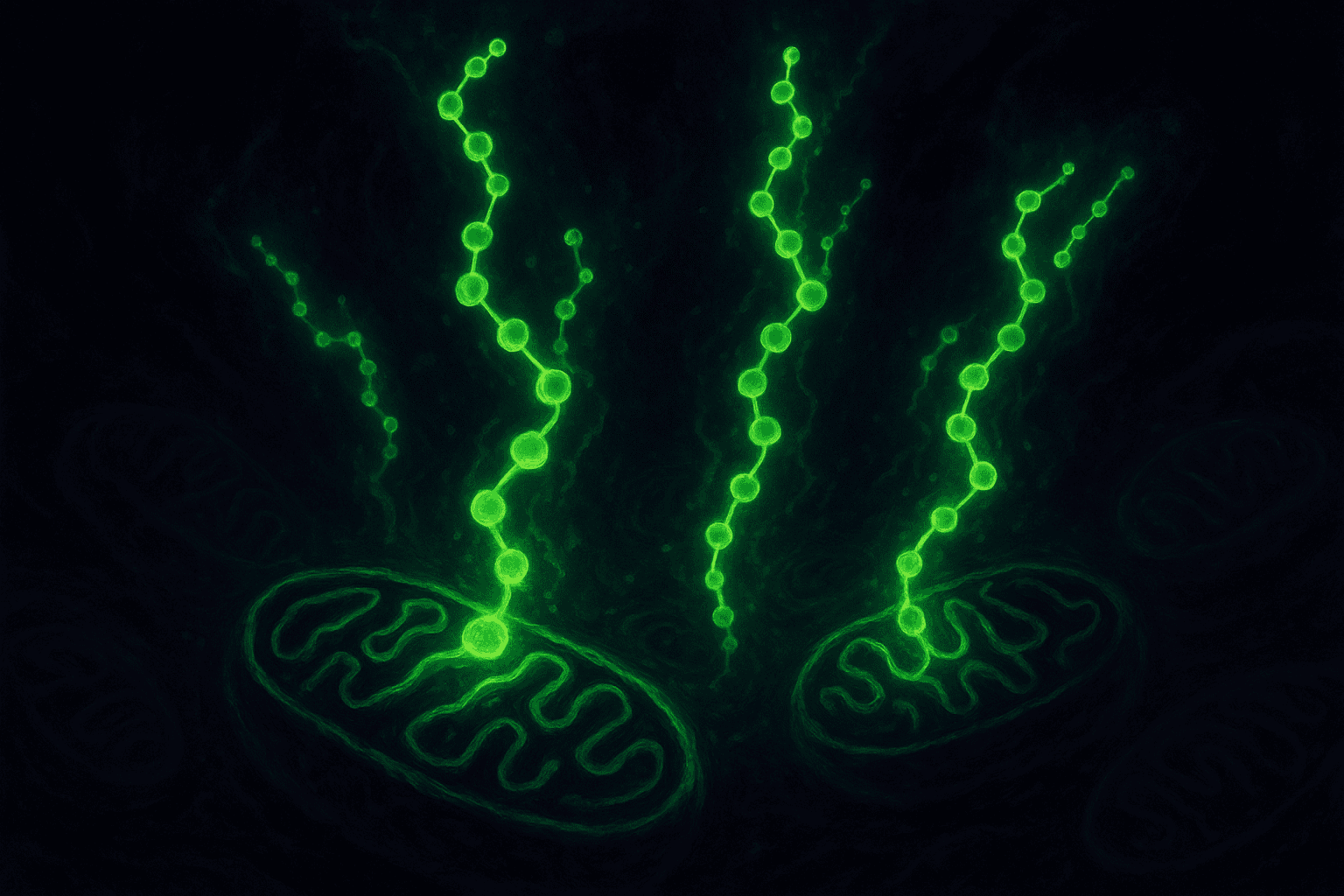
MOTS-c operates through a broader signaling pathway. Lee et al. (2015) demonstrated that MOTS-c activates the AMPK (AMP-activated protein kinase) pathway (PMID: 25738459). AMPK is sometimes called the cell’s energy sensor — it monitors how much energy is available and triggers responses accordingly. MOTS-c does not stay at the mitochondrial membrane. It travels outward, potentially reaching other cells entirely.
An analogy: SS-31 is a mechanic who goes directly to a specific part of the engine and works on it. MOTS-c is a message that the engine sends to the control room, telling the whole building about conditions inside. One works locally. The other communicates broadly.
Mitchell et al. (2020) examined SS-31 in aged mouse skeletal muscle, documenting effects on the mitochondrial proteome and inner membrane organization. Published in eLife, the study provided detailed proteomic evidence of how this synthetic tetrapeptide interacts with cardiolipin-associated protein complexes. (PMID: 32273339)
Size and Structure: How Different Are They Physically?
The structural contrast could hardly be more dramatic. SS-31 is a tetrapeptide — just four amino acids in a row, with a molecular weight of roughly 640 Daltons. MOTS-c is four times longer at 16 amino acids, weighing approximately 2,174 Daltons. In molecular terms, that is a significant gap.
SS-31’s tiny size is part of its design. An alternating pattern of aromatic (ring-shaped) and basic (positively charged) amino acids gives it the ability to cross cell membranes on its own and accumulate at the negatively charged inner mitochondrial membrane. Its small size means it reaches its target quickly and efficiently — like a dart aimed at a bullseye.
MOTS-c is larger because its job is different. As a signaling peptide, it needs to carry enough structural information to interact with the AMPK pathway and potentially with receptors on cell surfaces. A four-amino-acid chain would not carry enough molecular “information” to serve as a complex signal. MOTS-c needs its extra length to function.
Their shapes have nothing in common either. SS-31’s amino acid arrangement gives it lipid-seeking properties. MOTS-c behaves as a water-soluble signaling molecule. In a laboratory setting, they dissolve differently, move through solutions differently, and interact with analytical instruments differently. No researcher would confuse one for the other.
Publication Volume: Which Has More Published Research?
SS-31 has a significant head start. Preclinical work on SS-31 began in the early 2000s, giving it more than two decades of published data. Research groups worldwide have examined it in rodent models across multiple organ systems, producing a substantial body of preclinical literature.

MOTS-c entered the scientific conversation much later. Lee et al. published their discovery paper in 2015 (PMID: 25738459). Since then, MOTS-c publications have grown rapidly, but the total volume is still smaller than SS-31’s accumulated library. However, the rate of new MOTS-c publications has accelerated year over year, reflecting growing scientific interest in mitochondrial-derived peptides.
Here is what the publication difference means practically: SS-31 has more data points across more experimental conditions. Researchers choosing SS-31 can build on a larger existing literature. MOTS-c offers more uncharted territory — fewer studies mean more open questions and more opportunities for novel findings. Neither situation is inherently better. It depends on whether a research group wants to extend established knowledge or explore newer ground.
MOTS-c vs SS-31 Research: Complementary, Not Competitive
The most important takeaway from this comparison is that these peptides are not competitors. They are not two versions of the same tool. They are separate instruments for investigating separate aspects of mitochondrial biology.
A researcher studying inner membrane organization and electron transport chain integrity would reach for SS-31. Mitchell et al. (2020) demonstrated its utility precisely in this context (PMID: 32273339). A researcher studying how mitochondria communicate with the rest of the cell through signaling pathways would reach for MOTS-c. Lee et al. (2015) established the foundation for that line of inquiry (PMID: 25738459).

Some research groups do study both peptides within the same experimental framework to compare membrane-targeted versus signaling-targeted approaches. These combination studies are more complex but represent a growing area of mitochondrial research.
Alpha Peptides carries research-grade MOTS-c with third-party HPLC purity verification and mass spectrometry identity confirmation. Visit our MOTS-c product page for specifications, or browse our full catalog to explore both mitochondrial peptides. Review all testing documentation on our Certificates of Analysis page.
Frequently Asked Questions
Can MOTS-c and SS-31 be used in the same experiment?
Yes. Because they target different aspects of mitochondrial biology (MOTS-c through AMPK signaling, SS-31 through inner membrane cardiolipin), researchers can study them in parallel or in combination. This approach allows comparison of membrane-level versus signaling-level effects within the same experimental model.
Which peptide is better for mitochondrial research?
Neither is universally better. SS-31 is better suited for studies focused on inner membrane integrity and electron transport chain organization. MOTS-c is better suited for studies focused on mitochondrial signaling and metabolic communication. The right choice depends entirely on the specific research question.
Does the body produce SS-31 naturally?
No. SS-31 is entirely synthetic — designed by researchers Hazel Szeto and Peter Schiller. It does not occur anywhere in nature. MOTS-c, by contrast, is naturally encoded in the mitochondrial genome and has been detected in human blood plasma. The research-grade versions of both compounds are manufactured through solid-phase peptide synthesis.
Why is MOTS-c four times larger than SS-31?
Their different sizes reflect their different functions. SS-31 was engineered to be as small as possible while still crossing membranes and binding cardiolipin. Its compact four-amino-acid structure is optimized for membrane penetration. MOTS-c is a signaling peptide that needs enough structural complexity (16 amino acids) to interact with the AMPK pathway and carry biological “instructions” across distances.
For research use only. Not for human consumption. This article is intended for informational purposes and does not constitute medical advice, dosing guidance, or therapeutic recommendations.