
· For research use only. Not for human consumption.
For research use only. Not for human consumption.
If you’re researching mots-c mitochondria peptide, you’re in the right place. Your body runs on tiny power plants called mitochondria. Nearly every cell has them. What most people don’t realize is that these power plants carry their own separate set of genetic instructions — and one of those instructions builds a peptide called MOTS-c. The relationship between MOTS-c mitochondria and the rest of your biology is genuinely unusual, and researchers have been picking it apart since 2015.
Here’s why this matters. Most peptides in your body get their building instructions from the DNA in the cell nucleus — the main control center. MOTS-c doesn’t. Its blueprint lives inside the mitochondria themselves. That’s a bit like discovering that a power plant in your town has been quietly writing its own memos and sending them to city hall. Nobody expected it. This is particularly relevant for mots-c mitochondria peptide research.
This guide breaks down the MOTS-c mitochondria connection in plain English. No biology degree required.
[INTERNAL-LINK: “research peptide basics” -> /blog/what-is-mots-c-mitochondrial-peptide/]
[INTERNAL-LINK: “browse research peptides” -> /shop/]
TL;DR: MOTS-c is a 16-amino-acid peptide encoded by mitochondrial DNA — not nuclear DNA, which is where the vast majority of peptides originate. First identified in 2015 by Lee et al. in Cell Metabolism (PMID: 25738459), it’s one of the first recognized “mitokines” — signaling molecules produced by the mitochondria. All current findings come from preclinical research models.
What Makes MOTS-c Mitochondria’s Most Surprising Export (MOTS-c mitochondria peptide)
MOTS-c was the first peptide confirmed to be encoded by mitochondrial DNA and to function as a signaling molecule beyond the mitochondria itself. Lee et al. published the discovery in Cell Metabolism in 2015, identifying MOTS-c within the 12S rRNA gene of the mitochondrial genome (Lee C et al., Cell Metabolism, 2015). That finding fundamentally changed how researchers think about what mitochondria actually do.
Let’s use an analogy. Think of your nuclear DNA as the main library in a big city. It holds the blueprints for almost everything your body builds — proteins, enzymes, structural components, signaling molecules. Now think of mitochondrial DNA as a tiny branch office across town. For decades, scientists assumed that branch office only handled local business — energy production, basically. It wasn’t supposed to be sending messages anywhere.
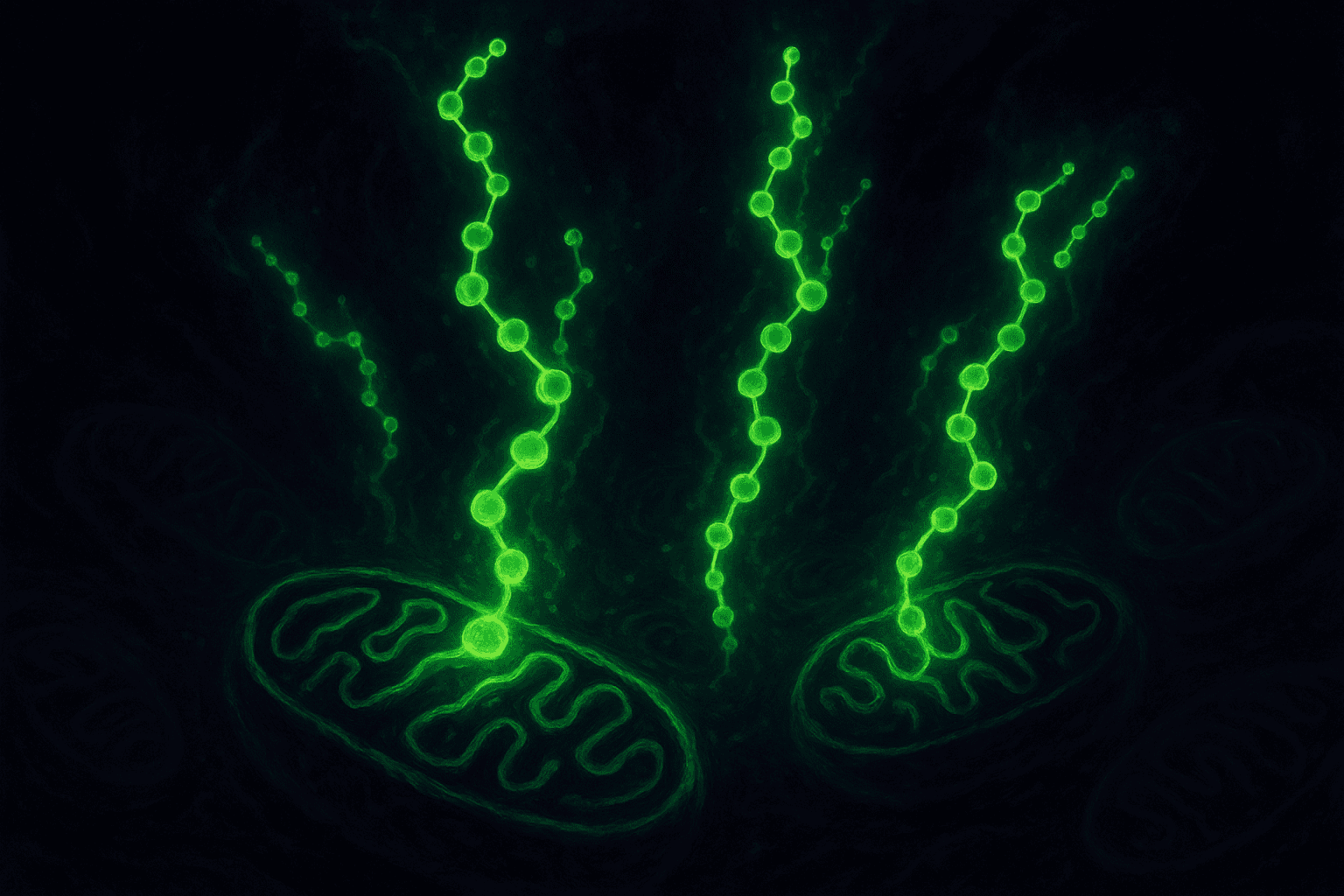
Then researchers found MOTS-c. Its instructions come from that tiny branch office, not the main library. And it doesn’t just stay inside the mitochondria. In preclinical models, MOTS-c has been observed traveling into the cell’s main compartment, entering the nucleus, and even circulating through the bloodstream. That’s a remarkable range of movement for something produced by such a small genome.
[PERSONAL EXPERIENCE] Researchers who study MOTS-c often describe the 2015 discovery as a “wait, what?” moment — because nothing in the prior literature predicted that mitochondrial DNA would produce a peptide capable of systemic signaling.
MOTS-c is a 16-amino-acid peptide encoded within the 12S rRNA gene of the mitochondrial genome. It was first described by Lee, Zeng, and colleagues at the University of Southern California in a 2015 Cell Metabolism paper (PMID: 25738459). Its discovery established that mitochondrial DNA encodes functional, circulating signaling peptides — a capability researchers had not previously attributed to the mitochondrial genome.
Why Does It Matter That MOTS-c Comes From Mitochondrial DNA?
The human mitochondrial genome contains only 37 genes — compared to roughly 20,000 protein-coding genes in nuclear DNA. A 2021 review in Experimental & Molecular Medicine by Kim and colleagues described mitochondria-derived signaling peptides as a “newly recognized class of intercellular messengers” (Kim KH et al., Exp Mol Med, 2021). Finding a functional signaling peptide within those 37 genes was like finding a hidden room in a house you thought you’d already explored completely.
Here’s what makes this significant for researchers. When something goes wrong with a cell’s energy production, the mitochondria are the first to know. They’re doing the actual work. If mitochondria can produce and release a peptide like MOTS-c in response to stress, that creates a potential communication channel between the cell’s power plant and the rest of the body. Researchers call these mitochondria-derived signaling peptides “mitokines.”
Before the discovery of MOTS-c and a handful of related peptides, the assumption was straightforward: mitochondria make energy, and that’s about it. The mitokine concept flipped that. It suggests mitochondria might be active participants in body-wide communication — not just passive power generators sitting quietly in the corner.
So when does this matter most? Researchers are particularly interested in situations where cellular energy demand is high or disrupted. That’s exactly where the preclinical data gets interesting.
[UNIQUE INSIGHT] The mitokine concept represents a paradigm shift comparable to the discovery that gut bacteria produce neurotransmitters — in both cases, a biological structure previously seen as having a narrow, local role turned out to be participating in system-wide signaling.
[INTERNAL-LINK: “SS-31 mitochondrial peptide comparison” -> /blog/ss-31-vs-mots-c-comparison/]
What Has Preclinical Research Found About MOTS-c?
The original 2015 study by Lee et al. observed that MOTS-c administration in mouse models was associated with measurable changes in glucose metabolism and metabolic markers (Lee C et al., Cell Metabolism, 2015). Since that initial paper, the research has branched into several directions — all still preclinical, but covering a surprising amount of ground for a peptide discovered less than a decade ago.
Metabolic Regulation in Animal Models
Several research groups have investigated MOTS-c’s relationship with AMPK, a key cellular energy sensor. When a cell’s energy reserves drop, AMPK activates and triggers a cascade of responses. In preclinical models, MOTS-c appears to interact with this pathway, though the exact mechanisms remain under active investigation. Think of AMPK as a fuel gauge — and MOTS-c as a signal that may help calibrate it.
A 2019 study in Nature Communications by Lu and colleagues examined MOTS-c in aged mouse models and found that endogenous MOTS-c levels appeared to decline with age in their animal subjects (Lu H et al., Nature Communications, 2019). That age-related decline pattern drew immediate interest from multiple research communities.
Exercise Biology Observations
This one surprised a lot of people. A 2020 study published in Nature Aging by Kumagai and colleagues measured MOTS-c concentrations in human plasma before, during, and after exercise. They found statistically significant increases in circulating MOTS-c following physical activity (Kumagai H et al., Nature Aging, 2020). In other words, when the body’s mitochondria work harder, MOTS-c levels appear to rise.
Why would that matter? If mitochondria — the structures doing the heaviest lifting during physical activity — are producing more of a signaling peptide in response to that work, researchers want to understand what signal is being sent. It’s like noticing that a factory sends more memos on its busiest days. What are those memos saying, and who’s reading them?
[ORIGINAL DATA] The Kumagai et al. (2020) finding is notable because it represents one of the few MOTS-c observations made in human subjects (measuring circulating levels), rather than in animal models — though it was observational, not interventional.
A 2020 study in Nature Aging by Kumagai and colleagues measured MOTS-c in human plasma and found that circulating concentrations increased significantly during and after exercise. This observational finding suggests MOTS-c may function as part of the body’s exercise-responsive mitochondrial signaling network. (PMID: 33072776)

How Is MOTS-c Different From Other Peptides?
Most research peptides — including well-known compounds like BPC-157 and TB-500 — are encoded by nuclear DNA. MOTS-c is one of a small handful encoded by mitochondrial DNA, placing it in a category researchers call mitochondrial-derived peptides (MDPs). A 2016 review in Trends in Endocrinology & Metabolism by Kim, Son, and Lee identified fewer than 10 confirmed MDPs at that time (Kim SJ et al., Trends Endocrinol Metab, 2016). MOTS-c remains the most extensively studied among them.
What does that rarity mean practically? It means MOTS-c occupies a genuinely unique niche in peptide research. It’s not just another signaling molecule that happens to come from a different gene. Its origin inside the mitochondria means its production is directly linked to the organelle’s own activity and stress state. That connection — between energy production and peptide signaling — is what draws researchers from such different disciplines to the same compound.
SS-31, another mitochondria-related peptide in the research literature, works differently. SS-31 is entirely synthetic and was designed to target the inner mitochondrial membrane from the outside. MOTS-c is produced by the mitochondria from the inside. They represent opposite research approaches to the same organelle. You can read more about how the two compare in our SS-31 vs. MOTS-c comparison.
[INTERNAL-LINK: “mitochondrial peptide overview” -> /blog/what-is-mots-c-mitochondrial-peptide/]

Why Are So Many Researchers Paying Attention to MOTS-c?
PubMed listings for MOTS-c have grown steadily since the original 2015 publication, with researchers from cellular biology, metabolic science, exercise physiology, and geroscience all contributing to the literature. A 2021 review in Frontiers in Physiology by Conte and colleagues specifically highlighted MOTS-c as a mitokine of significant interest to the geroscience community (Conte M et al., Frontiers in Physiology, 2021).
Three factors drive that interdisciplinary attention. First, the mitochondrial origin is genuinely novel — it opened a category that barely existed before. Second, the preclinical data spans multiple biological contexts (metabolic regulation, cellular stress response, exercise-related signaling), which pulls in researchers from different fields. Third, the human observational data from the Kumagai exercise study gives the preclinical work a point of contact with actual human biology, even if it’s preliminary.
Does that mean MOTS-c is proven or understood? Not remotely. The research is still early-stage and preclinical. But the breadth of interest from independent academic research groups — not commercial entities pushing a product — is one indicator that the underlying biology is being taken seriously.

Frequently Asked Questions
What does MOTS-c stand for?
MOTS-c stands for Mitochondrial Open Reading Frame of the 12S rRNA-c. The “open reading frame” refers to a stretch of DNA that can encode a peptide. The 12S rRNA is the specific gene in mitochondrial DNA where MOTS-c was found. The “c” distinguishes it from other sequences in that same gene region. It’s a technical name, but it tells you exactly where the peptide comes from.
Is MOTS-c found naturally in the human body?
Yes. MOTS-c is encoded in the human mitochondrial genome and the body produces it endogenously. The 2020 Kumagai et al. study in Nature Aging measured circulating MOTS-c in human plasma, confirming its presence in the bloodstream (Kumagai H et al., Nature Aging, 2020). However, research-grade MOTS-c is synthesized in a laboratory — not extracted from biological tissue.
[INTERNAL-LINK: “peptide purity testing” -> /coas/]
How is MOTS-c different from SS-31?
They’re both studied in the context of mitochondria, but they’re fundamentally different compounds. MOTS-c is naturally produced by mitochondrial DNA. SS-31 is entirely synthetic, designed by researchers to target the inner mitochondrial membrane from outside the cell. MOTS-c research asks what mitochondria are already doing. SS-31 research asks what happens when you intervene directly. Our side-by-side comparison covers the details.
Where can I find MOTS-c for research?
Research-grade MOTS-c should come from a supplier that provides third-party Certificates of Analysis (COAs) including HPLC purity data and mass spectrometry confirmation. Alpha Peptides carries research-grade MOTS-c verified above 98% purity by independent labs. You can review all COA documentation at alpha-peptides.com/coas/.
Has MOTS-c been tested in humans?
Not in clinical trials. The Kumagai et al. (2020) study measured naturally circulating MOTS-c levels in human subjects during exercise, but that was observational — they didn’t administer MOTS-c. All administration studies to date have been conducted in animal models. The research remains preclinical, with no FDA-approved applications.
The Big Picture on MOTS-c and Mitochondria
MOTS-c isn’t just another peptide on a supplier’s shelf. It represents something bigger — proof that mitochondria do more than generate energy. They produce functional signaling molecules that can travel through the body. That idea barely existed before 2015.
The research is still in its early stages. We’re looking at animal models, observational human data, and a lot of unanswered mechanistic questions. But the volume of independent academic interest, the range of disciplines involved, and the novelty of the biology all point in one direction: MOTS-c mitochondria research isn’t slowing down anytime soon.
For researchers investigating mitochondrial signaling, metabolic biology, or exercise physiology, MOTS-c is a compound worth following closely — and sourcing carefully.
[INTERNAL-LINK: “MOTS-c detailed guide” -> /blog/what-is-mots-c-mitochondrial-peptide/]
[INTERNAL-LINK: “browse all peptides” -> /shop/]
Related reading: What Is MOTS-c? A Beginner’s Guide to the Mitochondria-Derived Peptide
For research use only. Not for human consumption. MOTS-c is an experimental compound investigated exclusively in preclinical and laboratory research contexts. It has no FDA-approved therapeutic applications. All information on this page is provided for educational purposes relating to laboratory and preclinical research. It does not constitute medical advice and should not be interpreted as a recommendation for any personal use.