
· For research use only. Not for human consumption.
For research use only. Not for human consumption.
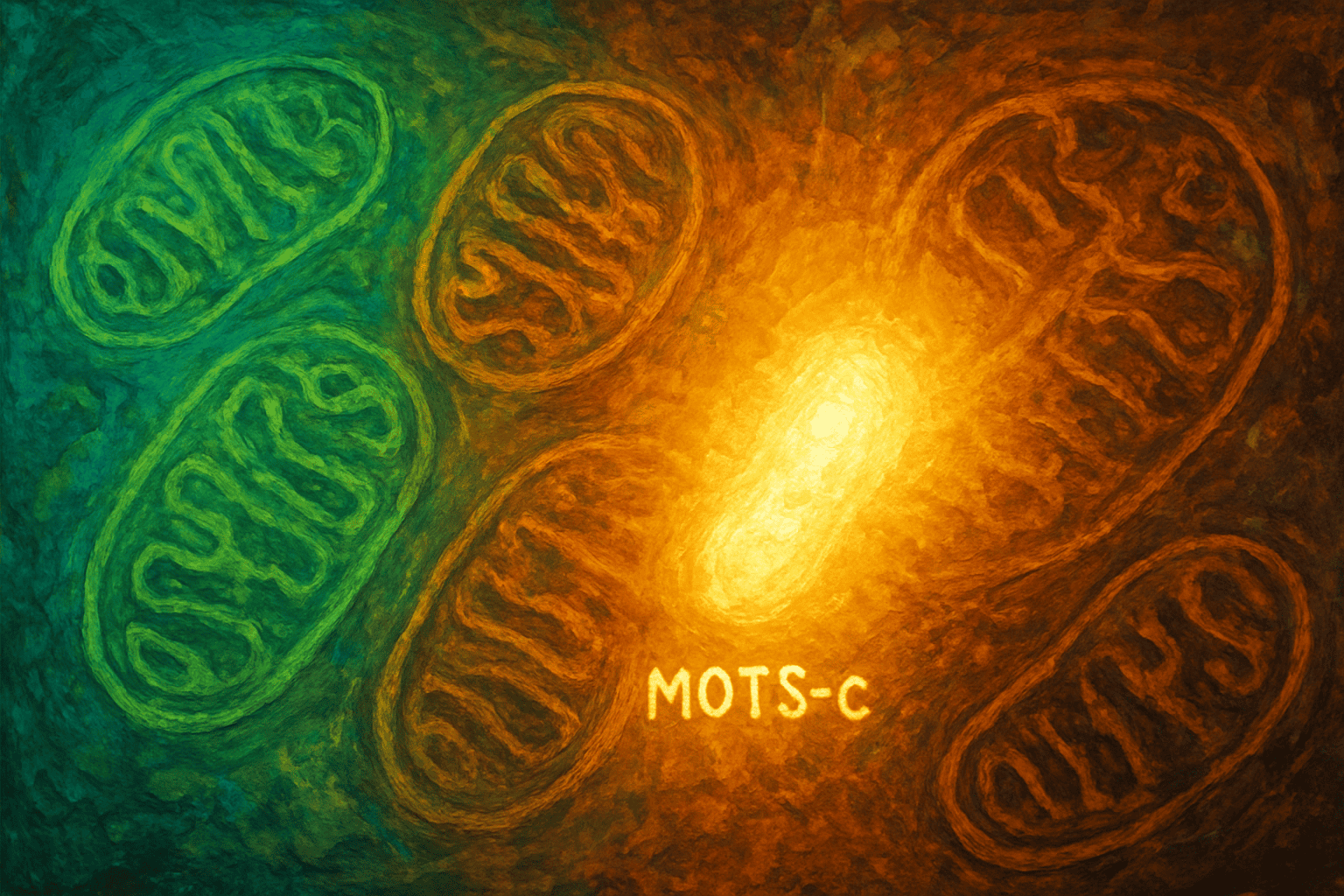
One of the most active areas of investigation for this mitochondrial peptide is MOTS-c aging research. Scientists have observed that MOTS-c levels appear to decline with age in animal models, and they want to understand what role — if any — this peptide plays in the aging process at a cellular level.
This guide reviews what published studies have found about MOTS-c and aging, why the connection makes biological sense, and what remains unknown. As always, we’ll keep it simple and stick to what the science actually says.
For background, see our MOTS-c beginner’s guide.
TL;DR: MOTS-c aging research has found that circulating levels of this mitochondrial peptide decline with age in preclinical models. Mohtashami et al. (2022) reviewed MOTS-c in the context of aging and age-related research (PMID: 36233287). The original discovery by Lee et al. (2015) noted metabolic connections relevant to aging biology (PMID: 25738459). All data is preclinical. For research use only. Not for human consumption.
The Aging-Mitochondria Connection
Before looking at MOTS-c aging research specifically, it helps to understand why mitochondria and aging are linked. The “mitochondrial theory of aging” is one of the most studied hypotheses in gerontology (aging science). Here’s the simplified version:
- Mitochondria produce energy (ATP) but also produce reactive oxygen species (ROS) as byproducts — like how a car engine produces exhaust.
- Over time, ROS damage mitochondrial DNA, which has limited repair mechanisms.
- Damaged mitochondrial DNA produces less efficient energy machinery.
- Less efficient mitochondria produce more ROS (a vicious cycle).
- Eventually, cellular energy production declines, contributing to the cellular changes associated with aging.
If MOTS-c is a signaling peptide produced by mitochondrial DNA, and mitochondrial DNA accumulates damage over time, it’s logical to ask: does MOTS-c production decline with age? And if so, what does that mean?
What MOTS-c Aging Research Has Found

Several preclinical observations have driven interest in MOTS-c aging research:
Declining Levels With Age
Studies measuring MOTS-c in blood samples from animal models have found that circulating MOTS-c levels decrease with age. Older animals consistently show lower MOTS-c levels than younger ones of the same species.
Metabolic Function Overlap
The metabolic changes observed when MOTS-c is administered to animal models (improved glucose handling, enhanced insulin sensitivity, AMPK activation) overlap with metabolic functions that decline during aging. This correlation — while not proof of causation — is what makes MOTS-c aging research compelling.
Exercise Connection
Exercise is the single most effective intervention for maintaining metabolic health during aging. The fact that both exercise and MOTS-c activate the AMPK pathway adds another layer to the aging connection. See our MOTS-c and exercise research guide for details.
Mohtashami et al. (2022) reviewed MOTS-c as the most recent mitochondrial-derived peptide studied in the context of human aging and age-related research, examining the evidence for declining levels and metabolic implications. (PMID: 36233287)
What This Doesn’t Mean

MOTS-c aging research is promising but early-stage. It’s important to be clear about what the current data does NOT show:
- MOTS-c is not an “anti-aging” compound — No peptide has been proven to reverse or prevent aging in humans. Aging is extraordinarily complex, involving thousands of biological processes.
- Correlation is not causation — MOTS-c levels decline with age, but we don’t know if this decline causes age-related changes or is simply a consequence of other aging processes.
- Animal models have limitations — Mice age differently than humans. Metabolic pathways, lifespans, and disease patterns don’t translate directly.
- No human clinical trials — MOTS-c aging research in humans is limited to observational measurements. No intervention trials have established benefits of MOTS-c supplementation in aging humans.
The Research Questions Ahead
Scientists working on MOTS-c aging research are pursuing several key questions:
- Does restoring MOTS-c levels in aged animals improve metabolic parameters?
- What is the mechanism by which MOTS-c production declines with age?
- Are there genetic variations in the MOTS-c gene that affect aging differently?
- Do MOTS-c levels in humans follow the same age-related decline seen in animal models?
Lee et al. (2015) established the foundation for MOTS-c metabolic research, demonstrating effects on glucose homeostasis and obesity in preclinical models — observations that directly inform aging-related research questions. (PMID: 25738459)
Alpha Peptides offers research-grade MOTS-c for scientists investigating mitochondrial biology and aging. See also SS-31 for complementary mitochondrial research. All products include batch-specific COAs.
Frequently Asked Questions
Does MOTS-c decline with age?
Published preclinical research has found that circulating MOTS-c levels decrease with age in animal models. Whether this is a cause or consequence of aging-related changes remains under investigation.
Is MOTS-c an anti-aging peptide?
No. MOTS-c aging research has identified interesting correlations between this peptide and metabolic changes associated with aging, but no evidence establishes MOTS-c as an anti-aging intervention. It is a research tool, not a treatment.
Can MOTS-c reverse aging?
There is no evidence that MOTS-c or any single compound can reverse aging. Aging is a complex process involving thousands of biological pathways. MOTS-c is studied as a research tool for understanding specific metabolic aspects of aging biology.
Where can I read the research?
Key papers include Lee et al. (2015) in Cell Metabolism (PMID: 25738459) and Mohtashami et al. (2022) in International Journal of Molecular Sciences (PMID: 36233287).
For research use only. Not for human consumption. This article is intended for informational purposes and does not constitute medical advice, dosing guidance, or therapeutic recommendations.