
· For research use only. Not for human consumption.
For research use only. Not for human consumption.
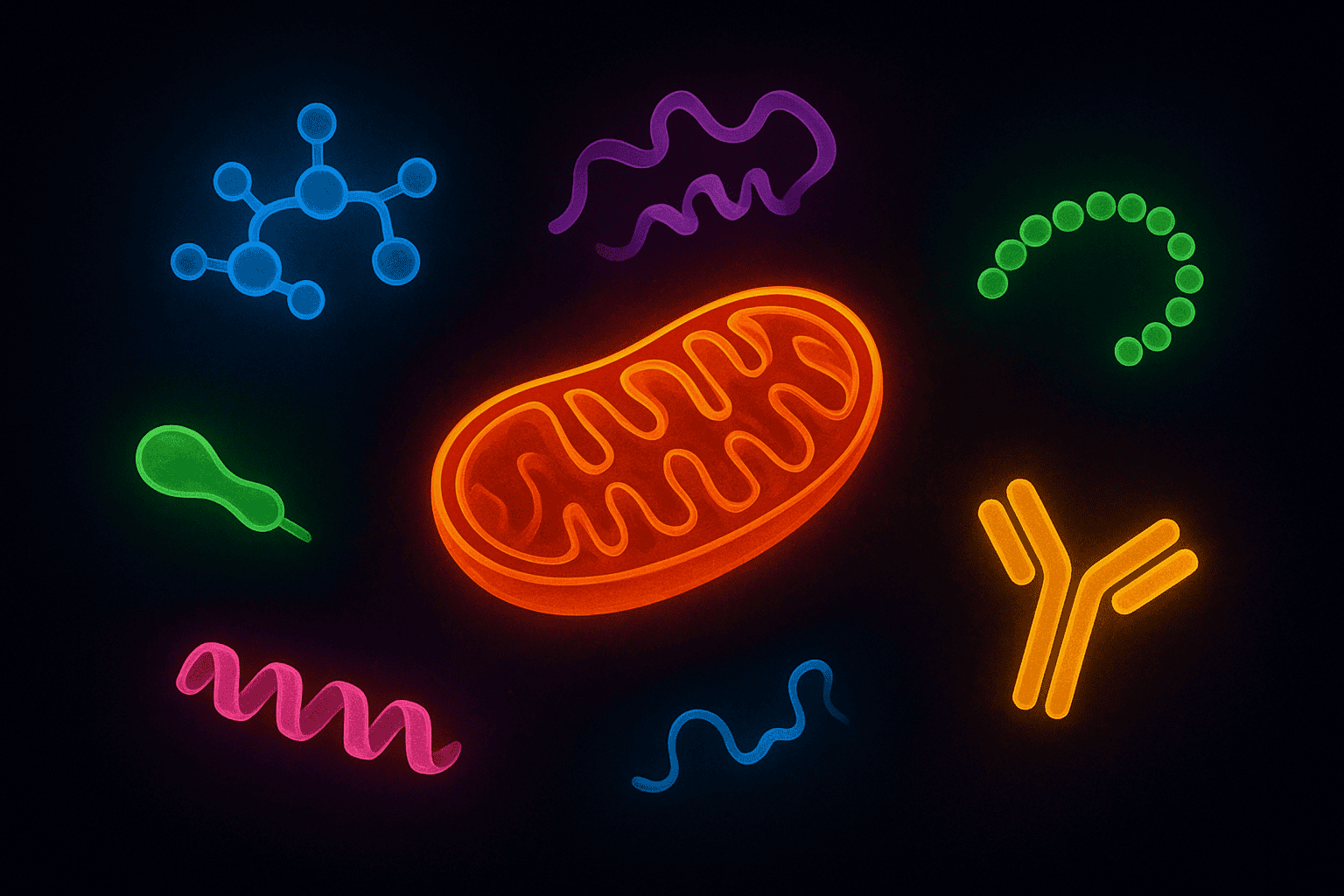
Mitochondria research peptides have become essential tools in modern cell biology. As scientists dig deeper into how cells produce energy, manage stress, and communicate internally, peptides that either come from or target mitochondria are playing an increasingly important role in laboratory research.
This guide surveys the peptide tools available for mitochondrial research in 2026, explains what each one does, and helps you understand which might be relevant for your research questions.
For individual deep dives, see our guides on MOTS-c and SS-31 vs MOTS-c.
TL;DR: Mitochondria research peptides fall into two categories: naturally encoded (MOTS-c, Humanin, SHLPs) and synthetically designed (SS-31/Elamipretide, other Szeto-Schiller peptides). Each targets different aspects of mitochondrial biology. Published research on MOTS-c (Lee et al., 2015) and SS-31 (Mitchell et al., 2020) continues to expand. For research use only. Not for human consumption.
Mitochondria research peptides: Category 1: Mitochondria-Derived Peptides (MDPs)
These mitochondria research peptides are encoded by mitochondrial DNA itself. They’re produced naturally by cells and act as signaling molecules. The discovery that mitochondrial DNA produces signaling peptides was relatively recent and has opened an entire new field.
MOTS-c
Discovered in 2015 by Lee et al., MOTS-c is a 16-amino-acid peptide encoded by the 12S rRNA gene of mitochondrial DNA. It activates the AMPK pathway and has been studied for metabolic effects in preclinical models. Alpha Peptides carries research-grade MOTS-c.
Humanin
Discovered in 2001, Humanin was the first identified mitochondria-derived peptide. It’s a 24-amino-acid peptide encoded by the 16S rRNA gene of mtDNA. Humanin research focuses on neuroprotection and cell survival signaling.
SHLPs (Small Humanin-Like Peptides)
A family of peptides discovered after Humanin, also encoded by the 16S rRNA region. At least six SHLPs have been identified (SHLP1-6), each with distinct biological activities observed in preclinical studies.
Lee et al. (2015) identified MOTS-c and characterized it as a mitochondrial-derived peptide with metabolic regulatory functions, establishing a new category of mitochondrial signaling molecules. (PMID: 25738459)
Category 2: Mitochondria-Targeted Synthetic Peptides
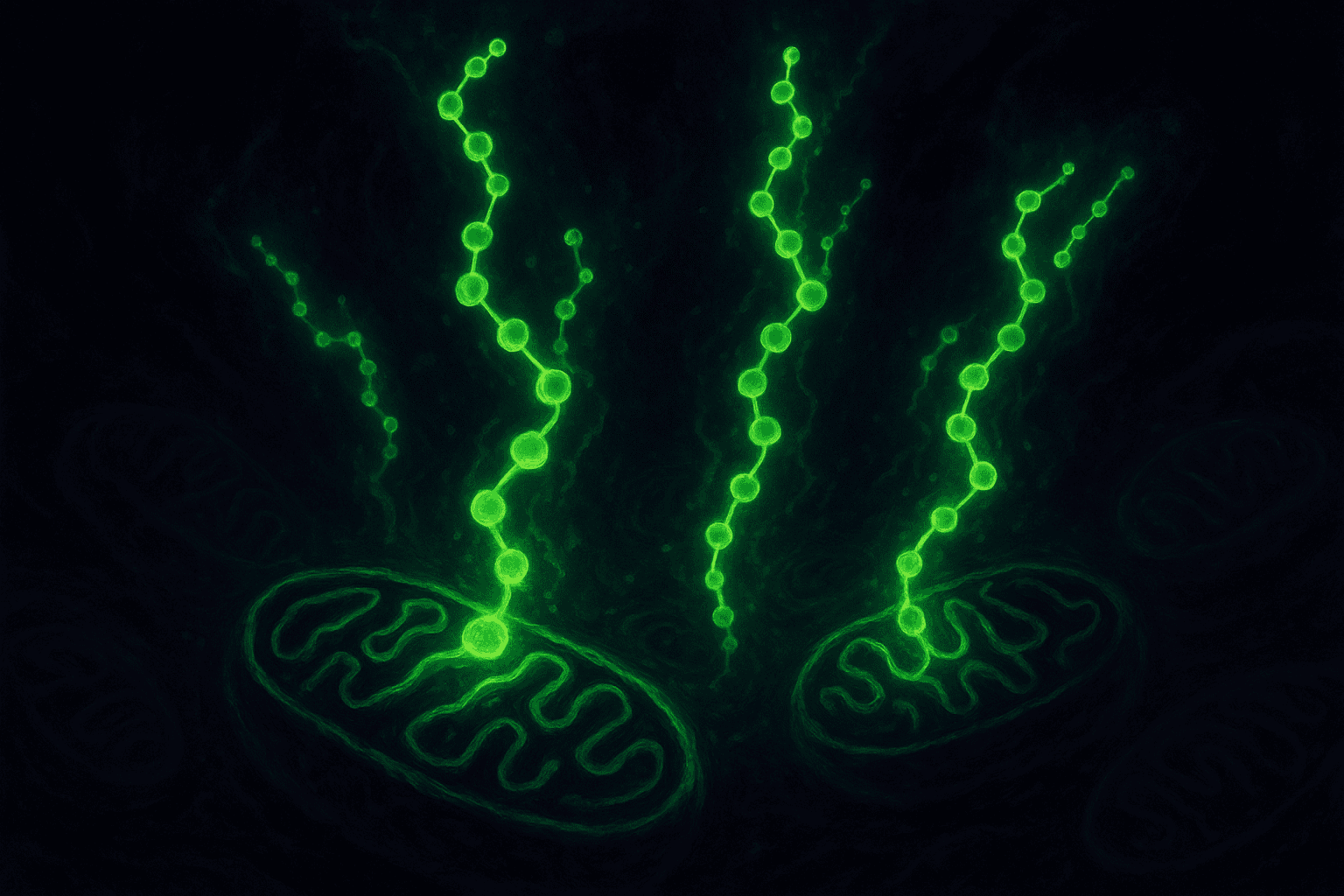
These mitochondria research peptides don’t come from mitochondrial DNA — they’re designed in labs to penetrate cell membranes and accumulate specifically in mitochondria. They use chemical properties (positive charge + hydrophobicity) to navigate cellular barriers.
SS-31 (Elamipretide)
The most studied mitochondria-targeted peptide. SS-31 is a synthetic tetrapeptide (D-Arg-Dmt-Lys-Phe-NH2) that binds to cardiolipin in the inner mitochondrial membrane. Alpha Peptides carries research-grade SS-31.
Other Szeto-Schiller Peptides
SS-31 belongs to a series of peptides with mitochondrial targeting properties. Other compounds in the series (SS-02, SS-20) have also been studied but SS-31 has the most extensive publication record.
Mitchell et al. (2020) characterized SS-31’s mechanism of action, demonstrating its binding to mitochondrial lipid bilayers and interaction with cardiolipin at the inner membrane. (PMID: 32273339)
Choosing the Right Tool for Your Research

The choice between mitochondria research peptides depends on your research question:
- Studying mitochondrial signaling? → MOTS-c (a natural mitochondrial signal)
- Studying mitochondrial membrane biology? → SS-31 (targets the inner membrane directly)
- Studying metabolic pathways? → MOTS-c (activates AMPK, a metabolic master switch)
- Studying energy production efficiency? → SS-31 (interacts with electron transport chain components via cardiolipin)
- Need both perspectives? → Both peptides can be used in complementary experiments
The Growing Field of Mitochondrial Peptide Research
The field of mitochondria research peptides has exploded since MOTS-c’s discovery in 2015. Researchers are now investigating whether additional undiscovered peptides are encoded by mitochondrial DNA, how these peptides change with age, and whether synthetic analogs can be designed with enhanced properties.
In 2026, mitochondrial peptide research sits at the intersection of metabolism, aging biology, and drug development — making it one of the most active areas in peptide science. Both MOTS-c and SS-31 from Alpha Peptides come with batch-specific Certificates of Analysis.
Frequently Asked Questions
What are mitochondria research peptides?
Mitochondria research peptides are small proteins that either originate from mitochondrial DNA (like MOTS-c and Humanin) or are synthetically designed to target mitochondria (like SS-31). They serve as tools for studying mitochondrial biology in laboratory settings.
Which mitochondrial peptide should I use for my research?
It depends on your research question. MOTS-c is best for studying mitochondrial signaling and metabolic pathways. SS-31 is best for studying mitochondrial membrane biology and energy production efficiency.
Are there more mitochondrial peptides to be discovered?
Likely yes. The mitochondrial genome has only been partially explored for peptide-encoding regions. Researchers believe additional mitochondria-derived peptides may exist and are actively searching for them.
Can I use these peptides for medical purposes?
No. All mitochondria research peptides sold by Alpha Peptides are for laboratory and scientific research only. They are not approved for human medical use.
For research use only. Not for human consumption. This article is intended for informational purposes and does not constitute medical advice, dosing guidance, or therapeutic recommendations.