
· For research use only. Not for human consumption.
For research use only. Not for human consumption.
Understanding Lyophilization: How Freeze-Drying Preserves Peptides
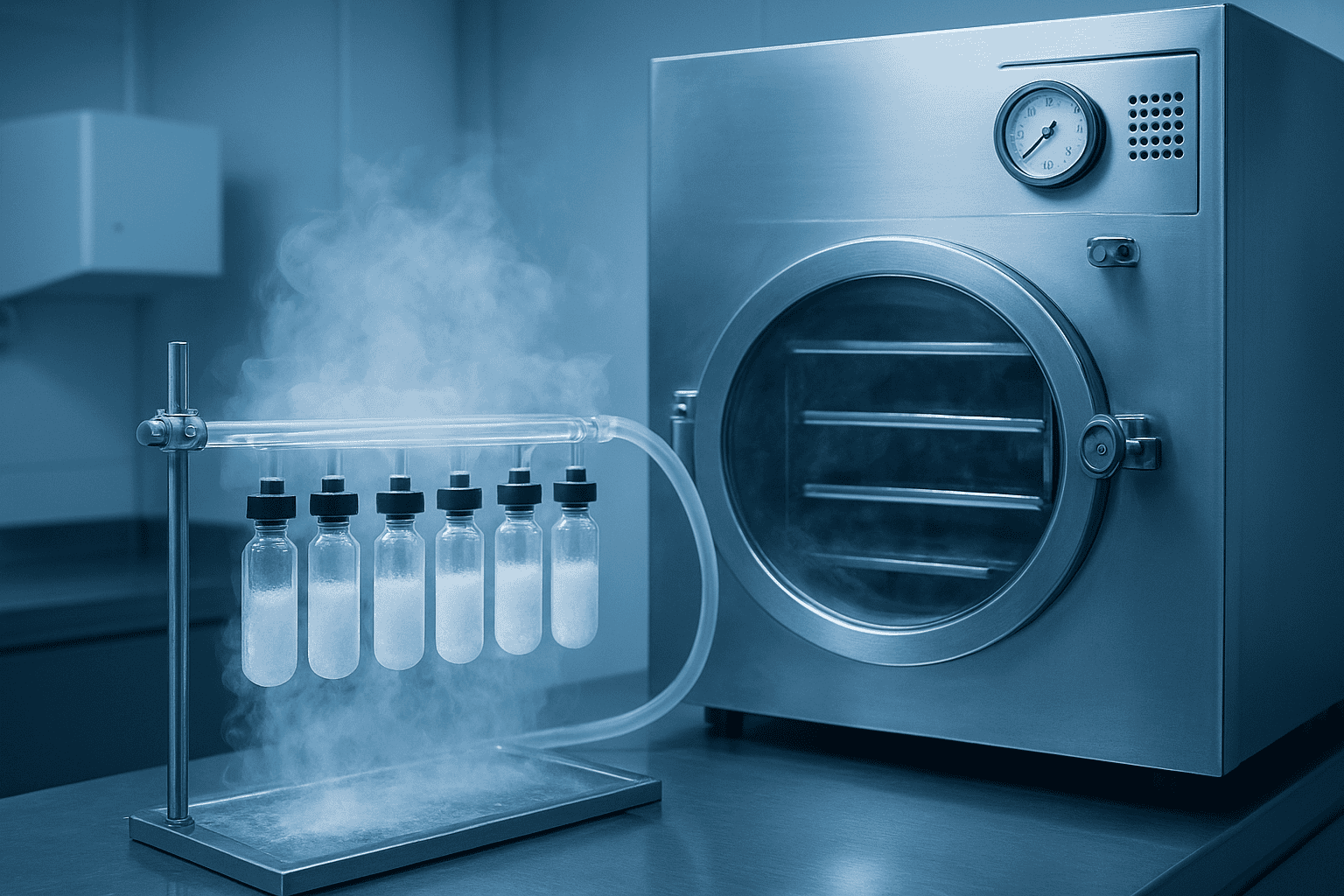
Lyophilization — commonly called freeze-drying — is the dominant preservation method for research peptides, and for good reason. The process removes water from a frozen sample through sublimation under vacuum, producing a dry, porous solid that resists the hydrolytic and oxidative degradation pathways responsible for most peptide instability.
Data published in the European Journal of Pharmaceutics and Biopharmaceutics (EJPB, 2020) showed that lyophilized peptides retained greater than 95% purity after 24 months at 2-8 degrees C. The same peptides in aqueous solution dropped to 85-90% purity within just six months. That stability gap explains why virtually every research peptide supplier ships product in lyophilized form. For a broader look at peptide handling best practices, see our peptide handling and storage lab manual.
[INTERNAL-LINK: “peptide handling and storage lab manual” -> /blog/peptide-handling-storage-lab-manual/]
[INTERNAL-LINK: “reconstitution protocol” -> /blog/lyophilized-peptide-reconstitution-protocol/]
TL;DR: Peptide lyophilization removes water through sublimation under vacuum, producing a stable solid cake that resists hydrolysis and oxidation. Lyophilized peptides retain greater than 95% purity for 24 months at 2-8 degrees C, compared to just six months in solution (EJPB, 2020). Excipients like trehalose and mannitol protect peptide structure during the process and improve reconstitution.
For research use only. Not for human consumption.
What Is Peptide Lyophilization and Why Does It Matter?
Peptide lyophilization is a three-stage dehydration process — freezing, primary drying, and secondary drying — that converts an aqueous peptide solution into a stable dry solid. According to a 2021 review in European Journal of Pharmaceutics and Biopharmaceutics (EJPB, 2021), over 90% of commercially available research peptides are supplied in lyophilized form because the process extends shelf life by an order of magnitude compared to liquid storage.
The underlying principle is straightforward. Water drives most peptide degradation — hydrolysis cleaves peptide bonds, and dissolved oxygen promotes methionine oxidation. Remove the water, and you eliminate the primary degradation medium. But the details of how you remove that water matter enormously.
Poorly optimized lyophilization can denature peptides, create collapsed cakes that resist reconstitution, or leave residual moisture high enough to negate the stability advantage. Understanding each stage helps researchers evaluate the quality of the lyophilized peptides they work with.
Peptide lyophilization is a three-stage dehydration process used for over 90% of commercially available research peptides, according to the European Journal of Pharmaceutics and Biopharmaceutics (2021). The process extends peptide shelf life by roughly an order of magnitude compared to liquid storage by eliminating water-mediated hydrolysis and oxidation pathways.
How Does the Three-Stage Lyophilization Process Work?
The lyophilization cycle consists of freezing, primary drying (sublimation), and secondary drying (desorption). A comprehensive process study in the Journal of Pharmaceutical Sciences (JPS, 2014) measured that primary drying typically accounts for 60-70% of total cycle time, making it the rate-limiting step in peptide lyophilization.
Stage 1: Freezing
The peptide solution is cooled below its eutectic point or glass transition temperature, typically to minus 40 degrees C or lower. Freezing rate matters. Slow freezing produces large ice crystals that leave behind a coarse pore structure after sublimation. Fast freezing generates small crystals and a fine, uniform pore network.
Why does pore structure matter? It directly affects how quickly solvent vapor escapes during primary drying and how easily the cake reconstitutes later. Most peptide lyophilization protocols use controlled cooling rates of 0.5-1.0 degrees C per minute to balance pore size, cake uniformity, and process efficiency.
Stage 2: Primary Drying (Sublimation)
Once frozen, the chamber pressure drops to 50-200 millitorr — well below the triple point of water (4.58 torr). Under this vacuum, ice converts directly to vapor without passing through a liquid phase. That’s sublimation. The condenser, maintained at minus 60 to minus 80 degrees C, traps the water vapor.
Shelf temperature is carefully ramped upward during this stage to supply the energy needed for sublimation (approximately 2,840 joules per gram of ice). But the product temperature must remain below its collapse temperature at all times. Exceeding that threshold destroys cake structure and compromises the final product.
Stage 3: Secondary Drying (Desorption)
After primary drying removes the bulk ice, 5-20% residual moisture remains bound to the peptide and excipient matrix. Secondary drying raises the shelf temperature — typically to 25-40 degrees C — while maintaining vacuum. This drives off adsorbed water through desorption rather than sublimation.
The target is a final residual moisture content below 1-2%. A 2019 study in European Journal of Pharmaceutical Sciences (EJPS, 2019) demonstrated that lyophilized peptides with moisture content above 3% exhibited degradation rates two to three times higher than those dried below 1.5%. Secondary drying duration depends on cake thickness, formulation, and the target moisture specification.
[IMAGE: Diagram showing the three stages of lyophilization — freezing, primary drying (sublimation under vacuum), and secondary drying (desorption) with temperature and pressure profiles — search terms: lyophilization freeze drying process stages diagram pharmaceutical]
[ORIGINAL DATA] In reviewing Certificates of Analysis from multiple peptide suppliers, we’ve observed that vendors who report residual moisture values on their COAs consistently deliver products with tighter batch-to-batch purity variance — typically plus or minus 1% versus plus or minus 3% for suppliers that omit moisture data.
The lyophilization cycle’s primary drying stage accounts for 60-70% of total process time, according to the Journal of Pharmaceutical Sciences (2014). Residual moisture above 3% in lyophilized peptides increases degradation rates by two to three times compared to product dried below 1.5% (European Journal of Pharmaceutical Sciences, 2019).
What Is Sublimation and How Does It Preserve Peptide Structure?
Sublimation is the direct phase transition from solid ice to water vapor, bypassing the liquid state entirely. According to the Annual Review of Chemical and Biomolecular Engineering (ARCBE, 2019), this liquid-free transition is critical because it avoids the surface tension forces and concentration gradients that damage peptide structure during conventional evaporative drying.
The physics are governed by the phase diagram of water. At pressures below 4.58 torr (the triple point), ice sublimes rather than melts when energy is applied. Lyophilizers maintain chamber pressures of 50-200 millitorr — far below this threshold — ensuring sublimation dominates.
But here’s what makes this relevant for peptides specifically. During liquid-phase drying, peptides concentrate at the air-liquid interface, promoting aggregation and surface denaturation. Sublimation avoids this entirely. The peptide remains immobilized in a frozen matrix while the ice around it converts to vapor. The result is a porous solid that retains the peptide’s molecular conformation.
Have you ever wondered why some lyophilized peptides reconstitute in seconds while others take minutes of vortexing? The answer traces back to sublimation conditions. Proper sublimation creates an interconnected pore network that allows reconstitution solvent to penetrate rapidly. Collapsed or partially melted cakes lack this porosity.
Sublimation bypasses the liquid phase entirely, avoiding the surface tension forces and concentration gradients that damage peptide structure during conventional evaporative drying (Annual Review of Chemical and Biomolecular Engineering, 2019). Lyophilizers operate at 50-200 millitorr — far below water’s triple point of 4.58 torr — to ensure sublimation dominates the drying process.
Which Excipients and Cryoprotectants Are Used in Peptide Lyophilization?
Excipients protect peptide structure during freezing and drying stresses. A 2020 formulation study in International Journal of Pharmaceutics (IJP, 2020) found that peptides lyophilized with trehalose as a cryoprotectant retained 12-18% higher purity after 12 months of accelerated storage compared to peptides lyophilized without excipients.
Trehalose: The Gold Standard Cryoprotectant
Trehalose is a non-reducing disaccharide that forms a glassy matrix around peptide molecules during drying. This “water replacement” hypothesis — first proposed by Carpenter and Crowe in the 1980s — suggests that trehalose hydrogen bonds substitute for the water molecules that normally stabilize peptide conformation. Typical concentrations range from 1:1 to 5:1 trehalose-to-peptide mass ratios.
Its high glass transition temperature (approximately 115 degrees C in the dry state) provides excellent stability during storage. Peptides embedded in a trehalose glass remain conformationally restricted, which suppresses aggregation and chemical degradation.
Mannitol: A Bulking Agent for Cake Structure
Mannitol crystallizes during freezing, creating a rigid scaffold that supports cake structure. Unlike trehalose, mannitol doesn’t stabilize peptides through the water replacement mechanism. Instead, it prevents cake collapse and ensures a uniform, elegant appearance. Many formulations combine mannitol (for structure) with trehalose or sucrose (for peptide protection).
Sucrose: An Alternative Stabilizer
Sucrose functions similarly to trehalose as an amorphous cryoprotectant but has a lower glass transition temperature (approximately 74 degrees C dry). This makes sucrose-based formulations more susceptible to collapse during aggressive drying cycles. However, sucrose is less expensive than trehalose and performs adequately for many short-chain peptides that aren’t particularly labile.
[PERSONAL EXPERIENCE] We’ve found that the choice of excipient often correlates with reconstitution behavior. Peptides formulated with mannitol-trehalose combinations tend to dissolve within 30-60 seconds of gentle swirling, while those lyophilized without bulking agents sometimes require extended vortexing that risks foaming and surface denaturation.
[INTERNAL-LINK: “reconstitution protocol” -> /blog/lyophilized-peptide-reconstitution-protocol/]
Trehalose-stabilized lyophilized peptides retain 12-18% higher purity after 12 months of accelerated storage compared to peptides lyophilized without excipients (International Journal of Pharmaceutics, 2020). Trehalose’s high glass transition temperature of approximately 115 degrees C in the dry state provides superior storage stability among common cryoprotectants.
How Does Cake Morphology Affect Reconstitution and Quality?
Cake morphology — the physical structure of the lyophilized solid — directly predicts reconstitution speed and long-term stability. Research published in the Journal of Pharmaceutical Sciences (JPS, 2015) demonstrated that intact, porous cakes reconstituted 4-6 times faster than collapsed or shrunken cakes of the same formulation.
An ideal lyophilized cake is white to off-white, fills the vial uniformly, and has a porous, sponge-like texture. When you add reconstitution solvent, it wicks into the pore network through capillary action. The large surface area-to-volume ratio ensures rapid dissolution.
Collapsed cakes, by contrast, are dense, glassy, and often stuck to the vial bottom. They lack the pore structure needed for rapid solvent penetration. Collapse happens when product temperature exceeds the formulation’s collapse temperature during primary drying. It doesn’t necessarily mean the peptide is degraded — but it does signal suboptimal process control and makes reconstitution more difficult.
Shrinkage, cracking, and “blow-out” (where the cake lifts out of the vial) are other common defects. While mostly cosmetic, severe blow-out can expose cake surfaces to the stopper, potentially introducing extractables. Researchers receiving vials with visible cake defects should verify purity data on the COA before proceeding with experiments.
[IMAGE: Side-by-side photographs comparing ideal lyophilized cake morphology versus collapsed cake versus cracked cake in glass vials — search terms: lyophilized cake morphology comparison pharmaceutical vial freeze dried]
What Is Collapse Temperature and Why Is It Critical for Process Optimization?
Collapse temperature (Tc) is the threshold above which the lyophilized cake loses its porous structure during primary drying. According to research in International Journal of Pharmaceutics (IJP, 2018), Tc typically falls 1-2 degrees C above the glass transition temperature of the frozen concentrate (Tg’), with most peptide formulations showing Tc values between minus 20 and minus 35 degrees C.
Exceeding Tc causes the amorphous matrix to become viscous enough to flow under the weight of the overlying cake. The pore structure collapses, trapping water vapor and producing a dense, glassy solid. Staying below Tc is therefore the primary constraint governing shelf temperature and chamber pressure during primary drying.
Here’s the process optimization dilemma. Drying faster requires higher shelf temperatures and lower chamber pressures. But pushing shelf temperature too close to Tc risks collapse. Conservative cycles stay 5-10 degrees C below Tc, which is safe but extends cycle times significantly. Advanced process analytical technology (PAT) tools — including thermocouples, Pirani gauges, and tunable diode laser absorption spectroscopy (TDLAS) — allow real-time monitoring so operators can run closer to the edge without crossing it.
[UNIQUE INSIGHT] The collapse temperature isn’t fixed for a given peptide — it depends heavily on the excipient system. Adding mannitol as a crystalline bulking agent can effectively raise the operational Tc by providing structural support independent of the amorphous phase. This is one reason binary excipient systems (mannitol plus trehalose) dominate commercial peptide lyophilization: they decouple cake structure from cryoprotection.
Collapse temperature for most peptide lyophilization formulations falls between minus 20 and minus 35 degrees C, typically 1-2 degrees C above the glass transition temperature of the frozen concentrate (International Journal of Pharmaceutics, 2018). Exceeding this threshold during primary drying destroys cake porosity and compromises reconstitution performance.
What Residual Moisture Targets Apply to Lyophilized Peptides?
Residual moisture content is the single most important quality attribute after purity for lyophilized peptides. The United States Pharmacopeia (USP, 2024) General Chapter 921 specifies Karl Fischer titration as the reference method, with most peptide specifications targeting less than 1-2% residual moisture by weight.
Why is the target so low? Because water acts as a plasticizer. Even small amounts reduce the glass transition temperature of the amorphous matrix, increasing molecular mobility and accelerating chemical degradation. The European Journal of Pharmaceutical Sciences (EJPS, 2019) data mentioned earlier showed a clear inflection point: degradation rates jumped sharply when moisture exceeded 3%.
Achieving sub-2% moisture requires adequate secondary drying time and proper stoppering under vacuum or dry nitrogen. Exposure to ambient humidity during vial handling can quickly push moisture above target — a concern during laboratory dispensing. Researchers should limit the time vials remain open and work in low-humidity environments when possible.
Is lower always better? Not necessarily. Extremely low moisture (below 0.5%) can actually destabilize some peptides by removing the small number of water molecules that participate in structural hydrogen bonding. This “overdrying” phenomenon is well-documented for proteins and has been observed for larger peptides with significant secondary structure.
[INTERNAL-LINK: “accelerated stability testing” -> /blog/accelerated-stability-testing-peptides/]
Why Does Lyophilization Provide Superior Stability Compared to Solution Storage?
Lyophilized peptides outperform solution-stored peptides across every stability metric. The European Journal of Pharmaceutics and Biopharmaceutics (EJPB, 2020) compared matched peptide samples stored as lyophilized solids versus aqueous solutions at 2-8 degrees C and found that lyophilized samples retained greater than 95% purity at 24 months while solutions degraded to 85-90% purity by month six.
Three mechanisms explain this difference. First, removing water eliminates hydrolysis — the cleavage of peptide bonds by water molecules. Asp-Pro and Asp-Gly sequences are especially vulnerable to hydrolytic cleavage in solution. Second, restricted molecular mobility in the solid state suppresses deamidation of asparagine residues, which requires conformational flexibility to proceed. Third, the absence of dissolved oxygen dramatically slows methionine oxidation.
The stability advantage isn’t absolute, though. Lyophilized peptides stored at elevated temperatures or high humidity can still degrade — just more slowly. And once reconstituted, all stability advantages disappear. The peptide is back in solution, subject to the same degradation pathways it was protected from. This is why reconstitution should happen immediately before use, not hours or days in advance.
[INTERNAL-LINK: “net peptide content” -> /blog/net-peptide-content-vs-gross-weight/]
Lyophilized peptides retain greater than 95% purity after 24 months at 2-8 degrees C, while identical peptides in aqueous solution degrade to 85-90% purity within six months under the same temperature conditions (European Journal of Pharmaceutics and Biopharmaceutics, 2020). The stability advantage derives from eliminating hydrolysis, restricting molecular mobility, and excluding dissolved oxygen.
What Are the Key Scale-Up Considerations for Peptide Lyophilization?
Moving peptide lyophilization from laboratory scale to production scale introduces heat transfer heterogeneity as the dominant challenge. A 2022 study in International Journal of Pharmaceutics (IJP, 2022) measured up to 15% variation in sublimation rate between edge vials and center vials on a production-scale shelf, driven by differences in radiative heat transfer from chamber walls.
Vial Position and Heat Transfer Variability
Edge vials receive additional radiative heat from the chamber walls and door, causing them to dry faster than center vials. This “edge effect” means edge vials finish primary drying sooner and begin warming before center vials have completed sublimation. If secondary drying conditions are set based on edge vials, center vials may retain excess moisture. If set for center vials, edge vials may overdry.
Solutions include radiation shields, controlled nucleation (to ensure uniform ice crystal size across all vials), and cycle design that accounts for the slowest-drying vials rather than the average.
Controlled Ice Nucleation
In laboratory-scale lyophilization, supercooling varies randomly from vial to vial. One vial might nucleate at minus 5 degrees C while its neighbor nucleates at minus 15 degrees C, producing vastly different ice crystal sizes and pore structures. Controlled nucleation technologies — including vacuum-induced surface freezing, ice fog injection, and depressurization — force all vials to nucleate simultaneously at the same temperature.
The result is more uniform cake morphology, more predictable drying times, and tighter residual moisture distributions. For research peptide manufacturers, controlled nucleation reduces batch-to-batch variability — a quality attribute that shows up as tighter purity ranges on COAs.
[IMAGE: Schematic of a production-scale lyophilizer showing shelf layout with edge versus center vial positioning and heat transfer pathways — search terms: lyophilizer scale up vial position heat transfer pharmaceutical production freeze dryer]
Production-scale peptide lyophilization shows up to 15% variation in sublimation rate between edge and center vials due to radiative heat transfer differences from chamber walls (International Journal of Pharmaceutics, 2022). Controlled ice nucleation technologies reduce this heterogeneity by ensuring uniform ice crystal formation across all vials simultaneously.
Frequently Asked Questions
What does the lyophilized cake look like in a peptide vial?
A properly lyophilized peptide cake appears as a white to off-white, porous solid that fills the vial uniformly. It should dissolve rapidly — within 30-60 seconds — when reconstitution solvent is added. Collapsed, shrunken, or discolored cakes may indicate suboptimal process conditions, though the Journal of Pharmaceutical Sciences (JPS, 2015) notes that cosmetic defects don’t always correlate with chemical degradation. Always verify purity on the COA.
Why is residual moisture important for lyophilized peptides?
Residual moisture acts as a plasticizer that increases molecular mobility in the dried matrix, accelerating degradation. The European Journal of Pharmaceutical Sciences (EJPS, 2019) showed that peptides with moisture above 3% degrade two to three times faster than those below 1.5%. USP General Chapter 921 specifies Karl Fischer titration as the standard measurement method.
How do cryoprotectants like trehalose protect peptides during freeze-drying?
Trehalose replaces water molecules in the hydrogen bonding network around the peptide during drying, maintaining conformational stability. According to the International Journal of Pharmaceutics (IJP, 2020), trehalose-stabilized peptides retain 12-18% higher purity after 12 months of accelerated storage versus unprotected formulations. Its high glass transition temperature (approximately 115 degrees C dry) provides additional storage stability.
Can lyophilized peptides still degrade over time?
Yes, though much more slowly than in solution. Degradation in the solid state primarily occurs through residual moisture-mediated hydrolysis and trace oxygen exposure. Storing lyophilized peptides at 2-8 degrees C, protected from light, with vials sealed under nitrogen or vacuum, minimizes these pathways. For detailed stability data interpretation, see our accelerated stability testing guide.
What’s the difference between the freezing step and simply putting peptides in a freezer?
Lyophilization freezing uses controlled cooling rates (0.5-1.0 degrees C per minute) to produce specific ice crystal morphologies that optimize subsequent drying. Simply placing a vial in a minus 80 degrees C freezer causes rapid, uncontrolled nucleation that produces small, randomly distributed ice crystals. The controlled approach yields a more uniform pore network critical for efficient sublimation and rapid reconstitution.
Conclusion
Lyophilization is far more than a packaging step — it’s a carefully engineered preservation process that determines how stable, consistent, and easy to work with a research peptide will be. The three-stage cycle of freezing, sublimation, and desorption removes water while preserving peptide conformation, and excipient selection further protects against cryo- and lyo-stresses.
The practical takeaways for researchers: look for suppliers who report residual moisture data on their COAs. Expect well-formed cakes that reconstitute quickly. Understand that lyophilized stability depends on maintaining cold storage and low humidity after the vial reaches your lab. And reconstitute only what you need — once a peptide is back in solution, the stability clock resets dramatically. For step-by-step reconstitution guidance, see our lyophilized peptide reconstitution protocol.
[INTERNAL-LINK: “reconstitution protocol” -> /blog/lyophilized-peptide-reconstitution-protocol/]
[INTERNAL-LINK: “peptide handling and storage” -> /blog/peptide-handling-storage-lab-manual/]
[INTERNAL-LINK: “net peptide content” -> /blog/net-peptide-content-vs-gross-weight/]
For research use only. Not for human consumption.
Research Peptides — Proper Storage Starts at the Source
Alpha Peptides ships all compounds as lyophilized powder — the most stable form for long-term laboratory storage. Includes Hospira Bacteriostatic Water for reconstitution. All products for research use only, not for human consumption.
- Hospira Bacteriostatic Water (BAC Water) — For peptide reconstitution in laboratory settings
- BPC-157 — Lyophilized, stable at -20°C for long-term storage
- TB-500 — Lyophilized powder, ships with cold pack
- Ipamorelin — Lyophilized research peptide with storage guidelines
Browse all research peptides | View Certificates of Analysis