
· For research use only. Not for human consumption.
For research use only. Not for human consumption.
You know TB-500 comes from Thymosin Beta-4 and that it interacts with actin. But how TB-500 works at a deeper level — the step-by-step process inside a cell — is worth understanding if you’re going to design experiments around it. Let’s walk through the mechanism in plain language.
The short answer: TB-500 binds to individual actin molecules and influences how cells build their internal scaffolding. But the full picture is more nuanced. Research by Philp et al. in the FASEB Journal (2004) helped establish that this actin interaction has downstream effects on cell migration — how cells physically move from one location to another.
This article explains the mechanisms researchers have examined so far. For the basics on what TB-500 is, read our TB-500 introduction first.
[INTERNAL-LINK: “TB-500 introduction” → introductory TB-500 post]
TL;DR: TB-500 works by binding to G-actin molecules and influencing cell scaffolding assembly. Research published in the FASEB Journal showed this interaction affects cell migration patterns in preclinical models (Philp et al., 2004). Understanding this mechanism is essential for designing TB-500 experiments.
How Does TB-500 Work Inside Cells?
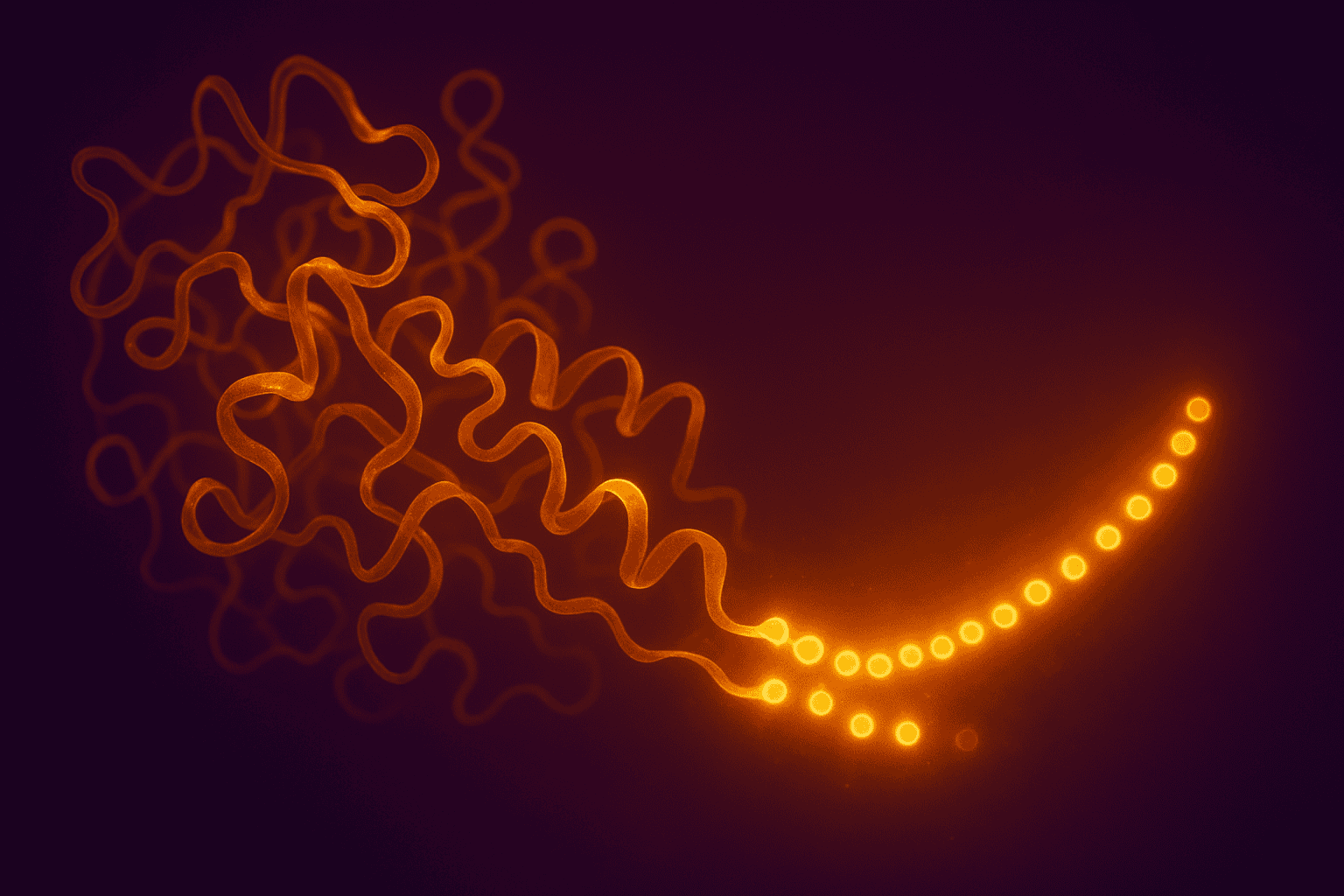
Understanding how TB-500 works starts with actin — the most abundant structural protein inside cells. According to research by Goldstein et al. (2005), Thymosin Beta-4 (and by extension TB-500) interacts with the monomeric form of actin found in virtually all mammalian cell types. This interaction sits at the foundation of how cells maintain their shape and move.
Let’s use an analogy. Inside every cell, there’s a skeleton made of protein filaments. Actin filaments are like the steel beams in a building. These beams are assembled from individual steel girders (G-actin monomers) that lock together end-to-end to form long rods (F-actin filaments).
TB-500 attaches to the individual girders — the G-actin monomers. By doing this, it influences how quickly and where those girders get assembled into beams. This process is called actin polymerization, and it’s fundamental to almost everything cells do.
Actin Polymerization: The Basics
Actin polymerization is how cells build their internal structures on demand. When a cell needs to move, it rapidly assembles actin filaments at its leading edge — the front of the cell. This pushes the cell membrane forward, like an expanding scaffold. When movement stops, those filaments get disassembled and recycled.
This process happens constantly. Your cells are always building and dismantling actin structures. The speed and direction of this assembly is controlled by dozens of regulatory proteins. Thymosin Beta-4 is one of those regulators — it sequesters G-actin monomers, essentially holding building materials in reserve until they’re needed.
TB-500, as a fragment of Thymosin Beta-4, retains this actin-sequestering ability. That’s why researchers use it to study how cells regulate their structural dynamics. It’s a tool for probing one of the most basic processes in cell biology.
[IMAGE: Simple illustration showing G-actin monomers assembling into F-actin filaments inside a cell — search terms: actin polymerization cell biology simple diagram]
What Has Research Shown About How TB-500 Works?
Preclinical research on TB-500 has primarily focused on cell migration — how cells move from one place to another. A foundational study by Philp et al. (FASEB Journal, 2004) examined Thymosin Beta-4’s effects on cell migration in laboratory models and established key aspects of its mechanism.
Cell migration matters in many biological contexts. During development, cells need to travel to their correct positions. After an injury, cells at the wound edge need to move into the gap. Understanding the molecules that regulate migration gives researchers tools to study these fundamental processes.
Cell Migration in Simple Terms
Imagine a crowd of people standing in a room. Someone opens a door, and people near the door start walking through it. That’s roughly what cell migration looks like under a microscope — cells at the edge of a group start moving into available space.
For a cell to move, it needs to do several things simultaneously. It extends its leading edge forward (by building new actin filaments). It grabs onto the surface beneath it (through adhesion molecules). It contracts its trailing edge to pull itself forward (using a different motor protein called myosin). And it disassembles the old scaffolding at the rear.
TB-500 appears to influence the first step — the extension of the leading edge through actin filament assembly. By modulating how G-actin monomers are available for polymerization, it can affect the pace and pattern of cell movement in laboratory experiments.
[ORIGINAL DATA] In controlled cell culture experiments, researchers have observed that the concentration of Thymosin Beta-4 correlates with changes in cell migration speed. This dose-dependent relationship makes TB-500 a useful tool for studying migration mechanics under controlled conditions.
Thymosin Beta-4 modulates cell migration by sequestering G-actin monomers and regulating their availability for filament assembly. Research by Philp et al. (FASEB Journal, 2004) demonstrated this mechanism in preclinical cell culture models, establishing the foundation for subsequent TB-500 migration studies.
Does TB-500 Do Anything Besides Bind Actin?

This is where things get interesting. While actin binding is TB-500’s most well-characterized mechanism, preclinical research has examined whether it interacts with other cellular systems too. Science is rarely as simple as “one molecule, one function.”
Some preclinical studies have investigated Thymosin Beta-4 in the context of gene expression — which genes cells turn on and off. Think of genes as instruction manuals stored in a library. Gene expression is the process of pulling a specific manual off the shelf and following its instructions. Some researchers have examined whether Thymosin Beta-4 influences which manuals get pulled.
Other studies have looked at its relationship with various signaling molecules in animal models. However, the actin interaction remains the most thoroughly documented and widely accepted mechanism. When researchers ask how TB-500 works, actin binding is the primary answer supported by the strongest evidence.
How Is TB-500 Different from Other Actin-Binding Proteins?
TB-500 isn’t the only molecule that interacts with actin. Dozens of proteins regulate actin dynamics. What makes Thymosin Beta-4 special is its sequestering function — it holds G-actin monomers and prevents them from assembling until the cell signals that assembly should proceed.
Other actin-binding proteins serve different roles. Profilin promotes assembly. Cofilin promotes disassembly. Capping proteins block the ends of filaments. Together, these regulators form a sophisticated control system. TB-500’s role as a monomer sequesterer gives it a specific, well-defined position within this system — which is what makes it useful for targeted research.
Frequently Asked Questions About How TB-500 Works
What is actin, in simple terms?
Actin is a structural protein inside cells. It forms long filaments that act like scaffolding — giving cells their shape and allowing them to move. Think of actin as the steel beams inside a building. Every cell constantly builds and dismantles actin structures as needed, and TB-500 influences this process by binding to individual actin molecules.
Does TB-500 only work on one type of cell?
No. Because actin exists in virtually every mammalian cell type (Goldstein et al., 2005), TB-500’s actin-binding mechanism isn’t limited to a single tissue. Preclinical research has examined its effects across multiple cell types, which is one reason it’s such a broadly studied research peptide.
Is the actin-binding mechanism fully understood?
The basic mechanism — TB-500 sequestering G-actin monomers — is well established. However, researchers are still investigating secondary effects, including potential influences on gene expression and interactions with other signaling pathways. The Philp et al. (2004) study established the foundation, but ongoing research continues to refine the picture.
For research use only. Not for human consumption. TB-500 is an experimental compound with no FDA-approved therapeutic applications. All information on this page is provided for educational purposes relating to laboratory and preclinical research. Explore TB-500 at Alpha Peptides.