
· For research use only. Not for human consumption.
For research use only. Not for human consumption.
If you’re researching how pt-141 works, you’re in the right place. Most peptides work in the bloodstream or in peripheral tissues — your skin, your gut, your muscles. PT-141 is different. It works primarily in the brain. That’s what makes it unusual among research peptides, and it’s why neuroscience researchers have paid close attention to it for over two decades.
Understanding how PT-141 works means understanding a specific receptor in the brain called MC4R and the signaling cascade it triggers. Molinoff and colleagues first characterized this mechanism in 2003, describing PT-141 as a centrally acting melanocortin agonist with preferential MC4R engagement (PMID: 12855214). This article explains how PT-141 works in terms anyone can follow.
If you’re looking for background on what PT-141 is and where it came from, start with our beginner’s guide to PT-141.
[INTERNAL-LINK: “beginner’s guide to PT-141” → /blog/what-is-pt-141-simple-guide/]
TL;DR: PT-141 works by binding to MC4R receptors in the brain, triggering a cAMP signaling cascade inside neurons. Unlike compounds that work in the bloodstream, PT-141 crosses the blood-brain barrier and acts on the central nervous system. Pfaus et al. (2004) demonstrated its central mechanism at nanomolar concentrations in preclinical models (PMID: 15163370). For research use only.
How Does PT-141 Work in the Brain?

PT-141 works through a receptor called MC4R (melanocortin 4 receptor) that sits on the surface of neurons — brain cells. Pfaus and colleagues demonstrated that PT-141 engages this receptor at nanomolar concentrations, meaning extremely small amounts are enough to trigger a response (PMID: 15163370). Here’s the step-by-step process.
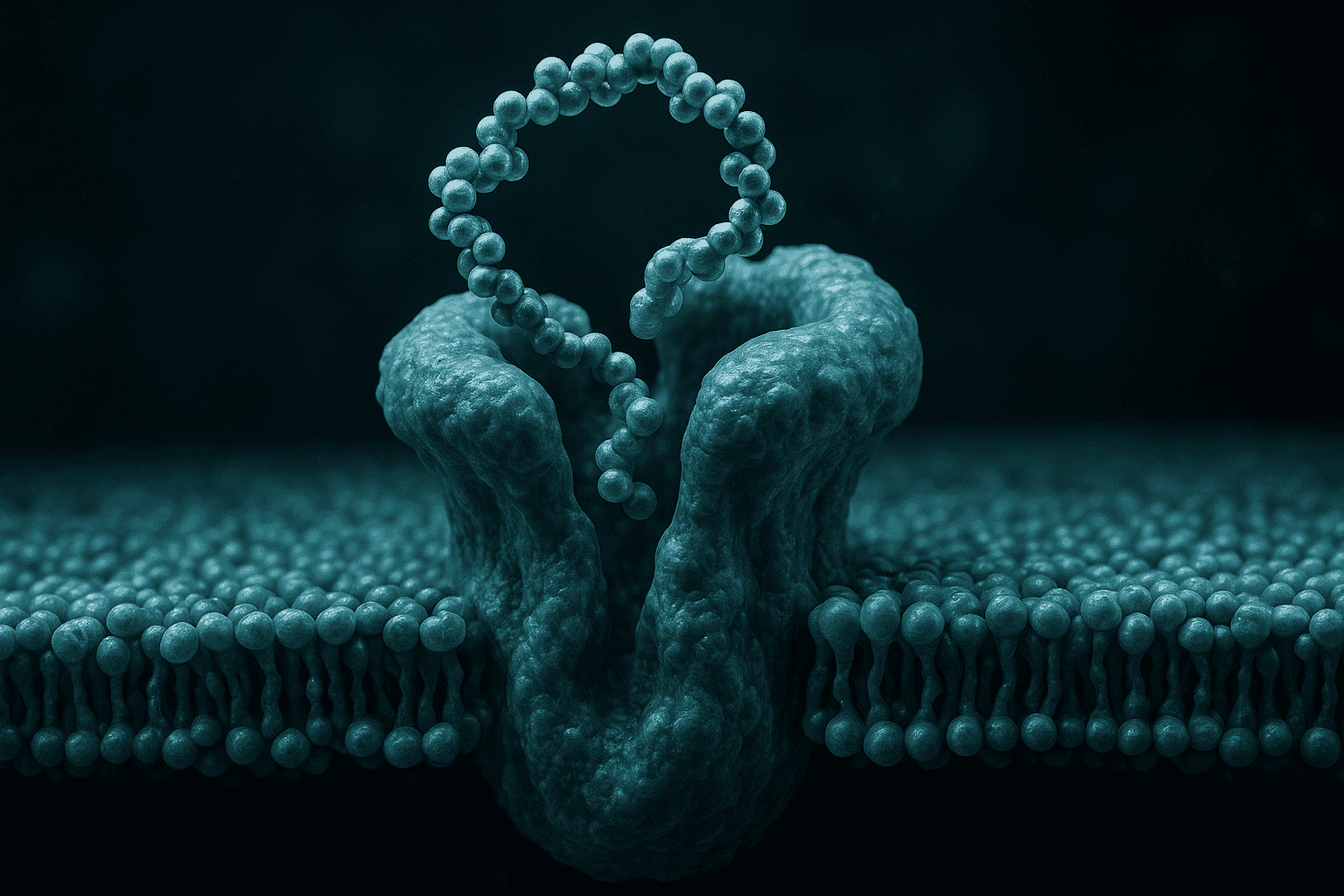
First, PT-141 crosses the blood-brain barrier. This is the protective wall between your bloodstream and your brain tissue. Many molecules can’t get through it. PT-141 can, thanks to its small size and cyclic structure. Once inside the brain, PT-141 finds MC4R receptors on neuron surfaces.
When PT-141 binds to MC4R, it activates a protein inside the cell called a G protein. Think of the G protein as a middleman. The receptor tells the G protein to switch on, and the G protein then activates an enzyme called adenylyl cyclase. This enzyme produces cyclic AMP (cAMP) — a messenger molecule that carries the signal deeper into the cell.
That cAMP signal triggers a chain of events: protein kinase A gets activated, which modifies other proteins, which ultimately changes how the neuron behaves. The entire sequence — from PT-141 binding to the final cellular response — happens in seconds.
What Is the MC4R Receptor?
MC4R is short for melanocortin 4 receptor. It belongs to the melanocortin receptor family, which includes five subtypes (MC1R through MC5R). According to published receptor mapping studies, MC4R has been detected in over 30 distinct regions of the brain, making it one of the most widely distributed melanocortin receptors in the central nervous system (Molinoff et al., 2003).
The hypothalamus contains particularly high concentrations of MC4R. The hypothalamus is like the brain’s thermostat — it monitors and adjusts basic biological functions. Other MC4R-rich areas include the limbic system (involved in emotional processing) and the brainstem (which controls automatic functions).
Why does this wide distribution matter? Because a receptor found in many brain regions can influence many different types of neural signaling. That’s what makes MC4R — and compounds that activate it like PT-141 — interesting to neuroscience researchers. It’s not a one-trick receptor. It’s a hub connected to multiple neural circuits.
Researchers study MC4R using tools like PT-141 precisely because the receptor is so broadly connected. Activating it with a known compound and then measuring what changes downstream helps scientists map out which circuits MC4R participates in.
[IMAGE: Simplified brain diagram showing MC4R distribution in hypothalamus, limbic system, and brainstem — search terms: brain melanocortin receptor MC4R distribution diagram hypothalamus]
How Does PT-141 Differ from How Melanotan II Works?

Both PT-141 and Melanotan II activate melanocortin receptors. The critical difference is which receptors they prefer. Molinoff et al. (2003) described PT-141 as having a “shifted selectivity profile” compared to Melanotan II, with greater MC4R preference and reduced MC1R activity (PMID: 12855214).
Melanotan II is non-selective. It activates MC1R (skin pigmentation), MC3R, MC4R, and MC5R all at once. It’s like turning on every light switch in a house simultaneously. Useful for seeing the whole house, but hard to tell which room is producing which effect.
PT-141, by contrast, preferentially activates MC4R while having much weaker activity at MC1R. It’s more like turning on lights in just one room. This selectivity makes it a cleaner research tool when scientists want to study MC4R-specific signaling without the noise from other receptor subtypes.
Here’s another way to think about it. Melanotan II works mostly at the surface — in melanocytes, the pigment cells of the skin. PT-141 works mostly underground — in the neurons of the brain. Same receptor family, but different members of that family, in completely different locations.
[INTERNAL-LINK: “Melanotan II” → /blog/how-melanotan-ii-works/]
[UNIQUE INSIGHT] The transition from Melanotan II to PT-141 mirrors a common pattern in drug development: start with a broad tool, observe unexpected effects, then engineer a more targeted version. In melanocortin research, this shift from peripheral to central pharmacology opened entirely new research questions about how neuropeptides modulate brain signaling.
Why Does Central Nervous System Signaling Matter?
When researchers say PT-141 works “centrally,” they mean it acts in the brain rather than in the bloodstream or peripheral tissues. This is a meaningful distinction. A compound that works in the bloodstream can affect tissues throughout the body. A compound that works in the brain affects neural circuits specifically.
Central signaling matters for research because the brain coordinates biology from the top down. The hypothalamus, where MC4R is densely concentrated, sends signals that influence the entire body. Understanding what activates those signals — and what turns them off — is fundamental to neuroscience.
PT-141’s ability to cross the blood-brain barrier and engage MC4R directly makes it a valuable probe for studying these pathways. Not all peptides can reach the brain. Many are too large or too hydrophilic (water-loving) to pass through the barrier. PT-141’s compact cyclic structure gives it the right physical properties to make the crossing.
PT-141 acts through central nervous system MC4R pathways rather than peripheral vascular mechanisms, a distinction first characterized by Molinoff et al. in 2003. Its ability to cross the blood-brain barrier and engage MC4R at nanomolar concentrations in preclinical models makes it a uniquely valuable pharmacological tool for mapping melanocortin signaling in the brain. (PMID: 12855214)
Frequently Asked Questions About How PT-141 Works

Does PT-141 work in the bloodstream or in the brain?
PT-141 primarily works in the brain. It crosses the blood-brain barrier and binds to MC4R receptors on neurons in the central nervous system. This central mechanism of action distinguishes it from many other peptides that act peripherally — in the bloodstream or in body tissues like skin or gut.
What receptor does PT-141 target?
PT-141 preferentially targets MC4R (melanocortin 4 receptor), which is widely distributed throughout the brain — particularly in the hypothalamus, limbic system, and brainstem. It also has some activity at MC3R, but its MC4R preference is what makes it useful as a targeted research tool compared to non-selective melanocortin agonists like Melanotan II.
Can researchers purchase PT-141?
Yes. Research-grade PT-141 is available from peptide suppliers that provide third-party analytical documentation. Alpha Peptides carries PT-141 with HPLC purity verification and mass spectrometry confirmation. All COA documents are available at alpha-peptides.com/coas/. For research use only.
For research use only. Not for human consumption. PT-141 is an experimental compound with no FDA-approved therapeutic applications in its research-grade form. All information on this page is provided for educational purposes relating to laboratory and preclinical research.
[INTERNAL-LINK: “PT-141” → /product/pt-141/]
[INTERNAL-LINK: “Certificates of Analysis” → /coas/]