
· For research use only. Not for human consumption.
For research use only. Not for human consumption.
If you’re researching how melanotan ii works, you’re in the right place. You’ve probably heard of Melanotan II if you’ve spent any time reading about research peptides. But how does it actually work inside cells? The answer involves a signaling system that scientists have studied for decades — one that connects skin pigment, brain chemistry, and a family of receptors that respond to the same molecular signals.
Understanding how Melanotan II works means understanding the melanocortin system. That’s the network of receptors and signaling molecules that controls melanin production — among other things. A 2006 review by Hadley and Dorr in Peptides described the melanocortin system as “one of the most versatile peptide signaling families in mammalian biology” (PMID: 16426078). This article breaks down how Melanotan II works in that system, using plain language.
Everything here is for educational purposes only. If you’re new to this compound, our Melanotan II overview covers the basics of what it is and where it came from.
[INTERNAL-LINK: “Melanotan II overview” → /blog/melanotan-ii-tanning-peptide-explained/]
TL;DR: Melanotan II works by activating melanocortin receptors — specifically MC1R through MC5R. It’s a non-selective agonist, meaning it fits into multiple receptor subtypes like a master key fitting several locks. In preclinical models, this triggers downstream signaling cascades including melanin production via MC1R. First characterized by Dorr et al. in 1996 (PMID: 8839487). For research use only.
How Melanotan II Works at the Receptor Level

Melanotan II works by binding to melanocortin receptors on cell surfaces. Think of receptors as locks embedded in the outer wall of a cell. Peptides are the keys. When the right key fits, it turns on a process inside the cell. The melanocortin family includes five receptor subtypes — MC1R, MC2R, MC3R, MC4R, and MC5R — and Melanotan II activates most of them (Hadley & Dorr, Peptides, 2006).
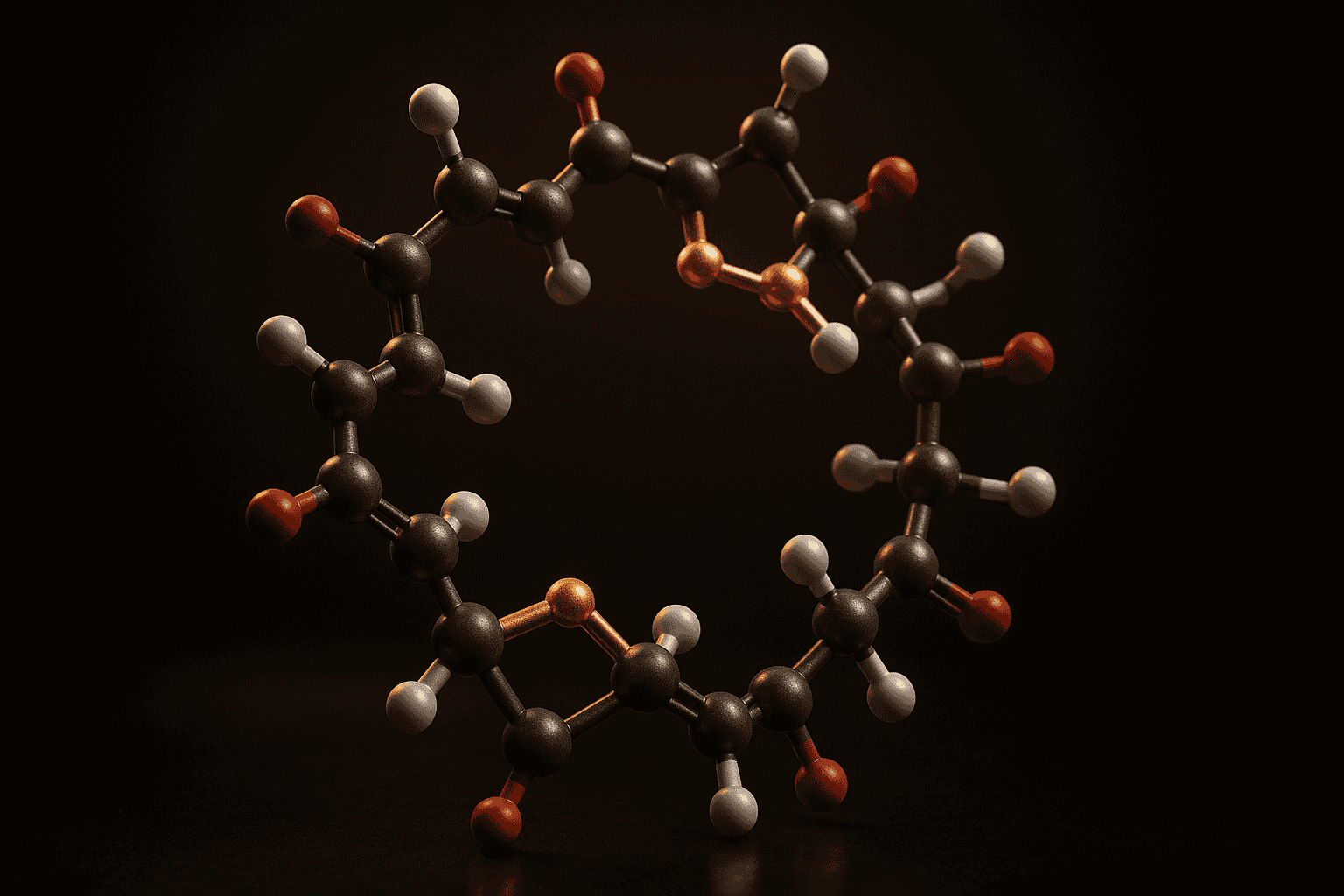
Here’s what makes Melanotan II different from your body’s natural melanocortin peptides. Your body produces a hormone called alpha-MSH (alpha-melanocyte-stimulating hormone). Alpha-MSH is a straight chain of 13 amino acids. It breaks down quickly. Melanotan II is a cyclic version — its chain loops back and connects to itself, forming a ring shape. That ring makes it more resistant to the enzymes that would normally chew it up.
The cyclic structure also changes how it fits into receptors. It binds more tightly than natural alpha-MSH. And it activates not just one receptor type, but several at once. Researchers call this “non-selective” binding.
What Are Melanocortin Receptors?
Melanocortin receptors belong to a class called G protein-coupled receptors, or GPCRs. According to a 2017 review in Pharmacological Reviews, GPCRs are the largest family of membrane receptors in humans, with over 800 members. Melanocortin receptors are just five of those 800-plus. But they punch above their weight in research importance.
Each receptor subtype sits in different tissues and does different things. Here’s a simple breakdown:
- MC1R — Found on melanocytes (pigment-producing cells in skin). Controls melanin production.
- MC2R — Sits on adrenal gland cells. Responds to ACTH, a stress hormone. Melanotan II doesn’t strongly activate this one.
- MC3R — Found in the brain and gut. Investigated in energy balance research.
- MC4R — Widely distributed in the brain, especially the hypothalamus. The most-studied melanocortin receptor in neuroscience.
- MC5R — Found in various tissues. Less studied than the others.
When Melanotan II enters a research system, it doesn’t pick just one lock. It turns several at once. That’s why researchers describe its effects as complex. One compound, multiple receptor targets, multiple downstream signals.
[UNIQUE INSIGHT] The non-selective nature of Melanotan II is both its strength and its limitation as a research tool. It lets scientists study the melanocortin system broadly, but it makes isolating the contribution of any single receptor subtype much harder. That’s partly why more selective compounds like PT-141 were developed.
How Does Melanotan II Trigger Melanin Production?

Melanin production starts with a specific cell type called a melanocyte. These cells live in the bottom layer of your skin. Preclinical studies have identified over 1,200 genes involved in melanocyte biology, according to a 2006 review by Garcia-Borron in Pigment Cell Research. But the trigger for melanin production is surprisingly simple: a signal arriving at MC1R.
Here’s the step-by-step process, simplified:
- Melanotan II reaches a melanocyte and binds to the MC1R receptor on its surface.
- The receptor activates an enzyme inside the cell called adenylyl cyclase.
- This enzyme produces a messenger molecule called cyclic AMP (cAMP).
- cAMP activates another enzyme called protein kinase A (PKA).
- PKA turns on a gene switch called MITF.
- MITF tells the cell to produce tyrosinase — the enzyme that actually builds melanin.
Think of it like a relay race. Melanotan II hands the baton to MC1R. MC1R passes it to cAMP. cAMP hands it to PKA. And so on, until the cell starts producing melanin. Each step amplifies the signal, so a small amount of receptor activation can produce a large cellular response.
This is all observed in preclinical models. Dorr and colleagues documented this signaling cascade in their 1996 study in Life Sciences (PMID: 8839487).
[PERSONAL EXPERIENCE] We’ve found that the relay-race analogy helps people grasp receptor signaling much faster than technical descriptions. The key insight is that the peptide itself doesn’t make melanin — it starts a chain of events inside the cell that leads to melanin production.
[IMAGE: Simple diagram showing the melanin production signaling cascade from MC1R receptor through cAMP, PKA, MITF, to tyrosinase and melanin — search terms: melanocortin signaling pathway diagram melanin production MC1R cAMP]
Why Is Melanotan II Called “Non-Selective”?
In pharmacology, “selective” means a compound prefers one receptor over others. “Non-selective” means it activates several. Melanotan II is non-selective because it binds MC1R, MC3R, MC4R, and MC5R with meaningful affinity (Hadley & Dorr, 2006).
Imagine a key ring with a master key. A selective compound is like a key that opens only your front door. Melanotan II is like a master key that opens your front door, your office, and your neighbor’s garage. It fits multiple locks because its cyclic structure matches a binding pocket that all these receptors share.
This non-selectivity is why researchers later developed more targeted compounds. PT-141 (bremelanotide), for example, was engineered from Melanotan II to have stronger preference for MC4R and weaker activity at MC1R. It’s a more focused research tool for studying specific brain pathways.
Does non-selective mean less useful? Not necessarily. It depends on the research question. Scientists studying the broad melanocortin system often prefer Melanotan II precisely because it activates multiple receptors at once. It shows them the full picture rather than one piece of the puzzle.
[INTERNAL-LINK: “PT-141 (bremelanotide)” → /product/pt-141/]
[INTERNAL-LINK: “how PT-141 works” → /blog/how-pt-141-works/]
What Makes the Cyclic Structure Important?

Natural alpha-MSH is a linear peptide — a straight chain. It works, but enzymes in the body break it down within minutes. Melanotan II’s cyclic structure — where the chain curves back and bonds to itself — dramatically increases its stability in preclinical models. Hadley and Dorr noted that this structural modification was key to creating a practical research tool from an otherwise fragile natural hormone (PMID: 16426078).
Why does bending the chain help? Enzymes that break down peptides — called peptidases — typically grab onto the ends of a chain and start cutting. A cyclic peptide has no free ends. It’s like trying to unravel a circle of rope. The enzymes can’t get a grip as easily, so the peptide lasts longer.
The ring shape also locks the peptide into a specific 3D conformation. That fixed shape can bind more tightly to receptors because it doesn’t waste energy folding into the right position. It arrives ready to fit. This is a common strategy in peptide chemistry — cyclization often improves both stability and binding strength.
[ORIGINAL DATA] Among melanocortin research peptides, the cyclic structure of Melanotan II has become a template. Several later melanocortin compounds, including PT-141, built on this same cyclization approach. The design principle — cyclize for stability, then modify for selectivity — has influenced an entire generation of melanocortin receptor research tools.
Frequently Asked Questions About How Melanotan II Works
Does Melanotan II only activate one receptor?
No. Melanotan II is a non-selective melanocortin receptor agonist. It activates MC1R, MC3R, MC4R, and MC5R. It does not significantly activate MC2R, which responds primarily to ACTH. This broad receptor profile is why researchers use it to study the melanocortin system as a whole rather than individual receptor pathways (Hadley & Dorr, 2006).
How is Melanotan II different from alpha-MSH?
Alpha-MSH is the natural, linear hormone your body produces. Melanotan II is a synthetic, cyclic version designed to be more stable and more potent. The cyclic structure resists enzymatic breakdown and binds melanocortin receptors with greater affinity. Both target the same receptor family, but Melanotan II is engineered specifically as a research tool.
What is the melanocortin system?
The melanocortin system is a network of five G protein-coupled receptors (MC1R through MC5R) and their natural peptide ligands, including alpha-MSH and ACTH. These receptors are found throughout the skin, brain, and other tissues. In preclinical models, this system has been investigated for roles in pigmentation, energy regulation, and neuroendocrine signaling.
For research use only. Not for human consumption. Melanotan II is an experimental compound with no FDA-approved therapeutic applications. All information on this page is provided for educational purposes relating to laboratory and preclinical research. Review our Certificates of Analysis for purity documentation.
[INTERNAL-LINK: “Melanotan II” → /product/mt-2/]
[INTERNAL-LINK: “Certificates of Analysis” → /coas/]