
· For research use only. Not for human consumption.
For research use only. Not for human consumption.
If you’re researching glp-3 receptors explained, you’re in the right place. Imagine a house with three doors. Behind each door sits a different room with different furniture, different lighting, and a different purpose. Now imagine one key that opens all three doors. That’s essentially how GLP-3 works at the molecular level — and once you understand the analogy, the science clicks into place fast.
GLP-3 is a synthetic research peptide that interacts with three separate receptor targets simultaneously. Most peptides carry one key for one door. GLP-3 carries three keys fused into a single molecule. With GLP-3 receptors explained in plain language, you don’t need a biology degree to follow along. A 2023 phase 2 trial in The Lancet examined this triple-receptor compound in 338 participants (Rosenstock et al., 2023).
This post walks through each of those three “doors,” what’s behind them, and why opening all three at once caught the attention of researchers worldwide. For foundational context, start with our beginner’s guide to GLP-3. For the broader triple-agonist concept, see what is a triple agonist peptide.
[INTERNAL-LINK: “beginner’s guide to GLP-3” -> /blog/what-is-glp-3-beginners-guide/]
[INTERNAL-LINK: “what is a triple agonist peptide” -> /blog/what-is-triple-agonist-peptide/]
TL;DR: GLP-3 is a synthetic peptide that activates three cell receptors at once: GLP-1, GIP, and glucagon. Think of receptors as doors on a house and GLP-3 as a key ring with three keys. Each door opens a different biological “room.” A 2022 phase 1b trial confirmed this triple-receptor activity under controlled conditions (Urva et al., 2022). For research use only. Not for human consumption.
What Is a Receptor, Anyway?
The human genome encodes roughly 800 G-protein coupled receptors alone — just one family among several receptor types (Lagerstrom and Schioth, Nature Reviews Drug Discovery, 2008). A receptor is a protein sitting on the surface of a cell. It waits for the right signal to arrive, then passes a message along to the cell’s interior.
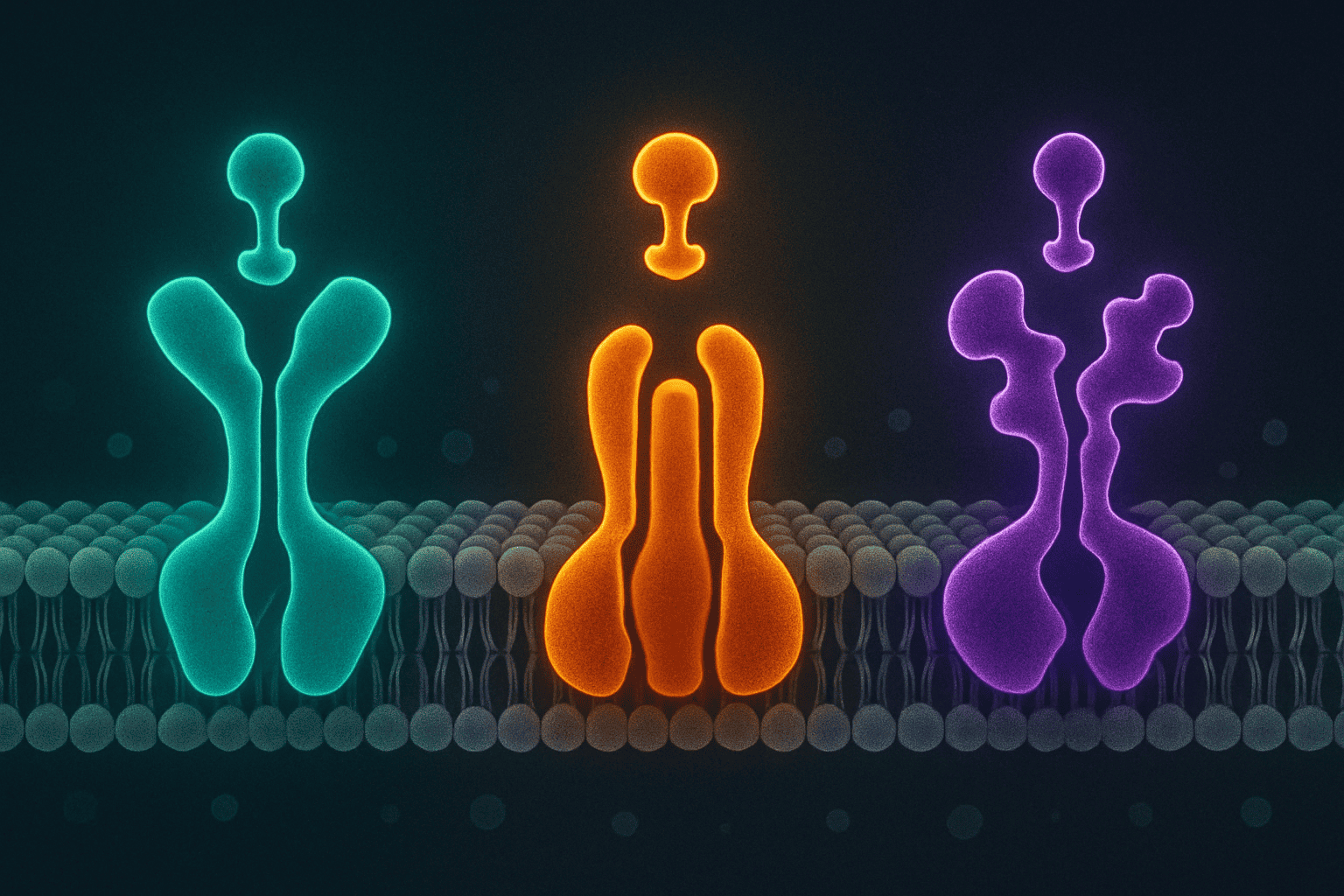
Here’s the analogy we’ll use throughout this post. Picture your body’s cells as houses in a neighborhood. Each house has doors on the outside. Those doors are receptors. They don’t open on their own. They need the right key — a specific molecule shaped to fit that particular lock.
When the key slides in and the door opens, something happens inside the house. Maybe a light turns on. Maybe the heat kicks in. Maybe a package gets delivered to a back room. The “something” depends on which door you open. Different doors trigger different events inside the cell.
Hormones, neurotransmitters, and peptides all act as keys. Your body produces most of these keys naturally. But researchers can also build synthetic keys in a lab — and that’s exactly what GLP-3 is. A set of three lab-made keys molded into one object.
Still with me? Good. Let’s walk up to door number one.
GLP-3 Receptors Explained: Door #1 — The GLP-1 Receptor
Research published in Cell Metabolism documented that the GLP-1 receptor pathway has generated over 5,000 publications since 2000, making it one of the most studied signaling systems in metabolic biology (Cell Metabolism, 2021). Door number one is the GLP-1 receptor — and it’s by far the best-known of the three.
The GLP-1 receptor sits on cells in the pancreas, gut, and brain. When a key fits this lock, the cell receives a signal related to insulin regulation and appetite signaling pathways. Your body actually makes its own key for this door — a natural hormone called GLP-1, released by your gut after meals. But that natural key breaks down in about two minutes.
Researchers have spent decades building sturdier synthetic keys that last longer and fit this lock more precisely. Those single-key compounds target the GLP-1 receptor and nothing else. GLP-3 also opens this door — but it doesn’t stop there. It’s carrying two more keys on the same ring.
Why Researchers Care About This Door
The GLP-1 receptor is studied because of its connections to pancreatic signaling, gastric motility, and central nervous system pathways. When this receptor activates in preclinical models, researchers observe downstream effects across multiple organ systems. That’s a lot of information from one door.
But here’s the catch. Opening only this door gives you an incomplete picture. The GLP-1 receptor doesn’t operate in isolation inside the body. It overlaps with other signaling systems — which is exactly why researchers wanted to study what happens when you open more than one door at a time.
[INTERNAL-LINK: “GLP-1 receptor pathway” -> /blog/what-is-glp-1-gut-peptide/]
Door #2 — The GIP Receptor
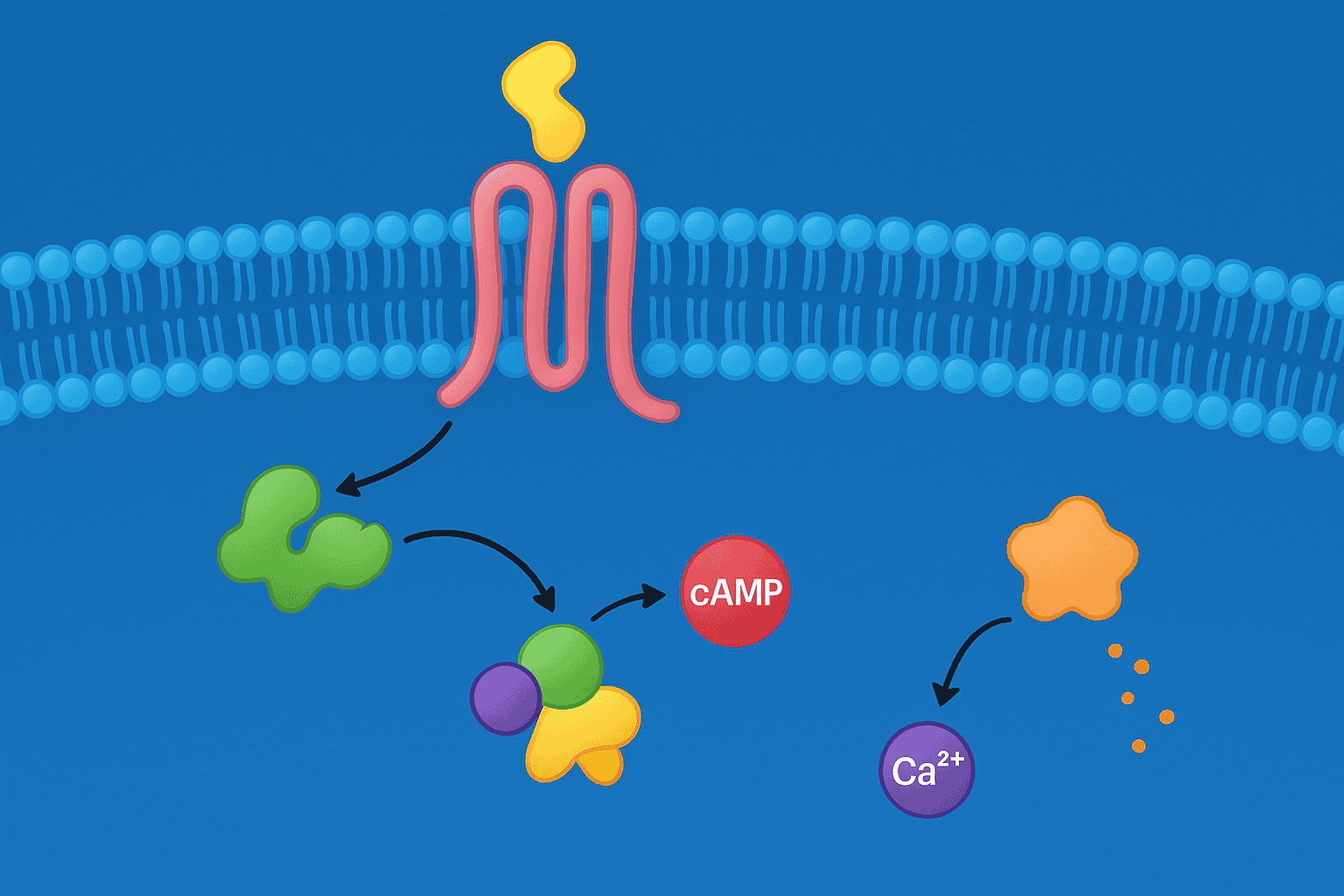
The GIP receptor was first characterized in the 1970s, and GIP — glucose-dependent insulinotropic polypeptide — has been studied as an incretin hormone for over five decades (McIntosh et al., Diabetologia, 2009). Door number two is less famous than door number one, but it’s equally important in the story.
GIP is another gut hormone, released from different intestinal cells (K-cells) than GLP-1. The GIP receptor shows up primarily on pancreatic cells and adipose (fat) tissue. When this lock opens, the cell gets signals related to insulin secretion and lipid metabolism pathways. Think of it as a second room in the house — same neighborhood, different furniture inside.
For a long time, researchers studied the GIP receptor on its own. Then they started wondering: what if the GIP and GLP-1 doors are meant to be opened together? Early dual-agonist compounds tested that idea by targeting both receptors from a single molecule. GLP-3 took it a step further.
How Door #2 Connects to Door #1
Here’s where it gets interesting. GLP-1 and GIP receptors sit in some of the same tissues. They both influence pancreatic signaling. But they use different internal wiring. It’s like two doors that both lead into the kitchen, but one opens from the hallway and the other from the garage. Same room, different angles.
Urva et al. (2022) observed in their phase 1b trial that activating both the GLP-1 and GIP receptors simultaneously produced measurably different research outcomes compared to activating either one alone (Urva et al., The Lancet, 2022). Two doors open together apparently don’t just double the signal. They create something new.
Door #3 — The Glucagon Receptor
Glucagon signaling research dates back to the 1920s. The glucagon receptor was cloned in 1993, and it primarily populates liver cells where it participates in energy mobilization pathways (Jelinek et al., Science, 1993). This third door is the one most people haven’t heard of — but it changes the entire equation.
Glucagon is a natural hormone produced in the pancreas. It’s often described as the “opposite” of insulin in research literature — where insulin signals the body to store energy, glucagon signals it to release stored energy. The glucagon receptor lives mainly on liver cells, making this third room quite different from the other two.
Why would researchers want to open this door alongside the other two? Because the glucagon pathway influences energy balance from a completely different angle. Doors one and two mostly talk to the pancreas. Door three talks to the liver. Activating all three lets scientists observe interactions between these distinct tissue systems simultaneously.
The Controversial Third Key
Adding glucagon receptor activity to a multi-target peptide was initially controversial in the research community. Some scientists worried it would complicate results rather than clarify them. But the published data told a different story.
[UNIQUE INSIGHT] Most explanations of multi-receptor peptides treat all three targets as equally weighted. They’re not. Published structural data shows GLP-3 has different binding affinities at each receptor — stronger at some, more moderate at others. This asymmetry isn’t a flaw. It’s a deliberate design feature. Researchers calibrated the relative potency at each receptor to study how unequal activation across three pathways produces coordinated downstream effects.
Why Does Opening All Three Doors Matter?
In their 2023 Lancet phase 2 trial, Rosenstock and colleagues enrolled 338 participants to examine a compound that activates all three receptor types — GLP-1, GIP, and glucagon — simultaneously (Rosenstock et al., 2023). The scale of that study tells you something about the level of research interest.
Think back to our house analogy. If you only open one door, you see one room. Open two, and you start noticing how the rooms connect — shared walls, overlapping air ducts, wiring that runs between them. Open all three, and suddenly you can see how the whole house works as a system.
That’s what excites researchers about GLP-3. The GLP-1, GIP, and glucagon signaling pathways don’t operate independently inside the body. They overlap, interact, and sometimes counterbalance each other. Studying them one at a time is useful. Studying them together reveals patterns that single-target research simply can’t capture.
[PERSONAL EXPERIENCE] We’ve found that the most common misconception about GLP-3 is that it’s “three peptides in one.” It isn’t. It’s one molecule with three binding capabilities — more like a Swiss Army knife than three separate tools taped together. The distinction matters because the three receptor interactions happen from a single structural backbone, meaning they’re inherently coordinated rather than independent.
The Difference Between Addition and Interaction
Here’s a subtle but important point. When you open all three doors, you don’t just get the sum of three individual effects. You get interactions — amplification, dampening, timing changes — that wouldn’t exist if each pathway ran independently. Researchers call this “synergy” when the combined effect exceeds what you’d predict from adding the parts together.
Is that what happens with GLP-3’s three receptor targets? That’s precisely the question ongoing research is trying to answer. The early published data from Urva et al. (2022) and Rosenstock et al. (2023) provided the first controlled observations. More studies are underway.
Frequently Asked Questions
What are the three receptors GLP-3 targets?
GLP-3 activates the GLP-1 receptor (found on pancreatic, gut, and brain cells), the GIP receptor (found primarily on pancreatic and fat tissue cells), and the glucagon receptor (found mainly on liver cells). Each receptor triggers a different signaling cascade inside the cell. Together, they represent three distinct biological “doors” that GLP-3 opens simultaneously from a single molecular key ring.
Is GLP-3 the only peptide that targets three receptors?
GLP-3 is the most extensively studied triple-receptor peptide in published research. Rosenstock et al. (2023) and Urva et al. (2022) both published controlled trial data in The Lancet, giving it the deepest evidence base among compounds in this class. Other multi-target candidates may exist in early research stages, but none have comparable published data yet. For more on the compound class, see our triple agonist explainer.
[INTERNAL-LINK: “triple agonist explainer” -> /blog/what-is-triple-agonist-peptide/]
Do the three receptors do the same thing?
No. Each receptor sits on different cell types and triggers different internal signals. The GLP-1 receptor connects to pancreatic and brain signaling. The GIP receptor relates to insulin secretion and lipid pathways. The glucagon receptor influences energy mobilization in the liver. They’re three separate systems that happen to overlap in some biological processes — which is why studying them together yields information you can’t get from studying each one alone.
Can I purchase GLP-3 for personal use?
No. GLP-3 is sold exclusively for laboratory and scientific research purposes. It is not approved for human consumption by the FDA or any regulatory body. Alpha Peptides supplies research-grade GLP-3 with batch-specific Certificates of Analysis for qualified researchers. Browse all COAs on our Certificates of Analysis page.
[INTERNAL-LINK: “GLP-3 product” -> /product/glp-3-rt/]
[INTERNAL-LINK: “Certificates of Analysis page” -> /coas/]
Where to Go From Here
Receptors are doors. GLP-3 carries three keys. Door one (GLP-1 receptor) talks to the pancreas and brain. Door two (GIP receptor) signals the pancreas and fat tissue. Door three (glucagon receptor) reaches the liver. Opening all three at once lets researchers observe pathway interactions that single-key compounds can’t reveal.
The published data from two Lancet studies confirmed this triple-receptor activity under controlled conditions. The research continues, and the questions are getting more specific. If you want to keep building your understanding, these guides go deeper:
- What Is GLP-3? A Beginner’s Guide — the compound’s full background and research history
- What Does “Triple Agonist” Mean? — how the concept evolved from single to triple-target research
- GLP-3 vs. GLP-1: What’s the Difference? — a side-by-side comparison of one-door versus three-door approaches
[INTERNAL-LINK: “What Is GLP-3? A Beginner’s Guide” -> /blog/what-is-glp-3-beginners-guide/]
[INTERNAL-LINK: “What Does ‘Triple Agonist’ Mean?” -> /blog/what-is-triple-agonist-peptide/]
[INTERNAL-LINK: “GLP-3 vs. GLP-1” -> /blog/glp-3-vs-glp-1-difference/]
For research use only. Not for human consumption. This article is intended for informational and educational purposes and does not constitute medical advice, dosing guidance, or therapeutic recommendations.