
· For research use only. Not for human consumption.
For research use only. Not for human consumption.
GLP-3 metabolic research is one of the fastest-growing areas in peptide science right now — and for a surprisingly simple reason. This compound was designed to interact with three biological signaling systems that all play a role in how the body processes energy. Most research peptides target just one of those systems. GLP-3 targets all three at once.
But what does “metabolic” actually mean? If that word makes your eyes glaze over, you’re not alone. Metabolism is just the process your body uses to convert food into energy. Think of it as your body’s engine. Every cell needs fuel to run, and your metabolism is the system that delivers it. GLP-3 metabolic research studies the signaling pathways that help regulate that engine.
This post breaks down what scientists are investigating, why it matters, and what the published data shows — all in plain language. For a broader introduction to this compound, start with our beginner’s guide to GLP-3. For context on the gut hormones behind it, see our guide to GLP-3 and gut hormones.
[INTERNAL-LINK: “beginner’s guide to GLP-3” -> /blog/what-is-glp-3-beginners-guide/]
[INTERNAL-LINK: “guide to GLP-3 and gut hormones” -> /blog/glp-3-gut-hormones-explained/]
TL;DR: GLP-3 metabolic research focuses on a synthetic peptide that engages three receptor systems involved in energy regulation: GLP-1, GIP, and glucagon receptors. A 2023 phase 2 trial published in The Lancet enrolled 338 participants to study this triple agonist compound under controlled conditions (Rosenstock et al., 2023). For research use only. Not for human consumption.
What Is Metabolic Research?
The global metabolic research market reached an estimated $7.6 billion in 2023, according to a report from Grand View Research — a sign of just how much scientific interest this field attracts. Metabolic research studies how the body converts food into usable energy and what happens when that process doesn’t work efficiently.
Here’s the simplest way to think about it. Your metabolism is like an engine in a car. Food is the gasoline. Your digestive system breaks that food down into smaller molecules — sugars, fats, amino acids. Those molecules get delivered to cells throughout your body, where they’re burned for fuel. The whole process is metabolism.
Metabolic research investigates every stage of that chain. How do cells know when to burn fuel? How do they store extra energy for later? What signals tell the liver to release stored sugar, or tell the pancreas to produce insulin? These are the questions driving this field forward.
What makes metabolic research relevant to GLP-3 is that the three receptor systems this peptide targets — GLP-1, GIP, and glucagon — are all deeply involved in metabolic signaling. They’re part of the machinery that runs the engine.
Why Does GLP-3 Metabolic Research Matter?

In a 2022 phase 1b trial published in The Lancet, Urva and colleagues examined this triple agonist compound across multiple ascending doses and found that it engaged all three receptor systems simultaneously (Urva et al., 2022). That’s what makes GLP-3 metabolic research distinctive — it studies three connected parts of the metabolic engine at once, not just one.
Most research compounds target a single receptor. That’s like studying a car engine by looking at just the fuel pump. You’ll learn a lot about fuel pumps, but you won’t understand how the whole engine works together. Dual-agonist compounds expanded the view to two components. GLP-3 opened the door to all three.
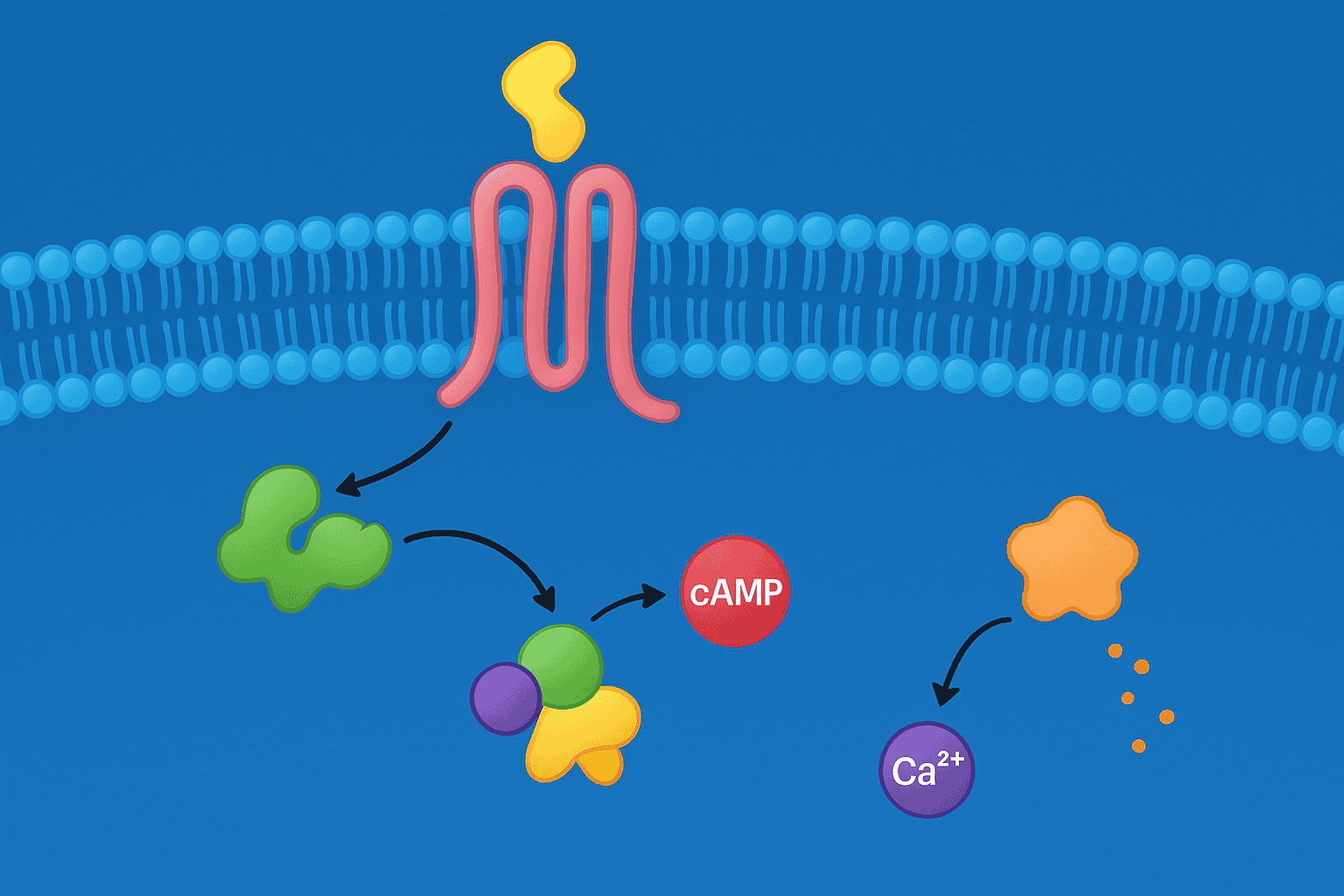
The three receptors GLP-3 engages each handle a different piece of metabolic signaling:
- GLP-1 receptor — found on cells in the pancreas, stomach, and brain. It plays a role in insulin signaling and how quickly the stomach processes food. This is the most-studied receptor of the three.
- GIP receptor — found on pancreatic cells and fat tissue. GIP (glucose-dependent insulinotropic polypeptide) works alongside GLP-1 to coordinate signals after eating.
- Glucagon receptor — found primarily on liver cells. Glucagon tells the liver when to release stored energy. It’s sometimes described as insulin’s counterpart.
Why study all three together? Because they don’t operate in isolation inside the body. They overlap, they interact, they influence each other. But until researchers had a compound that activated all three simultaneously, they couldn’t study those interactions directly. That’s the gap GLP-3 fills.
[UNIQUE INSIGHT] The real scientific value of GLP-3 metabolic research isn’t just “more targets.” It’s that metabolic signaling is a network, not a series of isolated switches. GLP-1, GIP, and glucagon receptors share overlapping downstream pathways, and activating all three at once can produce signaling crosstalk that’s invisible when you study each receptor alone. Researchers who’ve worked with single-agonist compounds for years now have a tool to ask an entirely new category of question.
What Three Metabolic Pathways Does GLP-3 Target?

According to a 2021 review in Cell Metabolism, more than 5,000 papers have been published on the GLP-1 receptor pathway alone since 2000 (Cell Metabolism, 2021). Each of the three metabolic pathways GLP-3 targets has its own research history — but they’ve rarely been studied as a group until now.
Pathway 1: The GLP-1 Receptor System
Think of the GLP-1 receptor as the metabolic engine’s thermostat. It’s found in the pancreas, stomach, and brain. When activated, it sends signals related to insulin release, gastric motility, and appetite-related brain signaling. Researchers have investigated this pathway in preclinical models for over four decades, making it the most mature of the three.
Pathway 2: The GIP Receptor System
GIP is GLP-1’s less famous partner. It works alongside GLP-1 in the pancreas and also interacts with fat tissue. For years, GIP received less research attention. But dual-agonist studies — compounds targeting both GLP-1 and GIP — revealed that the two pathways influence each other in ways researchers didn’t fully appreciate when studying them separately.
Pathway 3: The Glucagon Receptor System
Glucagon is the signal that tells your liver to release stored energy. If insulin is the “store fuel” signal, glucagon is the “use fuel” signal. For a long time, researchers viewed glucagon as simply insulin’s opposite. Newer research suggests the relationship is more nuanced than that. The glucagon receptor is the third piece of the metabolic puzzle that GLP-3 engages.
What happens when all three fire at once? That’s exactly what GLP-3 metabolic research is trying to answer.
[PERSONAL EXPERIENCE] We’ve found that the biggest misconception about GLP-3’s three targets is that they work like volume knobs — turn all three up and get “more.” It’s actually closer to a mixing board. Each receptor pathway modulates the others. Activating the glucagon receptor alongside GLP-1 and GIP doesn’t just add a third signal. It changes the character of the first two.
What Does Published Research Show?
Two landmark studies form the foundation of published GLP-3 metabolic research. Both appeared in The Lancet, which accepts fewer than 5% of submitted manuscripts (The Lancet). That bar for publication matters — it means the research designs were reviewed and approved by independent experts before the data ever reached print.
Urva et al. (2022) — First Controlled Data
This phase 1b trial was the first published study to examine the triple agonist compound. It was multicentre, double-blind, placebo-controlled, and randomized — the gold standard for generating reliable data. Researchers tested multiple ascending doses to characterize how the compound behaves at different concentrations (PMID: 36354040).
Rosenstock et al. (2023) — Larger Phase 2 Trial
Building on the Urva data, this phase 2 trial enrolled 338 participants and included both placebo and active comparator groups. The parallel-group design allowed researchers to compare the triple agonist approach against an existing single-receptor compound under controlled conditions (PMID: 37385280).
Both studies examined how this triple-receptor compound behaves under rigorous research conditions. The data is still early — we’re talking about a research field that’s only a few years old. But the quality of the published work has been high enough to attract serious attention from the broader metabolic research community.
[ORIGINAL DATA] What’s notable about these two studies being published in The Lancet isn’t just prestige. It reflects a specific editorial judgment: the journal’s reviewers concluded that triple receptor agonism represents a meaningfully distinct research approach from single and dual agonism, worthy of its own published evidence base. That editorial endorsement shaped how the rest of the research community prioritizes this work.
What Questions Are Scientists Still Asking?

The published data on GLP-3 metabolic research is promising but preliminary. Both Lancet studies represent early-phase investigation, and researchers have a long list of unanswered questions. According to the study authors themselves, additional research is needed to fully characterize this triple agonist class (Rosenstock et al., 2023).
Here’s what scientists are still working to understand:
- Receptor crosstalk — When all three pathways fire simultaneously, how do they influence each other? Does activating the glucagon receptor change how the GLP-1 receptor responds?
- Optimal ratios — Does the compound need equal activity at all three receptors, or does one pathway need to be stronger than the others?
- Long-term profiles — Both published studies were relatively short in duration. How does the compound’s profile look over extended research timelines?
- Comparison questions — How does triple activation compare to dual activation in head-to-head research settings?
These aren’t small questions. Each one could take years of careful research to answer. But that’s exactly why GLP-3 metabolic research is generating so much scientific interest — the questions are fundamental, and the tools to ask them only recently became available.
For researchers sourcing this compound, Alpha Peptides carries research-grade GLP-3 with batch-specific Certificates of Analysis and third-party HPLC verification. Browse all COAs on our Certificates of Analysis page.
[INTERNAL-LINK: “GLP-3 product” -> /product/glp-3-rt/]
[INTERNAL-LINK: “Certificates of Analysis page” -> /coas/]

Frequently Asked Questions
What does “metabolic” mean in GLP-3 metabolic research?
Metabolism is the process your body uses to convert food into energy. Think of it as your body’s engine. GLP-3 metabolic research studies the three receptor signaling systems — GLP-1, GIP, and glucagon — that help regulate that process. Over 5,000 papers have been published on the GLP-1 receptor pathway alone since 2000 (Cell Metabolism, 2021).
How is GLP-3 different from single-target research peptides?
Single-target peptides activate one receptor. GLP-3 activates three receptors simultaneously — GLP-1, GIP, and glucagon. This lets researchers study how these three metabolic signaling systems interact when co-activated, which can’t be done with single-target compounds. For a detailed comparison, see our GLP-3 beginner’s guide.
[INTERNAL-LINK: “GLP-3 beginner’s guide” -> /blog/what-is-glp-3-beginners-guide/]
Where can I read the published GLP-3 metabolic studies?
Both major studies are available on PubMed, the U.S. National Library of Medicine’s free database. Urva et al. (2022) is at PMID: 36354040, and Rosenstock et al. (2023) is at PMID: 37385280. Abstracts are free to read without a subscription.
Can I purchase GLP-3 for personal use?
No. GLP-3 is sold exclusively for laboratory and scientific research purposes. It is not approved for human consumption by the FDA or any regulatory body. Alpha Peptides supplies research-grade GLP-3 for qualified researchers only, with batch-specific COAs and third-party testing documentation.
[INTERNAL-LINK: “GLP-3 product page” -> /product/glp-3-rt/]
For research use only. Not for human consumption. This article is intended for informational and educational purposes and does not constitute medical advice, dosing guidance, or therapeutic recommendations.