
· For research use only. Not for human consumption.
For research use only. Not for human consumption.
Collagen is the most abundant protein in the human body. It is the main building material for skin, bones, tendons, and cartilage. So when researchers discovered that a tiny copper-binding peptide called GHK-Cu appears to influence collagen-related processes in laboratory settings, it naturally attracted a lot of attention. GHK-Cu collagen signaling has become one of the most studied areas in peptide research.
But what does “collagen signaling” actually mean? And what has research shown so far? In this post, we will explain collagen in plain English, walk through the different types, and look at what preclinical studies have observed about how GHK-Cu interacts with collagen pathways. Everything discussed here comes from published laboratory research — no medical claims, just science broken down simply.
Whether you are new to peptide research or just curious about collagen biology, this overview will give you a clear picture of why GHK-Cu collagen signaling research matters in the lab.
TL;DR: GHK-Cu has been studied for its effects on collagen-related processes in preclinical models. Research in fibroblast cultures has observed effects on collagen production pathways (Pickart L, Margolina A, 2012, PMID: 22782788). GHK-Cu’s influence extends to thousands of genes, including those involved in collagen biology (Pickart et al., 2014, PLOS ONE). For research use only. Not for human consumption.
What Is Collagen, Exactly?
Think of collagen as the scaffolding that holds your body together. It is a structural protein — meaning its main job is to provide shape, strength, and support. If you have ever seen a building under construction with metal beams forming the skeleton, collagen does something similar at the microscopic level inside living tissue.
Collagen makes up roughly 30 percent of all the protein in the human body. It is found in skin, bones, cartilage, blood vessels, the gut lining, and connective tissue throughout the body. Without collagen, these structures would lack their strength and flexibility.
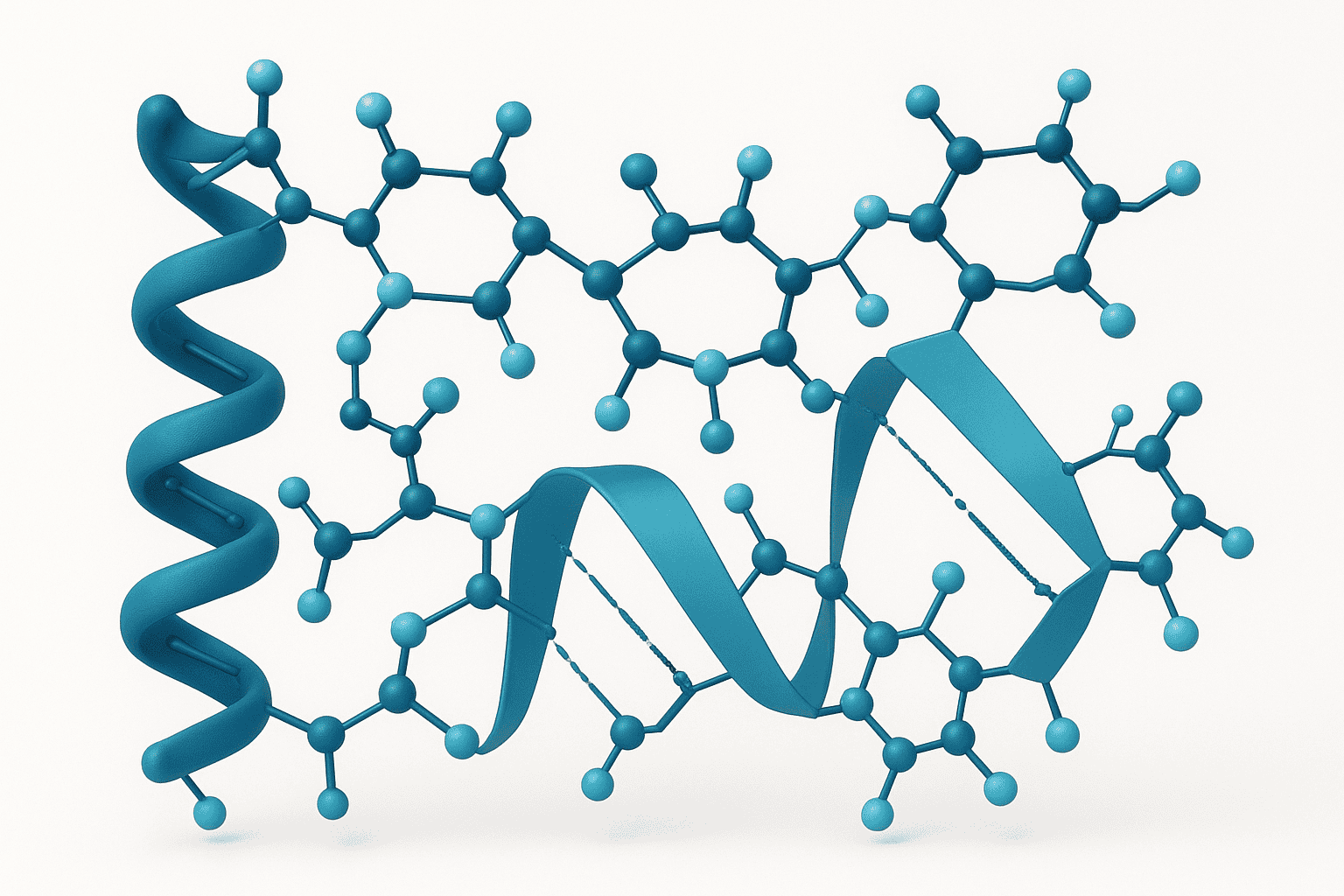
The protein has a distinctive shape: three chains of amino acids twisted together like a rope. This triple-helix structure gives collagen its unusual strength. It is one of nature’s most effective building materials, and researchers have been studying it for well over a century.
The Different Types of Collagen
Scientists have identified at least 28 different types of collagen in the human body. Each type has a slightly different structure and shows up in different tissues. Here are the main ones that come up most often in research:
Type I is the most common. It is found in skin, bones, tendons, and ligaments. When researchers study collagen in the context of connective tissue, they are usually talking about Type I.
Type II is the primary collagen in cartilage — the flexible tissue that cushions joints.
Type III often appears alongside Type I and is found in blood vessels and internal organs. It tends to show up early during tissue development and repair processes studied in laboratory models.
Understanding these types matters for research because different peptides and compounds may affect different collagen types in laboratory experiments.
How GHK-Cu Collagen Signaling Works in the Lab
When researchers talk about GHK-Cu collagen signaling, they are describing what happens when GHK-Cu is introduced to cells in a controlled laboratory environment. The word “signaling” refers to the chain of chemical messages that tell cells what to do — in this case, messages related to collagen production and organization.
In preclinical studies, researchers have observed that when GHK-Cu is added to fibroblast cultures (fibroblasts are the cells responsible for building collagen), certain collagen-related gene pathways appear to become more active. This does not mean GHK-Cu directly “makes” collagen. Instead, it seems to influence the signaling pathways that fibroblasts use to manage their collagen-building activities.
Published analysis of GHK-Cu’s effects on gene expression found that it influenced over 4,000 human genes, many of which are involved in extracellular matrix processes — the biological framework that includes collagen (Pickart et al., 2014, PLOS ONE).
Pickart L, Margolina A (2012) reviewed GHK-Cu research across wound models and fibroblast cultures, documenting observations related to collagen processes. (PMID: 22782788)
Fibroblast Activation and What It Means
Fibroblasts are the workhorses of connective tissue. These cells produce collagen, elastin, and other structural proteins that form the extracellular matrix. When researchers say GHK-Cu “activates” fibroblasts, they mean that in laboratory experiments, fibroblasts exposed to GHK-Cu showed increased activity compared to control groups that did not receive the peptide.
This increased activity has been measured in several ways in published research: changes in gene expression patterns, observations of cell behavior under microscopy, and analysis of the proteins produced by the cells. It is important to note that all of these observations come from controlled laboratory environments — cell cultures and preclinical models — not from studies in people.
The copper component of GHK-Cu appears to play a role in this process. Copper is a necessary cofactor for lysyl oxidase, an enzyme involved in cross-linking collagen fibers. Cross-linking is what gives collagen its structural strength — like how weaving threads together makes fabric stronger than individual threads.
Why Collagen Research Matters
Collagen is involved in so many biological structures that understanding how it is produced, organized, and maintained is relevant to multiple fields of scientific research. From tissue engineering to biomaterial development, collagen biology sits at the center of many research questions.
The study of peptides like GHK-Cu that appear to influence collagen signaling in preclinical models gives researchers tools to better understand these processes. Each experiment adds a piece to the puzzle of how cells manage their structural protein production in different conditions.
It is worth emphasizing that preclinical research — experiments done in cell cultures and laboratory models — is an early stage of scientific investigation. These findings help guide future research directions but do not represent conclusions about effects in living organisms or people.
Pickart L, Vasquez-Soltero JM, Margolina A (2015) documented the natural occurrence and age-related decline of GHK-Cu in human plasma, providing context for its biological relevance. (PMID: 26050778)
The Bigger Picture of GHK-Cu Collagen Signaling Research
What makes GHK-Cu particularly interesting in collagen research is the scope of its observed effects. While many compounds studied in the lab affect one or two pathways, GHK-Cu’s influence across thousands of genes — including many tied to collagen and extracellular matrix biology — sets it apart as a research tool.
The fact that GHK-Cu occurs naturally in human blood plasma (at concentrations around 200 ng/mL in younger adults) adds another layer of interest. Researchers have noted that plasma levels of GHK-Cu decline with age, which has made it a subject of investigation in age-related biology research conducted in laboratory settings.
Alpha Peptides offers GLOW, a proprietary research blend built around GHK-Cu. Every batch undergoes third-party testing for purity and identity — review the results on our Certificates of Analysis page. GLOW is intended exclusively for laboratory and research use.
Frequently Asked Questions
What is collagen signaling?
Collagen signaling refers to the chain of chemical messages inside cells that regulate collagen production, organization, and maintenance. These pathways tell cells like fibroblasts when and how much collagen to produce.
Does GHK-Cu make collagen?
GHK-Cu does not directly produce collagen. In preclinical laboratory studies, it has been observed to influence the signaling pathways that fibroblasts use to manage collagen-related processes. These are early-stage research observations from cell culture experiments.
What types of collagen are studied with GHK-Cu?
Most GHK-Cu collagen research has focused on Type I and Type III collagen, which are the types most associated with connective tissue and the types primarily produced by fibroblasts in cell culture experiments.
Is this research done in humans?
The collagen signaling research discussed in this article comes from preclinical models — cell cultures and laboratory experiments. These findings represent early-stage scientific observations, not conclusions about effects in people.
For research use only. Not for human consumption. This article is intended for educational and informational purposes. It does not constitute medical advice. Always consult qualified professionals for health-related questions.