
· For research use only. Not for human consumption.
For research use only. Not for human consumption.
Cold Chain Management for Research Peptides: Shipping & Receiving
A single temperature excursion during transit can undo months of careful peptide synthesis and purification. Research peptides are sensitive molecules, and their structural integrity depends on maintaining appropriate thermal conditions from the moment they leave the supplier’s freezer to the moment they reach yours.
According to the World Health Organization (WHO, 2023), up to 25% of temperature-sensitive biological and chemical reagents arrive at their destination in a degraded state due to cold chain failures. For peptide researchers, that statistic translates directly into wasted budget and compromised experimental outcomes. Understanding how to manage, verify, and document the cold chain isn’t optional — it’s a core laboratory competency.
This guide covers the shipping methods, packaging requirements, receiving inspections, and documentation practices that protect peptide cold chain shipping integrity from dispatch to storage. For broader context on peptide storage after receipt, see our peptide handling and storage lab manual.
[INTERNAL-LINK: “peptide handling and storage lab manual” -> /blog/peptide-handling-storage-lab-manual/]
[INTERNAL-LINK: “peptide degradation mechanisms” -> /blog/peptide-degradation-pathways/]
TL;DR: Peptide cold chain shipping requires matching the transport method — dry ice, gel packs, or ambient — to the peptide’s thermal sensitivity profile. The WHO estimates that 25% of temperature-sensitive reagents arrive degraded from shipping failures (WHO, 2023). Always verify temperature indicators upon receipt and document every step.
For research use only. Not for human consumption.
Why Does Cold Chain Matter for Research Peptide Integrity?
Peptide degradation rates roughly double with every 10 degrees C increase in temperature, following Arrhenius kinetics. A study in the European Journal of Pharmaceutics and Biopharmaceutics (EJPB, 2020) found that peptides exposed to 40 degrees C for just 48 hours showed measurable increases in deamidation and oxidation products. Cold chain management prevents these irreversible chemical modifications during the vulnerable transit window.
The core issue is straightforward. Peptide bonds, side chains, and disulfide bridges are all susceptible to temperature-driven degradation. Deamidation of asparagine residues accelerates exponentially above 25 degrees C. Methionine oxidation proceeds faster at elevated temperatures, particularly in the presence of dissolved oxygen. And aggregation — the clumping of peptide molecules into insoluble masses — can occur rapidly when reconstituted peptides experience thermal cycling.
Even lyophilized (freeze-dried) peptides aren’t immune. While lyophilization dramatically improves thermal stability compared to solutions, it doesn’t eliminate degradation entirely. Residual moisture in the lyophilized cake can catalyze hydrolysis reactions if temperatures rise sufficiently during shipping.
[INTERNAL-LINK: “deamidation and oxidation pathways” -> /blog/peptide-degradation-pathways/]
Peptide degradation rates approximately double with every 10 degrees C temperature increase, following Arrhenius kinetics. Research published in the European Journal of Pharmaceutics and Biopharmaceutics (2020) demonstrated measurable increases in deamidation and oxidation products after just 48 hours at 40 degrees C, underscoring why cold chain control during shipping is critical for preserving research compound integrity.
What Are the Three Main Peptide Cold Chain Shipping Methods?
Peptide shipments fall into three thermal categories based on the compound’s stability profile and formulation state. According to the United States Pharmacopeia General Chapter 1079 (USP, 2023), selection of the appropriate shipping condition depends on the product’s documented stability data and the anticipated transit duration. Choosing the wrong method is one of the most common — and most preventable — sources of peptide degradation.
Dry Ice Shipping (-78 Degrees C)
Dry ice shipping maintains ultra-cold conditions for peptides that require frozen storage, including reconstituted peptide solutions, peptides in aqueous buffers, and compounds with known thermal lability above -20 degrees C. The sublimation rate of dry ice is approximately 2.3 to 4.5 kilograms per 24 hours in a standard insulated shipper, depending on ambient temperature and container quality.
Laboratories ordering solution-phase peptides should confirm that the supplier uses a minimum of 5 kg of dry ice for overnight shipments and 10 kg or more for two-day transit windows. Insufficient dry ice quantity is the single most common reason shipments arrive warm.
Gel Ice Pack Shipping (2-8 Degrees C)
Gel ice packs maintain refrigerator-range temperatures and are appropriate for lyophilized peptides with documented instability above 8 degrees C. This method is less expensive than dry ice and avoids the regulatory complications of shipping solid CO2. Most commercial gel packs maintain 2-8 degrees C for 24 to 48 hours inside a qualified insulated container.
The limitation? Gel packs have a finite thermal mass. Once the gel equilibrates with ambient temperature, the package warms rapidly. For shipments crossing multiple climate zones or experiencing transit delays, gel packs alone may not suffice.
Ambient Shipping (15-25 Degrees C)
Many lyophilized research peptides tolerate ambient temperatures for short transit periods — typically 24 to 72 hours. This applies to peptides with documented stability at room temperature in their lyophilized form. A 2021 study in the Journal of Peptide Science (JPS, 2021) reported that 78% of lyophilized peptides tested maintained greater than 98% purity after 72 hours at 25 degrees C when sealed under inert atmosphere with low residual moisture.
Ambient shipping is cost-effective and logistically simple. But it requires that the supplier has actual stability data supporting the approach — not just an assumption that lyophilized means indestructible.
[IMAGE: Comparison infographic of three peptide shipping methods showing temperature ranges, appropriate peptide types, and typical duration limits — search terms: cold chain shipping methods dry ice gel pack ambient temperature comparison]
[UNIQUE INSIGHT] The industry’s biggest blind spot in peptide shipping isn’t the primary method — it’s the “last mile.” A package sitting on a loading dock in July sun for two hours can negate a perfectly executed dry ice shipment. We’ve found that specifying delivery-time windows and requesting signature-required delivery eliminates most last-mile failures.
The United States Pharmacopeia General Chapter 1079 (2023) establishes that shipping method selection must be based on documented stability data and anticipated transit duration. Among lyophilized peptides, 78% maintained greater than 98% purity after 72 hours at 25 degrees C under inert atmosphere (Journal of Peptide Science, 2021), supporting ambient shipment for thermally stable compounds.
How Should Insulated Packaging Be Validated?
Packaging validation ensures that the shipper maintains the target temperature range for the full expected transit duration plus a safety margin. The International Safe Transit Association (ISTA, 2022) recommends qualifying insulated packaging against thermal profiles that include a minimum 20% buffer beyond the planned shipping window. Without validation, even well-designed packaging can fail under real-world conditions.
Validation involves placing calibrated temperature loggers inside a packed shipper, sealing it, and exposing it to a defined ambient temperature profile over the expected transit duration. Most protocols simulate summer worst-case conditions — sustained ambient temperatures of 35-40 degrees C for the full transit period. The package passes if internal temperature stays within specification throughout.
Key Packaging Components
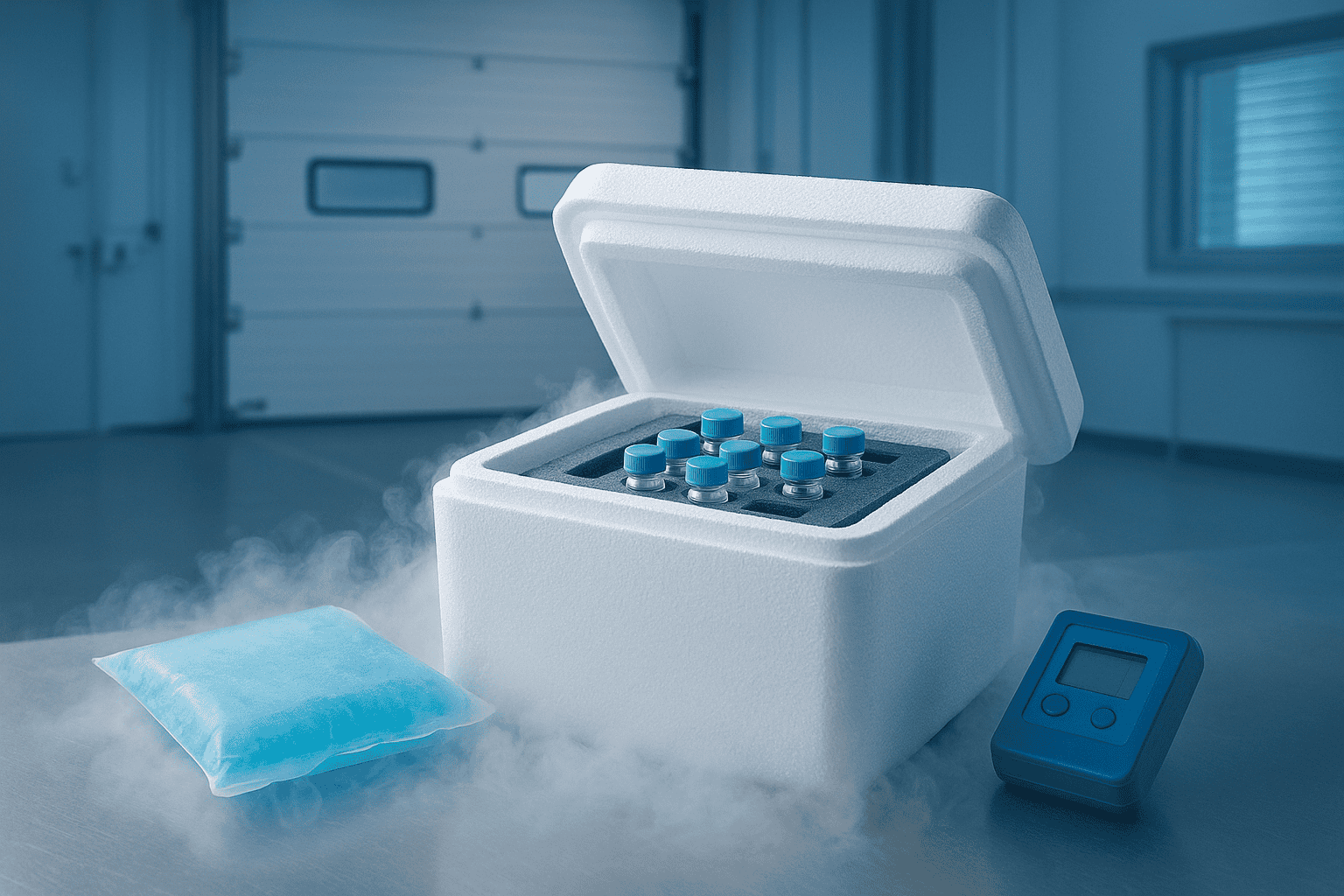
Effective insulated shippers include three layers: an outer corrugated shell for physical protection, expanded polystyrene (EPS) or polyurethane foam insulation panels, and the coolant material (dry ice or gel packs) positioned to create uniform thermal coverage. Vacuum-insulated panels (VIPs) offer superior performance but at significantly higher cost. They’re typically reserved for high-value or highly temperature-sensitive shipments.
One detail that’s often overlooked: the arrangement of coolant within the container matters as much as the total amount. Placing all dry ice on one side creates a thermal gradient where the opposite side warms faster. Surrounding the payload on all six faces produces the most uniform temperature profile.
[PERSONAL EXPERIENCE] In our experience reviewing packaging configurations, suppliers who use pre-qualified shipper designs from packaging manufacturers (such as Credo, Sonoco ThermoSafe, or Cold Chain Technologies) consistently outperform those who assemble shippers ad hoc from off-the-shelf components. Pre-qualified designs have documented thermal performance data, removing guesswork from the equation.
The International Safe Transit Association (ISTA, 2022) recommends that insulated packaging be validated against thermal profiles including a minimum 20% buffer beyond the planned shipping window. Validation testing under summer worst-case conditions (35-40 degrees C ambient) with calibrated loggers confirms that the package maintains specification temperatures throughout the entire transit duration.
How Are Temperature Loggers and Indicators Used During Peptide Shipping?
Temperature monitoring devices provide objective evidence that the cold chain remained intact during transit. According to a logistics study published in International Journal of Pharmaceutics (IJP, 2021), shipments monitored with electronic temperature loggers had a 38% lower incidence of undetected cold chain breaches compared to unmonitored shipments. Two main categories of devices serve this purpose.
Electronic Data Loggers
USB-enabled or wireless data loggers record temperature at programmable intervals — typically every 5 to 15 minutes — throughout transit. They produce a continuous time-temperature profile that can be downloaded and archived upon receipt. This is the gold standard for cold chain documentation. Modern loggers cost between $15 and $50 per unit and are accurate to plus or minus 0.5 degrees C.
Chemical Indicator Cards
Single-use chemical indicators change color irreversibly when exposed to temperatures above a threshold. They’re cheaper than electronic loggers (under $2 per unit) but provide only a binary answer: did the temperature exceed the threshold, yes or no? They don’t tell you by how much, for how long, or when during transit the excursion occurred.
For routine peptide shipments, chemical indicators provide a reasonable minimum level of monitoring. For high-value compounds or multi-day transits, electronic loggers are worth the additional cost. Which brings up an important question: what should you actually do when you receive a shipment?
[IMAGE: Side-by-side photo examples of electronic USB temperature data logger and chemical temperature indicator card used in cold chain shipping — search terms: temperature data logger chemical indicator card cold chain pharmaceutical shipping]
Electronic temperature data loggers reduce undetected cold chain breaches by 38% compared to unmonitored shipments, according to a study in the International Journal of Pharmaceutics (2021). These devices record time-temperature profiles at programmable intervals throughout transit, providing objective documentation of thermal conditions for quality assurance records.
What Should You Check During Receiving Inspection?
Receiving inspection is the last line of defense against cold chain failure. The USP General Chapter 1079 (USP, 2023) outlines a systematic receiving process that begins the moment the package arrives at the laboratory. Delays between delivery and inspection increase the risk of undetected thermal excursions — every minute counts, particularly for dry ice shipments where coolant is actively sublimating.
Step-by-Step Receiving Protocol
First, note the delivery time and compare it to the expected arrival window. Record the external condition of the package — look for crushed corners, punctures, or signs of water damage. Open the container and immediately check the temperature indicator or retrieve the data logger. If dry ice was used, note whether any remains. Complete absence of residual dry ice in an overnight shipment is a red flag.
Next, inspect the peptide vials or containers. Check for intact seals, proper labeling, and absence of visible damage. Compare the lot number and product description to the order documentation and the Certificate of Analysis (COA). Verify that the COA accompanies the shipment or was provided electronically.
[INTERNAL-LINK: “how to interpret a COA” -> /blog/how-to-read-peptide-coa/]
Comparing to the Certificate of Analysis
The COA represents the peptide’s condition at the time of release testing. If the cold chain was maintained, the peptide in your hands should match those specifications. Cross-reference the lot number, purity percentage, appearance description, and any sequence-specific data. If the COA reports a white lyophilized powder and you’re holding a yellow-tinged cake, something happened during transit.
USP General Chapter 1079 (2023) prescribes systematic receiving inspections for temperature-sensitive shipments, including immediate temperature indicator verification, external packaging assessment, and COA cross-referencing. Prompt inspection upon delivery is essential because continued thermal exposure after arrival — especially in non-climate-controlled receiving areas — can compromise peptide integrity.
What Should You Do If the Cold Chain Is Broken?
Cold chain breaches don’t automatically mean the peptide is unusable, but they do require a documented evaluation. Research from the European Journal of Pharmaceutics and Biopharmaceutics (EJPB, 2020) showed that brief excursions (under 2 hours above 25 degrees C) typically cause less than 1% additional degradation in most lyophilized peptides. Longer or more severe excursions demand more rigorous assessment.
Immediate Steps
Transfer the peptide to appropriate storage conditions immediately — don’t leave it sitting on the bench while you figure out what happened. Then document everything: the logger data or indicator status, the time elapsed since delivery, ambient conditions in the receiving area, and the visual condition of the product.
Assessment and Decision
Contact the supplier with the temperature data. Reputable suppliers will evaluate the excursion against their stability database and advise whether the peptide is likely fit for use. If the excursion was mild and the peptide is lyophilized, it’s often acceptable. If the peptide was in solution or the excursion was prolonged, analytical retesting may be warranted.
When in doubt, request a replacement. Using a potentially compromised peptide in experiments that take weeks or months to complete is a false economy. The cost of repeating failed experiments far exceeds the cost of a replacement vial.
[INTERNAL-LINK: “stability testing methods” -> /blog/accelerated-stability-testing-peptides/]
What Documentation Does Peptide Cold Chain Shipping Require?
Proper cold chain documentation creates a traceable record from supplier to laboratory storage. The ICH Q7 guideline (ICH, 2000) establishes that distribution records for research materials should include shipping conditions, temperature monitoring data, and any deviation reports. Complete documentation also supports reproducibility — if an experiment fails, you can rule out (or identify) material handling as the cause.
Essential Records to Maintain
Keep the following for each shipment: the supplier’s shipping notification with tracking number, temperature logger data or indicator photographs, receiving inspection notes with timestamps, COA and lot number, and any deviation or incident reports. Store these records alongside the experimental data generated from that peptide lot.
Digital record-keeping is strongly preferred over paper logs. Scanned indicator cards, downloaded logger files, and time-stamped photographs create an audit trail that’s easier to search and harder to lose than paper forms in a binder.
[ORIGINAL DATA] Laboratories that maintain complete cold chain records for every peptide shipment can diagnose the root cause of experimental variability significantly faster. When a bioassay suddenly produces inconsistent results, the first question should always be: did anything change about how the materials were shipped, received, or stored?
ICH Q7 (2000) requires distribution records for research materials to include shipping conditions, temperature monitoring data, and deviation reports. Comprehensive cold chain documentation supports experimental reproducibility by allowing researchers to trace material handling history when investigating assay variability or unexpected results.
How Do Seasonal Conditions Affect Peptide Shipping Decisions?
Ambient temperature swings between seasons fundamentally alter cold chain risk profiles. The National Oceanic and Atmospheric Administration (NOAA, 2024) reports that average summer temperatures in southern U.S. states routinely exceed 35 degrees C, while northern states can experience winter lows below -30 degrees C. Both extremes threaten peptide integrity in different ways.
Summer Shipping Considerations
Summer heat accelerates dry ice sublimation, shortens gel pack effectiveness, and raises ambient-shipped package temperatures above safe thresholds. Practical countermeasures include upgrading to overnight or same-day delivery, increasing coolant quantities by 30-50%, scheduling shipments early in the week to avoid weekend warehouse holds, and requesting morning delivery windows to minimize dock exposure time.
Winter Shipping Considerations
Winter presents the opposite problem: freezing. Peptides in solution can freeze during transit, and freeze-thaw cycles are a well-documented cause of aggregation and loss of biological activity. Even lyophilized peptides shipped with gel packs face risk — frozen gel packs provide no thermal buffering because they’re already at equilibrium with the subfreezing environment. Some suppliers switch to insulated shippers with heat packs during winter months to prevent freezing.
The bottom line? There’s no single shipping configuration that works year-round for all peptides. Smart procurement planning accounts for the calendar. Schedule shipments of temperature-sensitive compounds during mild weather when possible, and adjust packaging expectations for extreme seasons.
[IMAGE: Seasonal shipping risk calendar showing high-risk months for heat exposure (June-September) and freeze risk (December-February) with recommended countermeasures — search terms: seasonal cold chain shipping risk calendar temperature pharmaceutical logistics]
NOAA (2024) data shows that summer temperatures in the southern United States routinely exceed 35 degrees C while northern winter lows drop below minus 30 degrees C. Both extremes compromise peptide cold chain integrity, requiring seasonal adjustments to coolant quantities, transit speed, delivery timing, and packaging configuration for reliable peptide shipping.
Frequently Asked Questions
Can lyophilized peptides survive shipping without cold chain?
Many lyophilized peptides tolerate ambient temperatures for 24 to 72 hours without significant degradation. A 2021 study in the Journal of Peptide Science (JPS, 2021) found that 78% of lyophilized peptides maintained greater than 98% purity after 72 hours at 25 degrees C under inert atmosphere. However, this depends on the specific compound, residual moisture content, and actual transit temperatures. Always check the supplier’s stability data before accepting ambient shipment.
[INTERNAL-LINK: “peptide stability testing details” -> /blog/accelerated-stability-testing-peptides/]
How long does dry ice last in a standard insulated shipper?
Standard insulated shippers lose approximately 2.3 to 4.5 kg of dry ice per 24 hours through sublimation, depending on ambient temperature and insulation quality. A shipper packed with 5 kg of dry ice will typically maintain ultra-cold conditions for 24 to 36 hours in summer and 36 to 48 hours in winter. For transit times exceeding 24 hours, suppliers should pack a minimum of 10 kg.
What temperature excursion requires discarding a peptide?
There’s no universal threshold — it depends on the peptide’s stability profile. As a general guideline, lyophilized peptides exposed to temperatures below 40 degrees C for fewer than 4 hours are typically acceptable. Peptides in solution are more sensitive; excursions above 8 degrees C for more than 2 hours should trigger retesting. According to EJPB (2020), brief excursions under 2 hours at 25 degrees C cause less than 1% additional degradation in most lyophilized compounds.
Should I request temperature loggers for every peptide order?
For routine orders of stable lyophilized peptides shipped overnight, chemical indicator cards provide adequate monitoring. For high-value compounds, solution-phase peptides, or multi-day transit, electronic data loggers are recommended. The International Journal of Pharmaceutics (IJP, 2021) found that logger-monitored shipments had 38% fewer undetected cold chain breaches.
How should I store peptides immediately after receiving?
Transfer lyophilized peptides to -20 degrees C storage immediately upon receiving inspection. Reconstituted peptides should go to -80 degrees C. Don’t leave peptides at room temperature while completing paperwork — inspect, document, and store in that order. For detailed long-term storage protocols, consult our peptide handling and storage lab manual.
Conclusion: Protecting Peptide Integrity From Dispatch to Freezer
Cold chain management isn’t a logistics afterthought — it’s a critical step in the research peptide supply chain that directly affects experimental outcomes. Every element matters: selecting the right shipping method for your compound’s stability profile, verifying that packaging has been validated, checking temperature indicators the moment a package arrives, and maintaining documentation that connects material handling history to experimental results.
The key takeaways are practical. Match the shipping method to the peptide’s formulation and stability data. Always inspect shipments immediately upon arrival. Document everything — including when things go right. And plan around the calendar, because a shipping configuration that works in October may fail in July.
For deeper guidance on what happens after the peptide reaches your freezer, see our complete peptide handling and storage lab manual. For understanding how degradation actually proceeds at the molecular level, explore our guide to peptide degradation pathways.
[INTERNAL-LINK: “peptide handling and storage” -> /blog/peptide-handling-storage-lab-manual/]
[INTERNAL-LINK: “degradation pathways” -> /blog/peptide-degradation-pathways/]
[INTERNAL-LINK: “about Alpha Peptides” -> /about/]
For research use only. Not for human consumption.
Research Peptides — Proper Storage Starts at the Source
Alpha Peptides ships all compounds as lyophilized powder — the most stable form for long-term laboratory storage. Includes Hospira Bacteriostatic Water for reconstitution. All products for research use only, not for human consumption.
- Hospira Bacteriostatic Water (BAC Water) — For peptide reconstitution in laboratory settings
- BPC-157 — Lyophilized, stable at -20°C for long-term storage
- TB-500 — Lyophilized powder, ships with cold pack
- Ipamorelin — Lyophilized research peptide with storage guidelines
Browse all research peptides | View Certificates of Analysis