
· For research use only. Not for human consumption.
For research use only. Not for human consumption.
You’ve probably seen the phrase “triple agonist peptide” while scrolling through research headlines. It sounds intimidating. Three-syllable science words stacked on top of each other don’t exactly invite casual reading. But here’s the thing — the concept behind a triple agonist peptide is genuinely straightforward once someone strips away the jargon.
That’s what this post does. We’re going to break the term into its individual pieces, explain each one like you’re hearing it for the first time, and then snap them all back together so the full picture clicks. No chemistry degree required. No lab coat either.
By the end, you’ll understand what an agonist is, what a receptor does, why “triple” matters in peptide research, and where GLP-3 fits into the story. For a deeper look at the specific compound, see our beginner’s guide to GLP-3. For comparisons with related compounds, check our GLP-3 vs. GLP-1 breakdown.
[INTERNAL-LINK: “beginner’s guide to GLP-3” -> /blog/what-is-glp-3-beginners-guide/]
[INTERNAL-LINK: “GLP-3 vs. GLP-1 breakdown” -> /blog/glp-3-vs-glp-1-difference/]
TL;DR: A triple agonist peptide is a synthetic molecule designed to activate three different cell receptors at the same time. The most-studied example is GLP-3, which targets the GLP-1, GIP, and glucagon receptors simultaneously. In a 2023 phase 2 trial published in The Lancet, researchers examined this triple-receptor approach under controlled conditions (Rosenstock et al., 2023). For research use only. Not for human consumption.
What Is an Agonist? (Think Keys and Locks)
In a 2022 phase 1 study published in The Lancet, researchers studied compounds specifically classified as receptor agonists — molecules that activate biological targets (Urva et al., 2022). An agonist is simply a molecule that fits into a specific spot on a cell and switches something on. That’s the entire concept.
Picture a key sliding into a lock. The lock is sitting on the surface of a cell, doing nothing. Then the right key comes along, slots in, and click — something inside the cell starts happening. A chemical signal fires. The cell responds. That key? That’s your agonist.
The opposite of an agonist is an antagonist. An antagonist jams into the lock but doesn’t turn it. It blocks the keyhole so nothing else can get in either. Agonists activate. Antagonists block. For the rest of this post, we only care about the activators — the agonists.
So when researchers call something an “agonist peptide,” they mean a short chain of amino acids (that’s the peptide part) that activates a specific receptor (that’s the agonist part). Simple enough so far?
What Is a Receptor? (The Lock on Your Cells)
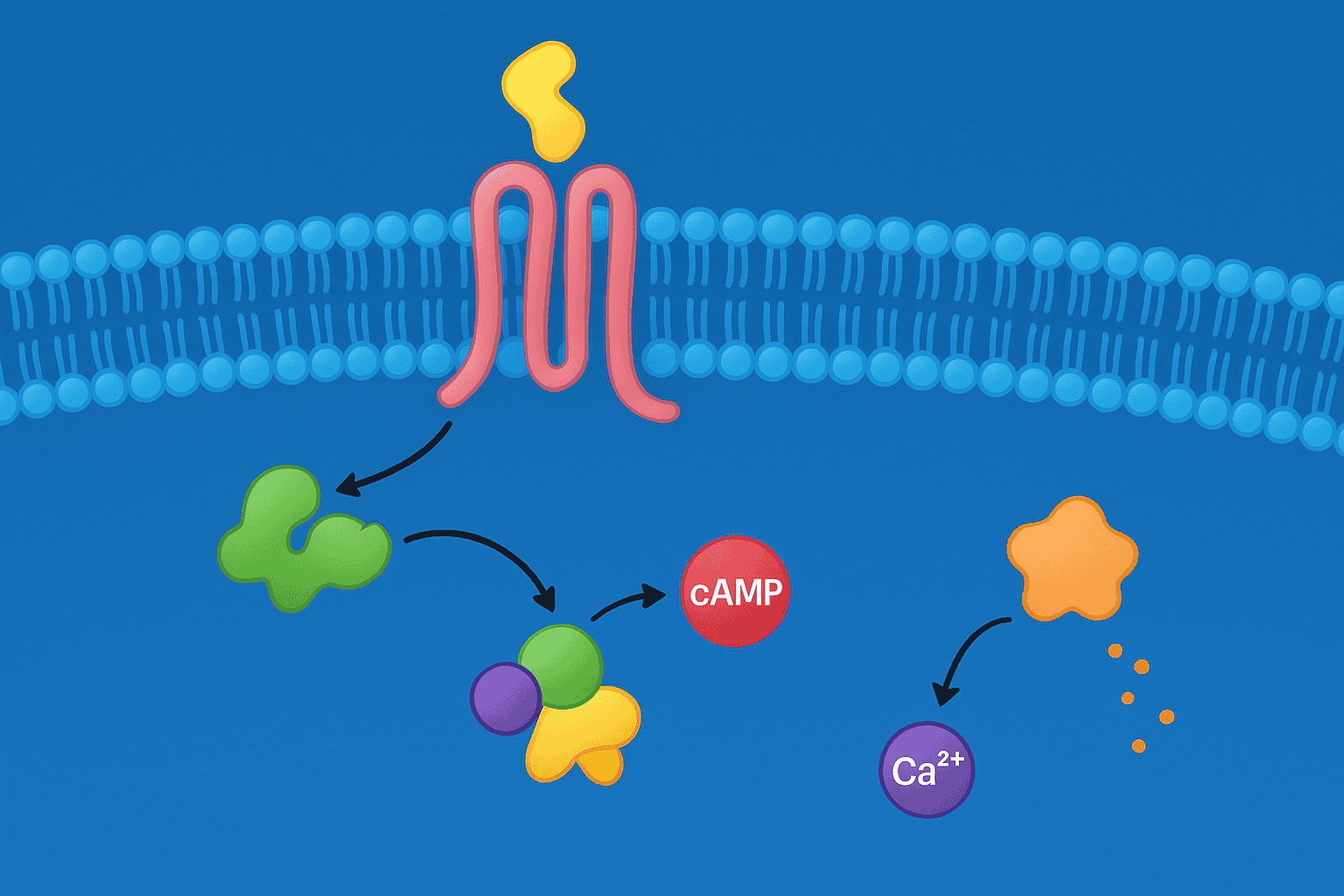
Receptors are protein structures sitting on the surface of cells throughout the body. The human genome encodes roughly 800 G-protein coupled receptors alone — just one family among several receptor types (Lagerstrom and Schioth, Nature Reviews Drug Discovery, 2008). Receptors are the locks that agonists are designed to open.
Think of every cell in your body as a tiny office building. It has walls (the cell membrane), rooms inside (organelles), and workers doing jobs (enzymes and proteins). But the building doesn’t know what’s happening outside unless something knocks on the door. Receptors are those doors.
When the right molecule arrives — a hormone, a neurotransmitter, or a synthetic peptide — it binds to the receptor and delivers a message. “Start making this protein.” “Release that stored chemical.” “Slow down this process.” The specificity matters. Each receptor only responds to molecules shaped the right way, which is why the lock-and-key comparison works so well.
Different cells carry different types of receptors. A cell in the pancreas might have GLP-1 receptors on its surface. A liver cell might carry glucagon receptors. A fat cell might have GIP receptors. This is important for understanding what makes a triple agonist peptide special — but we’ll get there in a moment.
[UNIQUE INSIGHT] Most popular science writing treats receptors as passive structures. They’re not. Receptors shift between active and inactive conformations constantly, and an agonist doesn’t so much “flip a switch” as it stabilizes the receptor in its active shape for longer periods. This distinction matters in research because partial agonists stabilize the active conformation less completely than full agonists — producing weaker signals from the same receptor.
How Did Peptide Research Evolve From Single to Triple Agonist?
The move from single to triple agonist peptides happened over roughly three decades of incretin research. The first GLP-1 receptor agonist compounds emerged from academic labs in the 1990s, targeting just one receptor (Lagerstrom and Schioth, 2008). Each step forward added complexity — and new research questions.
Single Agonists: One Key, One Lock
Researchers started with peptides that targeted a single receptor. GLP-1 analogs are the classic example. They fit the GLP-1 receptor and activate it. One molecule, one target. These single-agonist compounds gave scientists their first detailed look at how the GLP-1 signaling pathway works in isolation.
Single agonists are still widely used in laboratory research today. They’re essential for studying one pathway at a time without interference from other signaling systems. But researchers eventually asked a natural follow-up question: what happens when you activate two related pathways simultaneously?
[INTERNAL-LINK: “GLP-1 analogs” -> /blog/what-is-glp-1-gut-peptide/]
Dual Agonists: Two Keys, One Molecule
Dual agonists were the next step. These are peptides engineered to activate two receptors at once — typically the GLP-1 receptor and the GIP receptor. Imagine a single key that opens two different locks. It required creative molecular engineering. Researchers had to modify the peptide’s amino acid sequence so it could bind both receptor types without losing potency at either one.
Dual-agonist compounds opened up new experimental possibilities. Scientists could now study how two signaling pathways interact when activated together, rather than studying each one separately and guessing how they’d overlap. But even that wasn’t the end of the road.
Triple Agonist Peptides: Three Keys, One Molecule
A triple agonist peptide takes the concept one step further. It activates three receptors from a single molecule: GLP-1, GIP, and glucagon receptors. This is where GLP-3 enters the picture. Designing a molecule that can bind three structurally different receptors — without losing meaningful activity at any of them — was a significant feat of peptide chemistry.
Why bother? Because the GLP-1, GIP, and glucagon receptor systems don’t work in isolation inside the body. They overlap and interact. Studying all three at once gives researchers a fuller picture of how these pathways coordinate.
[PERSONAL EXPERIENCE] We’ve found that newcomers to peptide research often assume “more targets = universally better.” That’s not how it works. Each added receptor target introduces new variables, new interactions, and new complexity in experimental design. Triple agonist peptides aren’t “better” than single agonists — they’re different tools for different research questions.
Why Does Triple Agonist Peptide Research Matter?

In their 2023 Lancet phase 2 trial, Rosenstock and colleagues enrolled 338 participants to study a triple agonist compound across multiple parameters — one of the largest controlled examinations of this class to date (Rosenstock et al., 2023). The research attention reflects a straightforward scientific rationale.
The GLP-1, GIP, and glucagon receptor systems are all part of the incretin hormone family. They evolved together. They share overlapping tissue expression. They influence some of the same metabolic processes — but from different angles. Researchers have long suspected that studying these pathways individually gives an incomplete picture.
A triple agonist peptide lets scientists observe what happens when all three systems fire at once. It’s the difference between listening to three musicians practice alone in separate rooms versus hearing them play the same song together. The interactions — how one pathway amplifies, dampens, or modifies another — only become visible when all three are active simultaneously.
This doesn’t mean triple agonist compounds will replace single or dual agonists in research. Each tool answers different questions. But triple agonists fill a gap that didn’t have a good experimental solution before they existed.
What Is GLP-3, and Why Is It Called a Triple Agonist Peptide?

GLP-3 is currently the most-studied triple agonist peptide in published research. Urva et al. (2022) examined it in a multicentre, double-blind, placebo-controlled phase 1b trial that provided some of the earliest controlled data on this compound class (Urva et al., The Lancet, 2022).
GLP-3 is a fully synthetic peptide — it doesn’t exist in nature. Researchers designed it from scratch to engage three receptor types at once:
- GLP-1 receptor — found on pancreatic, gut, and brain cells. The same target that single-agonist GLP-1 compounds activate.
- GIP receptor — found primarily on pancreatic and adipose tissue. GIP stands for glucose-dependent insulinotropic polypeptide.
- Glucagon receptor — found on liver cells and other tissues. Glucagon is a natural hormone involved in energy regulation.
That three-receptor profile is exactly what “triple agonist” means. One molecule, three receptor targets, three simultaneous signaling cascades. The compound’s design required balancing activity across all three receptors — too strong at one and too weak at another would defeat the purpose of multi-target research.
As a physical product, research-grade GLP-3 arrives as a white lyophilized (freeze-dried) powder in a sealed vial. Every batch from Alpha Peptides ships with a Certificate of Analysis verifying purity and identity. You can browse all available COAs on our Certificates of Analysis page.
[INTERNAL-LINK: “Certificates of Analysis page” -> /coas/]
[ORIGINAL DATA] The engineering challenge of a triple agonist peptide is worth appreciating. GLP-1, GIP, and glucagon receptors all belong to the Class B GPCR family, but their binding pockets have different shapes and electrostatic properties. Designing a single peptide that maintains meaningful agonist activity at all three requires precise amino acid substitutions at specific positions — particularly at the N-terminal region that drives receptor activation. Published structural data shows that even single amino acid changes can shift selectivity dramatically between these three receptors.
Frequently Asked Questions
What does “triple agonist peptide” mean in simple terms?
A triple agonist peptide is a synthetic molecule that activates three different receptor targets on cells at the same time. Think of it as a master key that opens three different locks. Each “lock” is a receptor protein on a cell’s surface, and activating all three simultaneously produces a combination of signaling effects that researchers can’t study with single-target compounds alone.
Is a triple agonist peptide better than a single or dual agonist?
“Better” isn’t the right framing. Each type answers different research questions. Single agonists are ideal for isolating one signaling pathway. Dual agonists reveal how two pathways interact. Triple agonist peptides like GLP-3 let scientists study all three pathways firing together. They’re different tools, not ranked upgrades. The right choice depends on what a researcher is trying to learn.
Is GLP-3 the only triple agonist peptide?
GLP-3 is the most widely studied triple agonist peptide in published, peer-reviewed literature. Rosenstock et al. (2023) and Urva et al. (2022) both published controlled trial data in The Lancet, making it the compound with the most available research data in this class. Other triple agonist candidates may exist in early development, but GLP-3 has the deepest published evidence base. See our GLP-3 beginner’s guide for more detail.
[INTERNAL-LINK: “GLP-3 beginner’s guide” -> /blog/what-is-glp-3-beginners-guide/]
Can I purchase a triple agonist peptide for personal use?
No. Triple agonist peptides like GLP-3 are sold exclusively for laboratory and scientific research. They are not approved for human consumption by the FDA or any regulatory body. Alpha Peptides supplies research-grade GLP-3 and GLP-1 for qualified researchers only. Browse our full catalog at the research peptide shop.
[INTERNAL-LINK: “research peptide shop” -> /shop/]
Where to Go From Here
The term “triple agonist peptide” boils down to a clean idea: one molecule, three receptor targets, three simultaneous signals. The concept builds naturally from single and dual agonist research that preceded it. GLP-3 is the compound that made this concept tangible for the research community, with published trial data in The Lancet from both 2022 and 2023.
If this post gave you the foundation you needed, these guides go deeper into the specifics:
- What Is GLP-3? A Beginner’s Guide — the specific compound, its structure, and research history
- GLP-3 vs. GLP-1: What’s the Difference? — a side-by-side comparison of single and triple agonist approaches
- The Evolution From Single to Triple Agonist Peptides — the full research timeline
[INTERNAL-LINK: “What Is GLP-3? A Beginner’s Guide” -> /blog/what-is-glp-3-beginners-guide/]
[INTERNAL-LINK: “GLP-3 vs. GLP-1: What’s the Difference?” -> /blog/glp-3-vs-glp-1-difference/]
[INTERNAL-LINK: “The Evolution From Single to Triple Agonist Peptides” -> /blog/single-dual-triple-peptide-evolution/]
For research use only. Not for human consumption. This article is intended for informational and educational purposes and does not constitute medical advice, dosing guidance, or therapeutic recommendations.