
· For research use only. Not for human consumption.
For research use only. Not for human consumption.
If you’ve been reading about research peptides lately, the terms GLP-3 and GLP-2 probably look almost identical. One digit apart. Easy to mix up. But the science behind each compound tells a very different story. Understanding how GLP-3 vs GLP-2 compare starts with knowing they were designed for entirely separate research questions — and they work through different biological mechanisms.
GLP-2 has been studied in laboratories since the mid-1990s. It’s a naturally occurring peptide your gut produces after meals. GLP-3, on the other hand, doesn’t exist in nature at all. It’s a fully synthetic compound engineered to activate three receptor targets simultaneously. Same naming family, fundamentally different molecules.
This post breaks down both peptides in plain language — no chemistry degree required. We’ll cover what each one is, what makes them structurally different, and why the research community studies them for completely separate purposes. For deeper background, see our individual guides on what GLP-3 is and what GLP-2 is.
[INTERNAL-LINK: “what GLP-3 is” -> /blog/what-is-glp-3-beginners-guide/]
[INTERNAL-LINK: “what GLP-2 is” -> /blog/what-is-glp-2-gut-peptide/]
TL;DR: GLP-2 is a natural 33-amino acid gut peptide that signals through one receptor concentrated in the intestinal wall. GLP-3 is a fully synthetic triple incretin receptor agonist analog that engages three receptors — GLP-1R, GIPR, and the glucagon receptor — at the same time. A 2019 review in ACS Pharmacology & Translational Science documented GLP-2’s decades-long research history in intestinal biology (Drucker, 2019), while a 2023 phase 2 trial in The Lancet provided early data on the GLP-3 triple agonist approach (Rosenstock et al., 2023). For research use only. Not for human consumption.
What Is GLP-2?
GLP-2 is a 33-amino acid peptide hormone your intestinal cells produce naturally after you eat. According to a comprehensive review in ACS Pharmacology & Translational Science, GLP-2 research dates back to the 1990s when scientists first identified its dedicated receptor in gut tissue (Drucker, 2019). It’s one of the longest-studied gut peptides in biomedical science.
Here’s a simple way to picture it. Your small intestine is lined with specialized sensor cells called L-cells. When food arrives, these cells detect it and release two peptides at the same time: GLP-1 and GLP-2. Think of them as twins born from the same cell, in the same moment, but who go on to do completely different jobs.
GLP-1 sends signals outward — to the pancreas, the stomach, the brain. GLP-2 does the opposite. It signals inward, back toward the intestinal wall itself. It activates one specific receptor called GLP-2R, which researchers have found concentrated primarily in the small intestine and the enteric nervous system (Yazbeck et al., 2010).
That narrow focus is what makes GLP-2 so useful as a research tool. Because GLP-2R sits mainly in the gut, scientists can study intestinal biology with less interference from other organ systems. It’s like having a direct phone line to one room in the building instead of a loudspeaker that reaches every floor.
What Is GLP-3?
GLP-3 is a fully synthetic research peptide classified as a triple incretin receptor agonist analog. In a 2022 phase 1b trial published in The Lancet, Urva and colleagues provided the earliest published pharmacological data on this class of compound, documenting its activity across multiple ascending research parameters (Urva et al., 2022). Unlike GLP-2, this peptide does not exist anywhere in nature.

Let’s unpack that “triple agonist” label in plain terms. Most peptides are like a key designed for one specific lock. GLP-2 fits one lock (GLP-2R). GLP-1 fits one lock (GLP-1R). GLP-3 was engineered to be a master key that fits three locks at the same time:
- The GLP-1 receptor — found on cells in the pancreas, gut, and brain
- The GIP receptor — found primarily on pancreatic cells and fat tissue (GIP stands for glucose-dependent insulinotropic polypeptide)
- The glucagon receptor — found on liver cells and other tissues
That triple-target design is what sets GLP-3 apart from the rest of the GLP peptide family. Researchers wanted to study what happens when all three signaling pathways fire at once rather than individually. It’s the difference between testing one instrument at a time versus hearing the entire section play together.
A 2023 phase 2 study in The Lancet by Rosenstock and colleagues examined this triple agonist approach in a randomized, double-blind, placebo-controlled trial — one of the most rigorous study designs available (Rosenstock et al., 2023). The research is still early-stage, but it’s already generating significant scientific attention.
How Do GLP-3 vs GLP-2 Compare?
The GLP-3 vs GLP-2 comparison comes down to a fundamental design difference: GLP-2 is a natural single-receptor peptide studied for over 30 years, while GLP-3 is a synthetic triple-receptor compound with published data emerging since 2022 (Urva et al., 2022). They share part of a name, but that’s about where the similarities end.
Receptor Targets
This is the single biggest difference. GLP-2 activates one receptor — GLP-2R — which sits primarily in the intestinal wall. GLP-3 activates three receptors: GLP-1R, GIPR, and the glucagon receptor, which are distributed across the pancreas, gut, brain, liver, and fat tissue.
What does that mean in practical terms? GLP-2 research stays mostly focused on one organ system. GLP-3 research spans multiple systems simultaneously. Neither approach is “better” — they’re answering fundamentally different scientific questions.
Natural vs. Synthetic Origin
GLP-2 is a naturally occurring hormone. Your body makes it every time you eat. GLP-3 is entirely lab-created. No cell in the human body produces GLP-3. Researchers designed it from scratch by combining structural features from multiple peptide families into one molecule. That distinction matters because natural peptides come with decades of evolutionary context, while fully synthetic ones are still being characterized.
Research Focus Areas
GLP-2’s research literature centers on intestinal biology — the structure of the gut wall, barrier function, and how the intestinal lining maintains and repairs itself. A review by Yazbeck and colleagues documented GLP-2R’s role in intestinal architecture research across multiple preclinical models (Yazbeck et al., 2010).
GLP-3 research takes a different angle entirely. Because it hits three metabolic receptors at once, scientists are investigating how these pathways interact when activated simultaneously. The research questions are broader and more complex. Where does GLP-2 focus narrowly on the gut? GLP-3 casts a wider net across multiple organ systems.
[UNIQUE INSIGHT] Here’s something worth noting: GLP-2 and GLP-3 don’t share a single receptor target. GLP-2 signals through GLP-2R. GLP-3 signals through GLP-1R, GIPR, and the glucagon receptor. Zero overlap. Despite their nearly identical names, these two peptides are activating completely separate cellular machinery. Researchers sourcing both for comparative studies should understand they’re working with two independent signaling systems, not variations of the same one.
Structure and Size
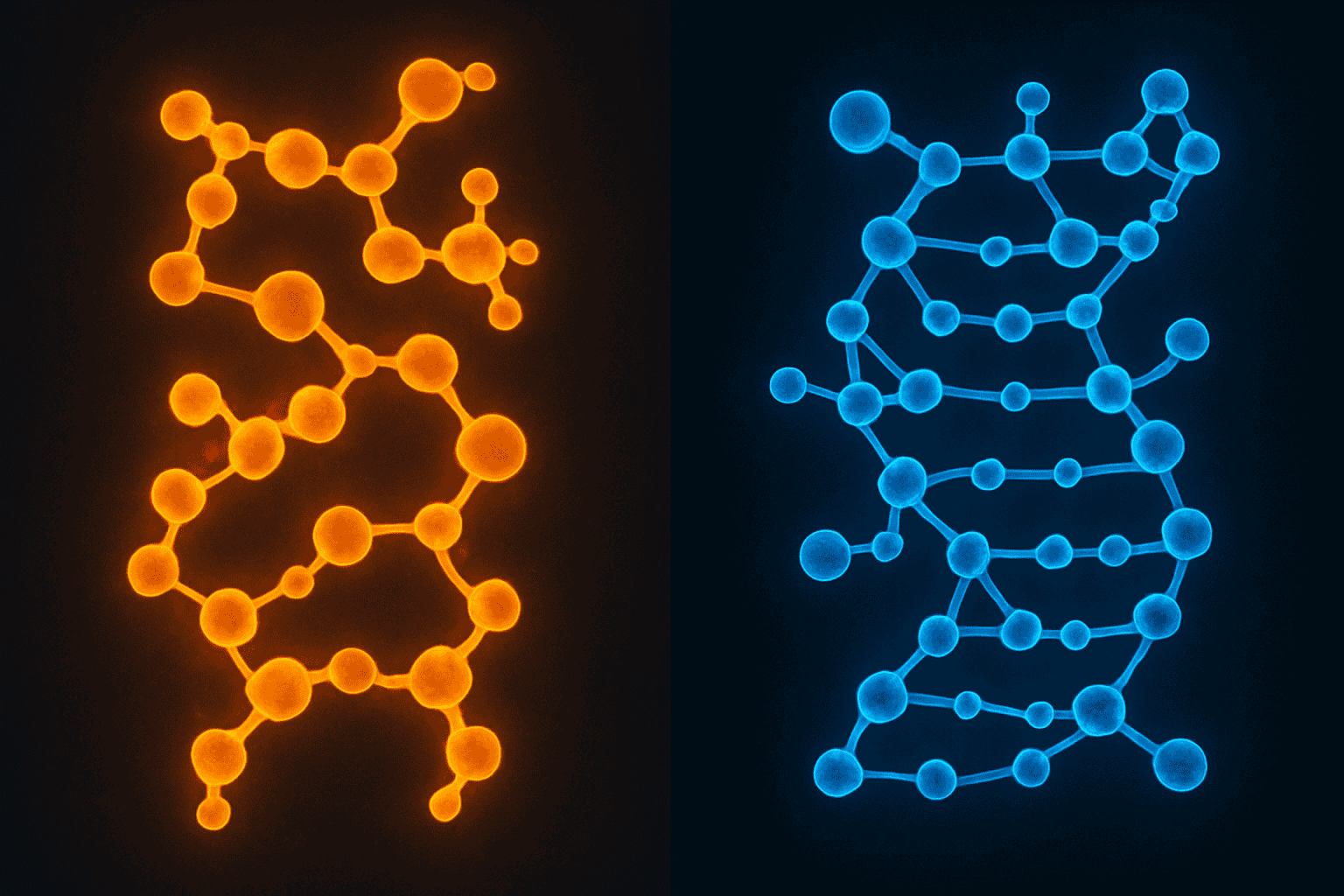
GLP-2 is a relatively short peptide — 33 amino acids. It degrades quickly in the body because an enzyme called DPP-4 chops it up within minutes. GLP-3 is a larger, more complex molecule. Its triple-receptor activity requires a more elaborate amino acid architecture to engage three different binding sites. The structural complexity of GLP-3 is part of why it took longer to develop — fitting one key to three different locks demands precise engineering.
Maturity of the Research
This is an important practical difference. GLP-2 has been studied since the 1990s. A pharmaceutical analog based on GLP-2 received FDA approval in 2012, which tells you the basic science was deep enough to support a full drug development program (Drucker, 2019). Thousands of papers have been published on GLP-2R biology.
GLP-3 research is much newer. The first major clinical data appeared in 2022 and 2023 in The Lancet. The compound is generating excitement precisely because it’s early-stage — there’s still a lot to discover. But that also means the evidence base is thinner. Researchers should keep that context in mind.

[PERSONAL EXPERIENCE] In our experience reviewing orders and inquiries from research customers, confusion between GLP-2 and GLP-3 is one of the most common sourcing mistakes. The names look interchangeable. They aren’t. GLP-2 is for gut biology research. GLP-3 is for multi-receptor metabolic pathway research. Ordering the wrong one won’t just waste money — it will produce data that doesn’t answer your research question.
Which Peptide Is Right for Your Research?
The answer depends entirely on the scientific question being asked. According to Yazbeck et al., GLP-2R activation has been investigated primarily in preclinical models of intestinal architecture and barrier function — making GLP-2 the standard research tool for gut-focused work (Yazbeck et al., 2010). GLP-3 serves a different purpose entirely.
Choose GLP-2 if your research involves:
- Intestinal epithelial biology and gut wall structure
- Barrier function and tight junction protein studies
- Enteric nervous system signaling
- GLP-2R-specific receptor pharmacology
Choose GLP-3 if your research involves:
- Multi-receptor activation studies across GLP-1R, GIPR, and glucagon receptors
- Comparing single-agonist vs. dual-agonist vs. triple-agonist pathway activity
- Investigating how three metabolic signaling systems interact simultaneously
Both compounds are available from Alpha Peptides with batch-specific Certificates of Analysis. You can review documentation on our COA page and find research-grade GLP-2 and GLP-3 on their respective product pages. For a broader comparison across the entire GLP peptide family, see our full GLP-1, GLP-2, and GLP-3 comparison guide.
[INTERNAL-LINK: “COA page” -> /coas/]
[INTERNAL-LINK: “GLP-2” -> /product/glp-2-tz/]
[INTERNAL-LINK: “GLP-3” -> /product/glp-3-rt/]
[INTERNAL-LINK: “full GLP-1, GLP-2, and GLP-3 comparison guide” -> /blog/glp-1-glp-2-glp-3-comparison/]

Frequently Asked Questions
Are GLP-3 and GLP-2 the same thing?
No. Despite the similar names, GLP-3 and GLP-2 are fundamentally different compounds. GLP-2 is a natural 33-amino acid gut hormone that activates one intestinal receptor (GLP-2R). GLP-3 is a fully synthetic triple incretin receptor agonist analog that activates three different receptors — GLP-1R, GIPR, and the glucagon receptor. They share zero receptor targets.
Does the body naturally produce GLP-3?
No. GLP-3 is entirely synthetic — it was designed in a laboratory. Your body does naturally produce GLP-2 (and GLP-1) from intestinal L-cells after eating, but GLP-3 does not occur anywhere in human biology. It was engineered by combining structural elements to engage three receptor systems that natural peptides only activate individually.
What receptors does each peptide target?
GLP-2 targets one receptor: GLP-2R, concentrated in the small intestine. GLP-3 targets three receptors: the GLP-1 receptor, the GIP receptor, and the glucagon receptor, distributed across multiple organs including the pancreas, brain, liver, and gut. The distinction means these peptides are used for completely separate lines of research.
Where can I read the published research on these peptides?
For GLP-2, Drucker’s 2019 review in ACS Pharmacology & Translational Science (PMID: 32219218) provides an authoritative overview. For GLP-3, the Rosenstock et al. (2023) phase 2 trial in The Lancet (PMID: 37385280) and Urva et al. (2022) phase 1b study (PMID: 36354040) are the key published references.
Can I use GLP-3 or GLP-2 for personal use?
No. Both GLP-3 and GLP-2 are sold strictly for laboratory and scientific research purposes. They are not approved for human consumption by the FDA or any regulatory body. Alpha Peptides supplies these compounds exclusively for research use. For details on what “research use only” means, see our explanation here.
[INTERNAL-LINK: “research use only” -> /blog/research-use-only-what-it-means/]
Conclusion
GLP-3 vs GLP-2 isn’t really a competition — it’s a comparison between two research tools built for different jobs. GLP-2 is a natural gut peptide with 30-plus years of published literature behind it and a proven role in intestinal biology research. GLP-3 is a newer, fully synthetic triple agonist with early-stage clinical data and a much wider receptor footprint.
The key takeaway: these peptides share a naming convention, not a function. GLP-2 talks to one receptor in the gut wall. GLP-3 talks to three receptors spread across multiple organ systems. Knowing that difference is the starting point for sourcing the right compound for your research.
Explore research-grade GLP-3 and GLP-2, review batch documentation on our COA page, or read our companion posts on GLP-3 vs GLP-1 for additional context on how these peptide families relate to each other.
[INTERNAL-LINK: “GLP-3” -> /product/glp-3-rt/]
[INTERNAL-LINK: “GLP-2” -> /product/glp-2-tz/]
[INTERNAL-LINK: “COA page” -> /coas/]
[INTERNAL-LINK: “GLP-3 vs GLP-1” -> /blog/glp-3-vs-glp-1-difference/]
For research use only. Not for human consumption. This article is intended for informational purposes and does not constitute medical advice, dosing guidance, or therapeutic recommendations.