
· For research use only. Not for human consumption.
GLP-2 nutrient absorption is a research topic that connects gut biology to one of the most fundamental processes in the body: getting nutrients from food into the bloodstream. GLP-2 (glucagon-like peptide-2) is a naturally occurring intestinal hormone, and published preclinical research has investigated its role in promoting the intestinal surface area responsible for absorbing nutrients.
If you’ve ever wondered how your gut actually absorbs vitamins, minerals, and other nutrients from what you eat, this article will make sense of it — and explain why GLP-2 has become such an important research tool for scientists studying that process. No science background needed.
For a broader look at GLP-2, start with our guide on GLP-2 and intestinal biology. To understand how GLP-2 maintains the gut wall, see our post on GLP-2 and the gut barrier.
[INTERNAL-LINK: “GLP-2 and intestinal biology” -> /blog/glp-2-intestinal-biology-research/]
[INTERNAL-LINK: “GLP-2 and the gut barrier” -> /blog/glp-2-gut-barrier-research/]
TL;DR: GLP-2 nutrient absorption research examines how this gut hormone influences the intestinal surface area available for absorbing nutrients. Preclinical studies have investigated GLP-2’s role in promoting villus growth, which increases the absorptive surface of the intestine. Drucker DJ (2019) documented GLP-2’s discovery and intestinal effects (PMID: 32219218), and Yazbeck R (2010) reviewed GLP-2 analog investigation in gastrointestinal models (PMID: 21154171). For research use only. Not for human consumption.
How Nutrients Are Absorbed in the Gut
Before understanding GLP-2’s role, you need to know how nutrient absorption works in the first place. It’s actually a beautifully simple concept once you strip away the technical jargon.
When you eat food, it gets broken down in the stomach into tiny particles. Those particles then move into the small intestine, which is where most absorption happens. The lining of the small intestine is designed to pull nutrients out of the digested food and transfer them into the bloodstream, where they can be delivered to the rest of the body.
The key to efficient absorption is surface area. The more surface the intestine has, the more contact points exist between the digested food and the absorptive cells. Your body uses a clever trick to maximize this surface area: instead of having a smooth, flat intestinal wall, it creates folds, projections, and microscopic bumps that dramatically increase the total surface area available for absorption.
This is where GLP-2 enters the picture. Preclinical research has investigated how GLP-2 influences the growth and maintenance of these surface-area-increasing structures.
Villi and Microvilli: Carpet vs. Tile Flooring
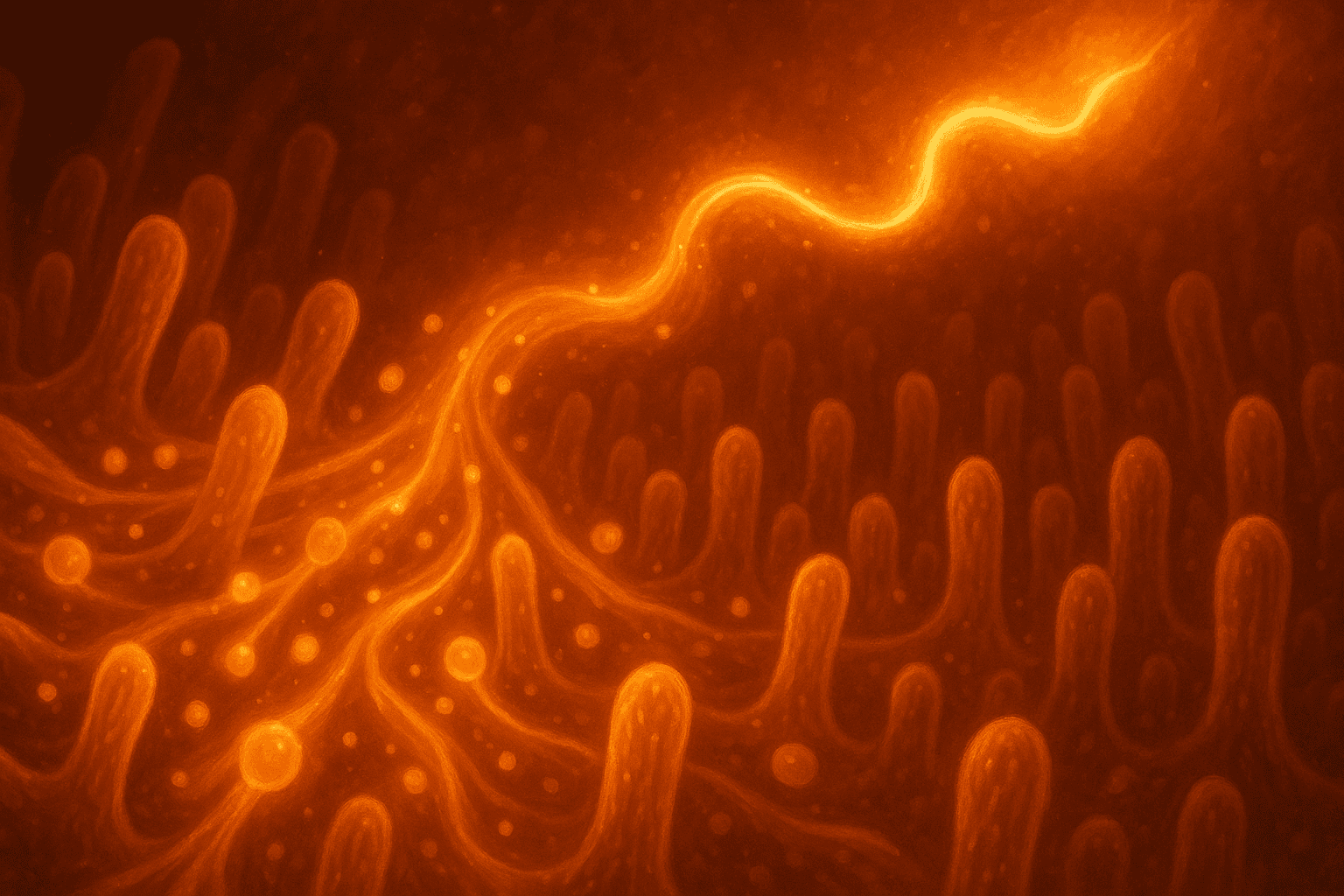
The inside of your small intestine is covered in millions of tiny finger-like projections called villi. Each villus is about one millimeter tall — tiny by everyday standards, but enormous in the world of cells. And on the surface of each villus, there are even tinier projections called microvilli, forming what scientists call the “brush border.”
Here’s an easy way to picture this: imagine two rooms of the same size. One has smooth tile flooring. The other has thick, deep carpet. The carpet room has far more surface area because every fiber adds a little bit of extra surface. Now imagine that each carpet fiber itself is covered in even finer fuzz. That’s essentially what villi and microvilli do for your intestine.
The result is remarkable. If you could flatten out all the folds, villi, and microvilli of the small intestine, the total surface area would be enormous — far larger than you’d expect from a tube that’s only about 20 feet long. This massive surface area is what makes efficient GLP-2 nutrient absorption research so compelling to scientists.
GLP-2’s Role in Promoting Intestinal Surface Area
This is where the connection becomes clear. GLP-2 has been investigated in preclinical models for its role in promoting the growth and maintenance of villi — those finger-like projections that create the intestine’s enormous absorptive surface area.
In animal model studies, researchers have observed that GLP-2 administration is associated with increases in villus height, intestinal mucosal thickness, and overall intestinal weight. When the villi grow taller, they create more surface area. More surface area means more contact between the intestinal lining and the nutrients passing through.
GLP-2 appears to accomplish this through its effects on the crypt cells at the base of each villus. These crypt cells are the stem cells of the intestine — they produce new lining cells that migrate upward to form the villus. Published research has examined how GLP-2 influences the rate of cell production in these crypts, which in turn affects villus height and absorptive capacity.
It’s important to emphasize that these observations come from preclinical and laboratory research. GLP-2 nutrient absorption studies in the published literature document effects in controlled experimental settings, not conclusions about human applications.
Drucker DJ (2019) documented how GLP-2 was discovered to promote intestinal mucosal growth in preclinical models, including observations of increased villus height and crypt cell proliferation that relate directly to the intestine’s absorptive capacity. (PMID: 32219218)
Preclinical Research on GLP-2 Nutrient Absorption
The published literature on GLP-2 and nutrient absorption spans several decades of preclinical investigation. Researchers have used animal models to examine how GLP-2 and its analogs affect various aspects of intestinal absorptive function.
One area of investigation involves transporter proteins. The cells lining the intestine use specialized proteins to move specific nutrients from the gut lumen (the inside of the tube) into the cell and then into the bloodstream. Some preclinical studies have examined whether GLP-2 influences the expression or activity of these transporter proteins, adding a molecular layer to the surface-area story.
Another research area involves blood flow. Efficient absorption requires not just surface area and transporters, but also adequate blood supply to carry absorbed nutrients away. GLP-2 has been investigated in preclinical models for its potential effects on intestinal blood flow, which would complement its surface-area effects by ensuring nutrients have somewhere to go once absorbed.
A third area examines the relationship between GLP-2 and specific nutrient types. Some researchers have investigated whether GLP-2’s effects are more pronounced for certain categories of nutrients (sugars, amino acids, fats) than others, which could provide insights into which transporter pathways are most influenced by GLP-2 signaling.
Why GLP-2 Nutrient Absorption Research Matters
Understanding how the body controls nutrient absorption at the hormonal level is a fundamental question in biology. GLP-2 provides researchers with a tool to investigate this question because it sits at the intersection of hormonal signaling and intestinal structure.
The research is significant because it connects two things that might seem separate: a signaling molecule (GLP-2) and a physical structure (the intestinal surface area). GLP-2 doesn’t absorb nutrients itself — it influences the growth and maintenance of the structures that do the absorbing. This makes it a regulator of absorption capacity rather than an absorber.
For researchers studying intestinal biology, GLP-2 provides a way to ask questions like: What controls how much surface area the intestine maintains? What signals the gut to grow or shrink its absorptive lining? How do hormonal inputs coordinate with the physical architecture of the intestine? These are fundamental questions that GLP-2 research helps address.
All published data on this topic comes from laboratory and preclinical studies. GLP-2 nutrient absorption research represents current scientific understanding based on controlled experiments, not clinical conclusions.
Yazbeck R (2010) reviewed the investigation of teduglutide (a GLP-2 analog) across multiple gastrointestinal research models, including studies examining the compound’s relationship to intestinal absorptive function and mucosal growth in preclinical settings. (PMID: 21154171)
Alpha Peptides offers research-grade GLP-2 with independent third-party testing and a Certificate of Analysis included with every order. For researchers investigating nutrient absorption pathways, intestinal surface area dynamics, or villus biology, GLP-2 remains one of the most thoroughly documented compounds in the field. Visit our research peptides shop to browse the full catalog, or check our Certificates of Analysis page for testing documentation.
Frequently Asked Questions
How does GLP-2 relate to nutrient absorption?
GLP-2 has been investigated in preclinical research for its role in promoting the growth of villi — the finger-like projections in the intestine that create absorptive surface area. By influencing villus height and intestinal mucosal thickness, GLP-2 may affect the intestine’s total absorptive capacity.
What are villi and microvilli?
Villi are tiny finger-like projections lining the inside of the small intestine. Microvilli are even smaller projections on the surface of each villus. Together, they dramatically increase the intestine’s surface area — like how carpet has far more surface area than a flat tile floor.
Has GLP-2 been studied for effects on specific nutrients?
Some preclinical research has examined whether GLP-2 affects the absorption of specific nutrient types (such as sugars, amino acids, or fats) by influencing transporter proteins in the intestinal lining. This research is ongoing in laboratory settings.
Is this research applicable to humans?
The GLP-2 nutrient absorption research described in this article comes from preclinical and laboratory studies. No conclusions about human applications should be drawn from these findings. The GLP-2 analog sold by Alpha Peptides is for research use only.
Where can I read more about GLP-2 research?
Our posts on GLP-2 and intestinal biology and GLP-2 and the gut barrier cover complementary research areas. The PubMed citations in this article link to detailed scientific publications.
For research use only. Not for human consumption. This article is intended for informational and educational purposes. It does not constitute medical advice, and no therapeutic claims are made. Always consult published peer-reviewed literature for detailed research data.