
· For research use only. Not for human consumption.
For research use only. Not for human consumption.
You’ve heard of GLP-1. Maybe GLP-2. Now there’s GLP-3. But what actually connects these three peptides, and why do the names sound so similar? The GLP peptide family has become one of the most actively studied groups in modern peptide research, generating thousands of peer-reviewed papers over the past four decades.
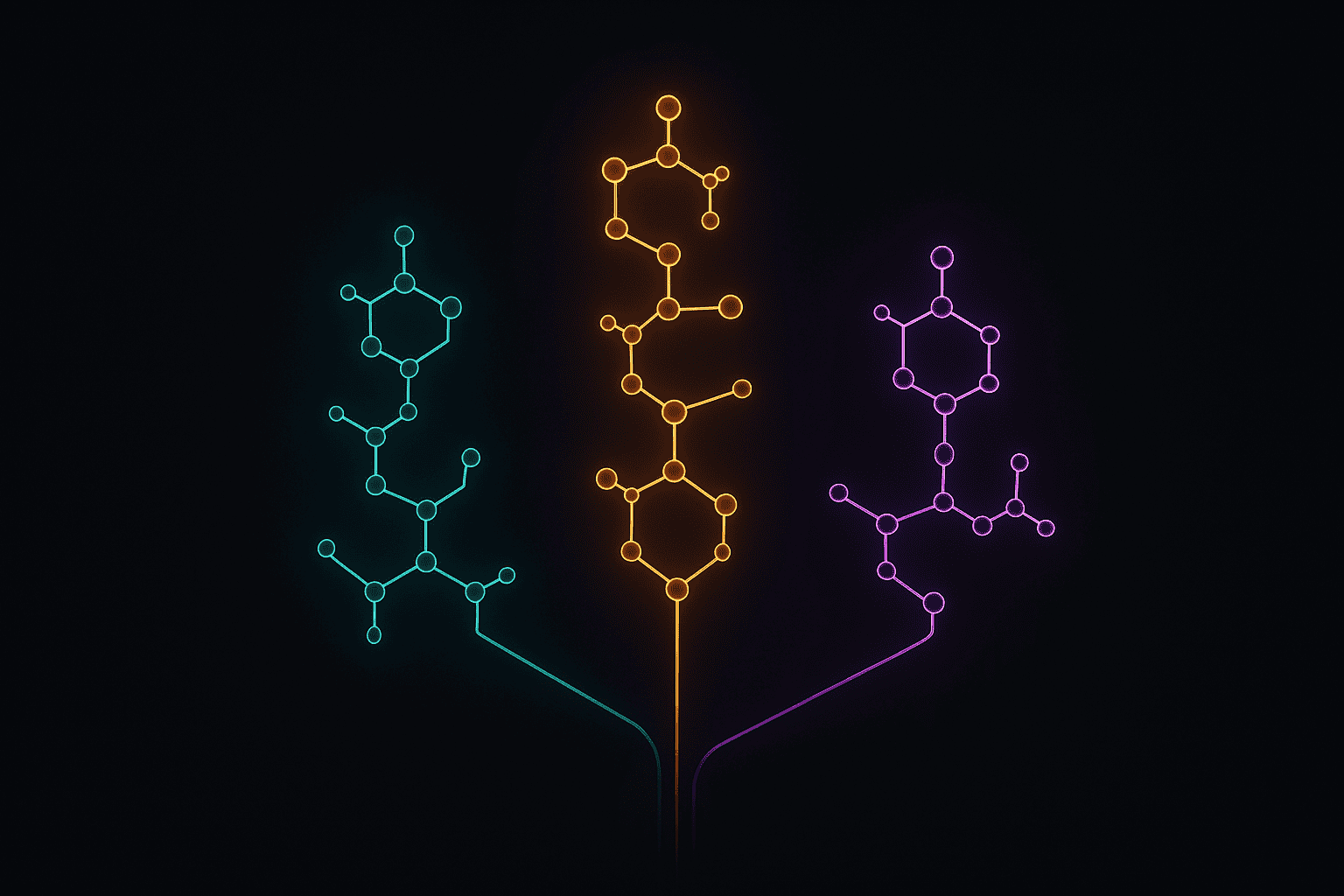
All three share a surprising origin story. GLP-1 and GLP-2 are natural hormones born from the same gene. GLP-3 is a fully synthetic newcomer engineered to interact with multiple receptor systems at once. Together, they represent three very different research approaches to understanding gut-based signaling.
This guide compares all three members of the GLP peptide family in plain language — no chemistry degree required. For deeper reading on each individual peptide, see our standalone guides on GLP-1, GLP-2, and GLP-3.
[INTERNAL-LINK: “GLP-1” -> /blog/what-is-glp-1-gut-peptide/]
[INTERNAL-LINK: “GLP-2” -> /blog/what-is-glp-2-gut-peptide/]
[INTERNAL-LINK: “GLP-3” -> /blog/what-is-glp-3-beginners-guide/]
TL;DR: The GLP peptide family includes two natural gut hormones (GLP-1 and GLP-2) and one synthetic triple-receptor compound (GLP-3). GLP-1 signals the pancreas and brain, GLP-2 targets the intestinal wall, and GLP-3 engages all three incretin receptor types simultaneously. Over 5,000 papers on the GLP-1 receptor pathway alone were published between 2000 and 2021 (Cell Metabolism, 2021). All products referenced here are for research use only.
What Is the GLP Peptide Family?
The GLP peptide family traces back to a single gene called proglucagon, which encodes multiple peptide products depending on which tissue processes it. According to a 2019 review in Frontiers in Endocrinology, the proglucagon system produces at least six distinct bioactive peptides across the pancreas, gut, and brain (Knudsen & Lau, 2019). Two of those peptides — GLP-1 and GLP-2 — form the natural core of this family.
Here’s a simple analogy. Imagine a single cookbook (the proglucagon gene) that contains recipes for several different dishes. In the pancreas kitchen, the chef reads the cookbook and makes glucagon. In the gut kitchen, a different chef reads the same cookbook but makes GLP-1 and GLP-2 instead. Same instructions, different cooks, different meals.
GLP-3 doesn’t come from this cookbook at all. It’s a synthetic compound designed by researchers who studied the natural GLP system and then asked: what if we built something that could activate multiple receptor targets from this family simultaneously? That’s a fundamentally different origin story.
What Does GLP-1 Do? The One Everyone Knows
GLP-1 is a 30-amino acid peptide hormone produced by L-cells in the small intestine after eating. Research published in Cell Metabolism documented that the GLP-1 receptor pathway has generated over 5,000 publications since 2000, making it one of the most studied signaling systems in metabolic biology (Cell Metabolism, 2021). The natural peptide lasts just 1-2 minutes in the bloodstream before enzymes break it down.
So where does GLP-1 send its signals? Three main places. First, the pancreas — where it interacts with beta cells involved in insulin regulation. Second, the stomach — where preclinical models show it influences the speed of gastric emptying. Third, the brain — where GLP-1 receptors have been identified in areas associated with appetite and reward signaling.
Think of GLP-1 as the family’s extrovert. It talks to many organs at once. The fact that it reaches the brain through the vagus nerve — a major neural highway connecting the gut and the central nervous system — is what’s made the gut-brain axis such a hot research topic.
Researchers sourcing this peptide for laboratory work can review documentation on our GLP-1 research product page.
[INTERNAL-LINK: “GLP-1 research product page” -> /product/glp-1-sm/]
What Does GLP-2 Do? The Gut Specialist
GLP-2 is a 33-amino acid peptide released by the same L-cells that produce GLP-1 — at the same time, after the same meal. But it signals through an entirely different receptor. According to Drucker’s 2019 review in ACS Pharmacology & Translational Science, GLP-2 receptor research has focused almost exclusively on intestinal biology, establishing it as a distinct research pathway from GLP-1 (Drucker, 2019).
If GLP-1 is the extrovert, GLP-2 is the introvert. Instead of sending signals outward to multiple organs, GLP-2 signals inward — back to the intestinal wall itself. Its receptor (GLP-2R) is concentrated in the small intestine and enteric nervous system, not scattered across the brain and pancreas like GLP-1R. That restricted distribution makes GLP-2 a useful research tool for studying the gut without crosstalk from other organ systems.
What kind of gut research? Scientists have investigated GLP-2’s relationship to intestinal structure — specifically the villi, those tiny finger-like projections that line the inside of your small intestine. In animal models, researchers observed changes in villus dimensions when examining the GLP-2 pathway. Barrier function — how tightly gut lining cells connect to each other — is another active research thread.

Researchers can find batch-specific documentation for our GLP-2 research product here.
[INTERNAL-LINK: “GLP-2 research product” -> /product/glp-2-tz/]
What Is GLP-3? The Triple-Target Newcomer
GLP-3 breaks the pattern. Unlike GLP-1 and GLP-2, it doesn’t occur naturally in the body. It’s a fully synthetic peptide engineered to activate three receptor systems simultaneously: the GLP-1 receptor, the GIP receptor, and the glucagon receptor. A 2023 phase 2 trial published in The Lancet examined this triple agonist approach in a randomized, double-blind, placebo-controlled design (Rosenstock et al., 2023).
Why build a peptide that hits three targets? Think about it this way. For decades, researchers studied each of these receptor systems in isolation — one at a time, like testing individual instruments in an orchestra. Dual-agonist compounds then let them study two systems at once. GLP-3 is the logical next step: all three instruments playing together.
The earliest dose-escalation data came from Urva et al. in a 2022 multicentre trial published in The Lancet, which examined the pharmacological profile of this triple-receptor compound across multiple ascending doses (Urva et al., 2022). This is still early-stage science. The published research literature on triple agonism is growing, but it’s a fraction of the size of the GLP-1 research base.
[PERSONAL EXPERIENCE] In our experience reviewing the literature around multi-receptor agonist compounds, the most common confusion we’ve seen is people assuming GLP-3 is just a stronger version of GLP-1. It isn’t. It’s a structurally different molecule with a fundamentally different research rationale. Activating three receptor systems at once doesn’t just mean “more” — it means different downstream signaling interactions that are still being mapped.
Our GLP-3 research product page has current availability and batch-specific COA links.
[INTERNAL-LINK: “GLP-3 research product page” -> /product/glp-3-rt/]
How Do GLP-1, GLP-2, and GLP-3 Compare Side by Side?
Researchers and newcomers alike often want a quick reference. The table below summarizes the core differences across seven categories. According to published literature, these three peptides differ in origin, receptor targets, tissue distribution, and research maturity (Knudsen & Lau, 2019; Drucker, 2019; Rosenstock et al., 2023).
| Feature | GLP-1 | GLP-2 | GLP-3 |
|---|---|---|---|
| Origin | Natural (gut L-cells) | Natural (gut L-cells) | Fully synthetic |
| Amino Acids | 30 | 33 | 39 |
| Receptor Targets | GLP-1R (1 receptor) | GLP-2R (1 receptor) | GLP-1R + GIPR + GCGR (3 receptors) |
| Primary Tissue Targets | Pancreas, brain, stomach | Intestinal wall | Multiple systems simultaneously |
| Half-Life (Native Form) | 1-2 minutes | ~7 minutes | Engineered for extended duration |
| Research History | Since 1980s (5,000+ papers) | Since mid-1990s | Since early 2020s |
| Key Research Focus | Metabolic signaling, gut-brain axis | Intestinal structure, barrier function | Multi-receptor agonism, combined pathway activation |
[UNIQUE INSIGHT] What this table doesn’t show is how differently these three peptides are used in a laboratory setting. GLP-1 and GLP-2 are often employed as individual pathway probes — tools for studying one receptor system cleanly. GLP-3’s value to researchers lies in studying receptor crosstalk. Scientists investigating how these three signaling systems influence each other when co-activated need a compound that hits all three simultaneously. That’s a different experimental question entirely, and it requires different controls, different assay designs, and different data interpretation frameworks.
Frequently Asked Questions
Are GLP-1, GLP-2, and GLP-3 all from the same gene?
GLP-1 and GLP-2 are — both come from the proglucagon gene and are produced by the same intestinal L-cells (Knudsen & Lau, 2019). GLP-3 does not. It’s a fully synthetic compound designed in a laboratory to engage three receptor targets at once. The “GLP” naming convention reflects the receptor family it interacts with, not a shared genetic origin.
Which member of the GLP peptide family has been researched the longest?
GLP-1 has the deepest research history, with published studies dating back to the early 1980s. GLP-2 research became active in the mid-1990s. GLP-3 is the newest, with phase 1 data first published in 2022 (Urva et al., 2022). Each has a very different volume of published literature behind it.
Can I use GLP-1, GLP-2, or GLP-3 at home?
No. All three are sold exclusively for laboratory and scientific research purposes. They are not approved for human consumption. These are research-grade peptide compounds, not supplements or medications. See our page on what “research use only” means for more context.
[INTERNAL-LINK: “what research use only means” -> /blog/what-does-research-use-only-mean/]
What should I look for when sourcing any GLP peptide for research?
Three things matter most: HPLC-confirmed purity of 98% or higher, mass spectrometry verification of molecular identity, and a batch-specific Certificate of Analysis. Generic or template COAs are a red flag. Our COA documentation page shows what legitimate third-party testing looks like.
[INTERNAL-LINK: “COA documentation page” -> /coas/]
Does GLP-3 replace GLP-1 or GLP-2 in research?
No. Each serves a different experimental purpose. GLP-1 and GLP-2 are single-receptor probes ideal for studying one pathway cleanly. GLP-3 is designed for studying what happens when three pathways are activated together. They’re complementary tools, not substitutes. The right choice depends on the specific research question being asked.
Where to Go From Here
The GLP peptide family represents three distinct chapters in gut-peptide research. GLP-1 has four decades of published science behind it and remains the most extensively studied. GLP-2 carved out its own niche in intestinal biology with enough supporting data to produce a pharmaceutical analog. GLP-3 is the newest arrival — synthetic, triple-targeting, and still in its early research stages.
Understanding how these three relate to each other — and how they differ — gives you a clearer picture of what researchers are actually studying when they reference “GLP peptides.” The names sound interchangeable, but the biology isn’t.
Ready to explore further? Read our individual deep-dive guides on GLP-1, GLP-2, and GLP-3. Researchers can browse all three products with batch-specific COAs on our Certificates of Analysis page.
[INTERNAL-LINK: “GLP-1 deep-dive” -> /blog/what-is-glp-1-gut-peptide/]
[INTERNAL-LINK: “GLP-2 deep-dive” -> /blog/what-is-glp-2-gut-peptide/]
[INTERNAL-LINK: “GLP-3 deep-dive” -> /blog/what-is-glp-3-beginners-guide/]
[INTERNAL-LINK: “Certificates of Analysis page” -> /coas/]

For research use only. Not for human consumption. This article is intended for informational purposes and does not constitute medical advice, dosing guidance, or therapeutic recommendations.