
· For research use only. Not for human consumption.
Browse Research Peptides — Lab Tested, COA Included →
For research use only. Not for human consumption.
Brain peptide research is one of the fastest-growing areas in modern neuroscience, and 2026 is shaping up to be a particularly active year. Peptides are short chains of amino acids — the same building blocks that make up proteins — and scientists have discovered that certain peptides interact with brain systems in ways that make them valuable research tools. From compounds derived from immune system fragments to modified pieces of brain hormones, the brain peptide research landscape has never been broader.
This isn’t a niche topic anymore. Laboratories around the world are investigating how synthetic peptides interact with neurotransmitter systems, neurotrophic factor pathways, and neuroprotective mechanisms. The compounds being studied include Selank (a tuftsin-derived heptapeptide), Semax (an ACTH fragment), and a growing list of other neuropeptides that target specific brain pathways.
This article provides a complete overview of where brain peptide research stands in 2026. It’s written for everyday readers with no science background and covers the major compounds, the key research directions, and why this field is attracting so much attention. For detailed posts on individual compounds, see our guides on Selank nootropic research and Semax and its ACTH origins.
[INTERNAL-LINK: “Selank nootropic research” -> /blog/selank-nootropic-research-overview/]
[INTERNAL-LINK: “Semax and its ACTH origins” -> /blog/semax-acth-fragment-explained/]
TL;DR: Brain peptide research in 2026 spans multiple compounds including Selank and Semax, with published findings on neurotransmitter interactions (Eremin et al., 2005; PMID: 16362768), neuroprotection (Levitskaya et al., 2004; PMID: 15341218), and neurotrophic factor regulation (Kolik et al., 2019; PMID: 31625062). This capstone overview connects the major research threads. All research is preclinical. All peptides are sold for research use only.
Why Peptides Are Interesting for Brain Peptide Research
Before diving into specific compounds, it helps to understand why peptides have become such popular brain peptide research tools. Three properties make them stand out.
First, peptides are small. Most proteins in your body are hundreds or thousands of amino acids long. Peptides, by contrast, are typically 2 to 50 amino acids. This small size means they can potentially cross biological barriers that larger proteins cannot — including the blood-brain barrier, the protective layer that separates the brain from the bloodstream.
Second, peptides are specific. Because they’re built from defined sequences of amino acids, each peptide has a particular three-dimensional shape. That shape determines which receptors it can interact with, like a key fitting into specific locks. This specificity allows researchers to target particular brain pathways rather than triggering broad, nonspecific effects.
Third, peptides can be modified. Scientists can change individual amino acids, add stabilizing tails, or combine fragments from different sources. This flexibility makes peptides uniquely adaptable as research tools. The Pro-Gly-Pro tail added to Semax is a perfect example — it doesn’t change what the peptide does, but it makes it last longer in experimental settings.
Selank: The Tuftsin-Derived Neuropeptide
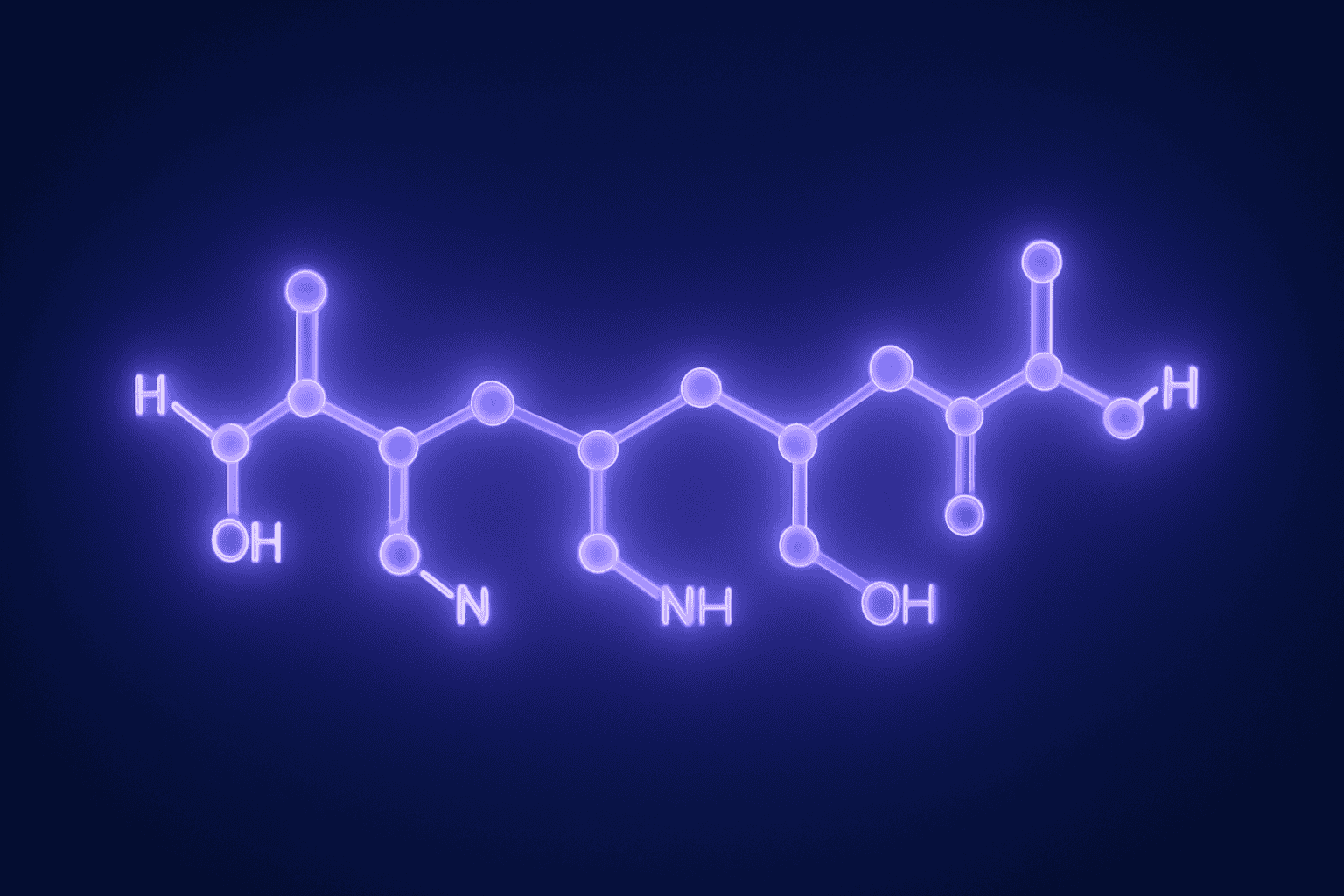
Selank is a seven-amino-acid synthetic peptide developed from tuftsin, a natural fragment of immunoglobulin G (an immune system protein). Russian scientists at the Institute of Molecular Genetics took the four-amino-acid tuftsin sequence and added a Pro-Gly-Pro stabilizing tail, creating a heptapeptide designed for brain peptide research applications.
The published research on Selank spans multiple areas. Seredenin et al. (1998) documented its anxiolytic properties in preclinical behavioral models (PMID: 9583175). Kozlovskaya et al. (2003) studied Selank alongside other tuftsin-family peptides and their neurotransmitter interactions (PMID: 14969422). Most recently, Kolik et al. (2019) connected Selank to BDNF regulation in models of memory impairment (PMID: 31625062).
What makes Selank significant in the brain peptide research landscape is the breadth of its documented interactions. It has been connected to GABAergic signaling, serotonergic pathways, and neurotrophic factor regulation — three distinct brain systems. For a deep dive, see our posts on Selank and GABA, Selank and BDNF, and the Selank-tuftsin connection.
[INTERNAL-LINK: “Selank and GABA” -> /blog/selank-gaba-research-studies/]
[INTERNAL-LINK: “Selank and BDNF” -> /blog/selank-bdnf-research-studies/]
[INTERNAL-LINK: “Selank-tuftsin connection” -> /blog/selank-tuftsin-connection/]
Kolik et al. (2019) investigated Selank in preclinical models of ethanol-induced memory impairment and found connections to BDNF regulation. This study expanded the peptide’s research profile from primarily behavioral observations to molecular-level neurotrophic factor interactions. (PMID: 31625062)
Semax: The ACTH Fragment Neuropeptide
Semax is a synthetic peptide based on amino acids 4 through 10 of ACTH (adrenocorticotropic hormone), a hormone the pituitary gland produces. Like Selank, it was developed by Russian scientists who added a Pro-Gly-Pro stabilizing tail to the natural fragment. The result is a ten-amino-acid research peptide with a distinct set of documented brain interactions.
The brain peptide research on Semax covers three major areas. Eremin et al. (2005) documented activation of dopaminergic and serotoninergic systems (PMID: 16362768). Levitskaya et al. (2004) investigated neuroprotective properties using an MPTP model (PMID: 15341218). Dolotov et al. (2006) connected Semax to BDNF and trkB expression (PMID: 16996037).
Like Selank, Semax stands out for its multi-system interaction profile. It has documented connections to dopamine, serotonin, and neurotrophic factors — making it another versatile tool in the brain peptide research toolkit. For detailed coverage, see our posts on Semax and dopamine and Semax and neuroprotection.
[INTERNAL-LINK: “Semax and dopamine” -> /blog/semax-dopamine-research-studies/]
[INTERNAL-LINK: “Semax and neuroprotection” -> /blog/semax-neuroprotection-research/]
Eremin et al. (2005) found that Semax activated both dopaminergic and serotoninergic brain systems in preclinical models. This dual-system activation documented through neurotransmitter turnover measurements established Semax as a multi-target brain peptide research compound. (PMID: 16362768)
Emerging Directions in Brain Peptide Research

Beyond Selank and Semax, the brain peptide research field in 2026 is expanding in several notable directions.
Neurotrophic factor modulation is one of the hottest areas. The discovery that synthetic peptides can interact with BDNF and other growth factors has opened an entire research stream focused on how short amino acid chains influence neuron growth and survival. This builds directly on the foundation laid by studies like Dolotov et al. (2006) and Kolik et al. (2019).
Multi-target compounds are attracting increased attention. Traditional brain peptide research often focused on compounds that interacted with a single neurotransmitter system. The finding that both Selank and Semax interact with multiple systems simultaneously has shifted the field’s interest toward understanding how peptides coordinate activity across different brain networks.
Stability engineering — the practice of modifying peptides to resist enzymatic breakdown — continues to evolve. The Pro-Gly-Pro tail used in both Selank and Semax was a pioneering approach, and newer techniques for extending peptide stability are being developed and published regularly. For more on peptide structure, see our post on what is a heptapeptide.
[INTERNAL-LINK: “what is a heptapeptide” -> /blog/what-is-heptapeptide-seven-amino-acid/]
The Russian Contribution to Brain Peptide Research
It’s impossible to discuss brain peptide research without acknowledging Russia’s outsized contribution to the field. Both Selank and Semax were developed at the Institute of Molecular Genetics in Moscow, and much of the foundational research was published by Russian scientists in Russian and international journals.
This is not a coincidence. The Soviet Union and later Russia invested heavily in peptide chemistry as a research discipline, producing a body of work that Western scientists are still catching up with. The publications by Seredenin, Kozlovskaya, Eremin, Dolotov, Levitskaya, Kolik, and their colleagues represent decades of systematic investigation.
For the full story, see our detailed post on Russian peptide research history, which covers how political, scientific, and institutional factors created one of the world’s most productive brain peptide research programs.
[INTERNAL-LINK: “Russian peptide research history” -> /blog/russian-peptide-research-history/]
Where Can Researchers Source Brain Peptides?
Research-grade brain peptides require verified purity documentation. Look for a supplier providing third-party HPLC purity data (minimum 98%), mass spectrometry confirmation of the correct molecular weight, and batch-specific Certificates of Analysis.
Alpha Peptides carries research-grade Selank and Semax with publicly available COAs. You can review documentation on our Certificates of Analysis page or browse the full catalog below.
[INTERNAL-LINK: “Certificates of Analysis page” -> /coas/]
Frequently Asked Questions
What is brain peptide research?
Brain peptide research is the scientific study of how short amino acid chains (peptides) interact with brain systems. This includes investigating interactions with neurotransmitter systems, neurotrophic factors, and neuroprotective pathways. All work is conducted in preclinical settings using animal models and cell cultures.
What are the main brain peptides being studied in 2026?
The two most extensively studied brain peptides with published preclinical data are Selank (a tuftsin-derived heptapeptide) and Semax (an ACTH fragment). Both have documented interactions with multiple brain systems and are subjects of ongoing brain peptide research in laboratories worldwide.
Why are peptides useful for neuroscience research?
Peptides are small enough to potentially cross the blood-brain barrier, specific enough to target particular receptor systems, and flexible enough to be modified for stability. These three properties make them valuable tools for brain peptide research compared to larger proteins or non-specific chemical compounds.
Is brain peptide research conducted in humans?
The research cited in this article is preclinical, meaning it was conducted in animal models or in vitro laboratory settings. All peptides mentioned are research compounds intended for laboratory investigation only. They are not approved for human use.
For research use only. Not for human consumption. All peptides referenced in this article are intended exclusively for laboratory and preclinical research purposes. Nothing on this page constitutes medical advice, dosing guidance, or a recommendation for personal use. All information is provided for educational purposes relating to peptide chemistry and laboratory research practice.