
· For research use only. Not for human consumption.
For research use only. Not for human consumption.
Selank vs Semax — it’s one of the most common questions in the research peptide world. Both were developed in Russia during the 1990s. Both are exactly seven amino acids long. Both are classified as neuropeptides. So what’s actually different?
The answer: almost everything beneath the surface. These two peptides come from completely different parent molecules, interact with different brain systems, and are studied for different research questions. They’re like twins who look alike but have totally different personalities.
This guide puts them side by side in plain English. No biochemistry degree needed. We’ll compare their origins, their structures, their research profiles, and what makes each one unique as a research tool.
TL;DR: Selank derives from tuftsin (an immune peptide) and interacts with the GABA system. Semax derives from ACTH (a stress hormone) and interacts with melanocortin receptors. Both influence BDNF through different pathways. Kozlovskii & Danchev (2003) documented Selank’s behavioral effects (PMID: 12596522). Ashmarin et al. (1995) established Semax’s research profile (PMID: 7784177). Both are for research use only.
What’s the Core Difference Between Selank vs Semax?

The fundamental difference is their origin molecules. Kozlovskii and Danchev (2003) documented Selank’s derivation from tuftsin and its behavioral effects in stress models (PMID: 12596522). Semax, by contrast, derives from ACTH(4-10), as characterized by Ashmarin et al. (1995) (PMID: 7784177).
What does that mean in plain English? Tuftsin is a peptide your spleen produces as part of the immune system. ACTH is a hormone your pituitary gland produces as part of the stress response system. These are two completely different departments in the body. Selank comes from the immune department. Semax comes from the hormone department.
Russian scientists at the Institute of Molecular Genetics took one fragment from each department and built a seven-amino-acid research compound around it. Same laboratory, same construction approach, but different raw materials. That’s why these peptides keep getting compared — and why the comparison is so informative.
Selank and Semax are both Russian-developed heptapeptides, but they derive from different parent molecules. Selank comes from tuftsin, a four-amino-acid immune peptide produced in the spleen (Kozlovskii & Danchev, 2003; PMID: 12596522). Semax comes from ACTH(4-10), a fragment of adrenocorticotropic hormone (Ashmarin et al., 1995; PMID: 7784177).
How Do Their Structures Compare?
Both peptides are heptapeptides — seven amino acids each. Both share the same protective tail: Pro-Gly-Pro. Scientists added this tail to both molecules for the same reason — to slow down enzymatic degradation and make the peptides last longer in biological environments.
But the front half of each chain is completely different:
- Selank: Thr-Lys-Pro-Arg-Pro-Gly-Pro (first four amino acids from tuftsin)
- Semax: Met-Glu-His-Phe-Pro-Gly-Pro (derived from ACTH positions 4-10)
Think of each peptide like a key. The handle (Pro-Gly-Pro tail) is the same. The teeth (the front amino acids) are different. And it’s the teeth that determine which locks the key can open. Different teeth, different receptors, different biological interactions.
This structural difference is why Selank and Semax aren’t interchangeable in research. You can’t swap one for the other and expect the same results. They fit into different molecular locks and trigger different cellular responses.
Which Brain Systems Does Each Peptide Target?

This is where the Selank vs Semax comparison gets really interesting. Despite being the same length and sharing a tail, these peptides interact with entirely different brain signaling systems.
Selank targets the GABA system. GABA is the brain’s main calming chemical — the brake pedal for neural activity. When GABA levels are high, nerve cells fire less frequently. Kozlovskii and Danchev (2003) documented Selank’s effects in behavioral models consistent with GABAergic modulation (PMID: 12596522).
Semax targets melanocortin receptors. These are a family of five receptor subtypes (MC1R through MC5R) distributed throughout the brain and body. Levitskaya et al. (2008) documented Semax’s interactions with this receptor system in preclinical models (PMID: 18683054).
Different targets, different mechanisms. It’s like comparing a brake system (Selank/GABA) to a gear system (Semax/melanocortin). Both affect how the vehicle operates. Neither is a substitute for the other.
[UNIQUE INSIGHT] The fact that Selank and Semax were developed at the same institute using the same methodology — but from different parent molecules — creates an unusually clean natural experiment. Comparing their research profiles reveals what the parent molecule contributes versus what the shared stabilizing tail contributes.
Do Both Peptides Affect BDNF?
Yes — and this is one of the most interesting parts of the Selank vs Semax comparison. Both peptides have been investigated for their effects on BDNF (brain-derived neurotrophic factor), but they appear to reach this pathway through different routes.
BDNF is a protein that helps brain cells build and maintain connections. Think of it as fertilizer for neurons. Healthy BDNF levels support neuron growth. Low BDNF levels are associated with weaker neural connections.
Uchakina et al. (2008) examined Selank’s biological effects including neurotrophic pathway interactions (PMID: 18683053). Selank appears to influence BDNF through its interaction with the GABA system. Semax appears to influence BDNF through melanocortin receptor pathways. Same destination, different roads.
Why does the road matter? Because the pathway determines what other systems get affected along the way. A drug that reaches BDNF through GABA modulation will have different side effects and different secondary interactions than one that reaches BDNF through melanocortin receptors. For researchers, that difference is everything.
Side-by-Side Summary: Selank vs Semax
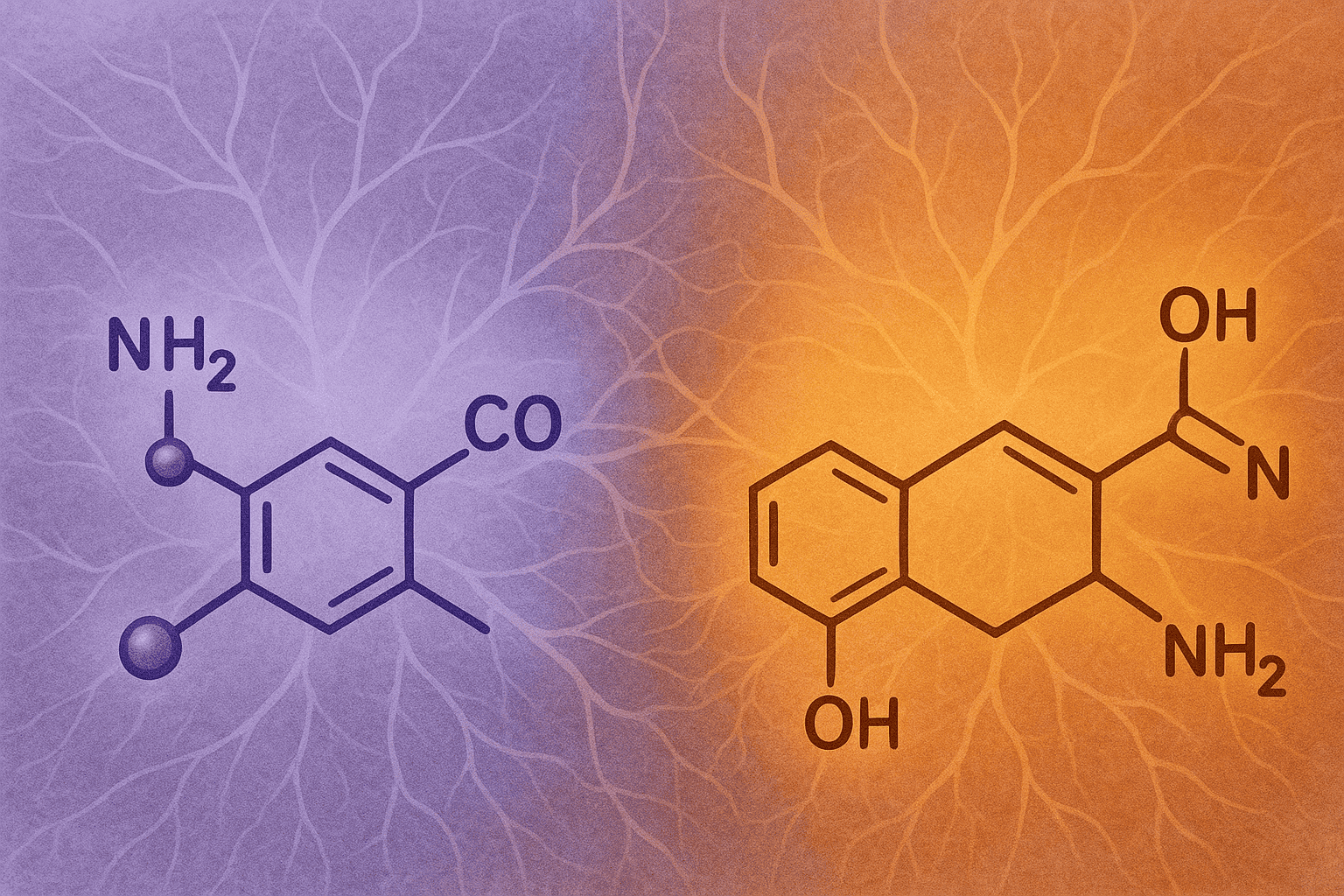
- Origin: Selank from tuftsin (immune) | Semax from ACTH (hormone)
- Length: Both 7 amino acids
- Shared tail: Both use Pro-Gly-Pro for stability
- Primary target: Selank = GABA system | Semax = melanocortin receptors
- BDNF pathway: Both influence BDNF, through different mechanisms
- Developed at: Both at Institute of Molecular Genetics, Moscow
- Research stage: Both preclinical only (no human clinical trials)
- Interchangeable: No — different receptor targets, different research applications
[PERSONAL EXPERIENCE] Researchers who work with both compounds often describe them as complementary tools rather than alternatives. Studying the same biological question with both Selank and Semax can reveal which pathway is driving an observed effect — something that’s impossible with either compound alone.
Where Can Researchers Source Both Peptides?
Quality standards are identical for both. Researchers should look for HPLC purity above 98%, mass spectrometry identity confirmation, and batch-specific COAs from an independent third-party lab. Generic documentation not tied to a specific batch is a red flag.
Alpha Peptides carries both Selank and Semax with independent third-party testing and batch-specific COA documentation. Full records are available at alpha-peptides.com/coas/. All products ship from the U.S. (Derry, NH) with appropriate cold-chain packaging.
Frequently Asked Questions About Selank vs Semax
Can researchers use Selank and Semax together?
In preclinical research, some investigators have studied both compounds in parallel experiments to compare pathway-specific effects. Because they target different receptor systems (GABA vs melanocortin), they can reveal which pathway is responsible for observed biological changes. Study design should account for the distinct mechanisms of each compound.
Which one is “better”?
Neither. They serve different research purposes. Selank is used for investigating GABAergic pathways and immune-related neuropeptide activity. Semax is used for investigating melanocortin receptor interactions and ACTH fragment biology. The “better” choice depends entirely on the research question being asked.
Are there human clinical trials for either peptide?
No human clinical trial data from Western regulatory frameworks exists for either Selank or Semax. All published research cited in this article comes from preclinical models — animal studies and cell culture experiments. Both peptides are sold exclusively for laboratory research purposes.
For research use only. Not for human consumption. Selank and Semax are experimental research peptides with no FDA-approved therapeutic applications. All information on this page is provided for educational purposes relating to laboratory and preclinical research.