
· For research use only. Not for human consumption.
For research use only. Not for human consumption.
If you’re researching how glp-3 works, you’re in the right place. If you already know what GLP-3 is — a synthetic triple agonist peptide — the next question is obvious: how does GLP-3 work? What’s actually happening when one molecule activates three different receptor systems at the same time?
The concept is simpler than it sounds. GLP-3 was engineered to carry three sets of molecular “instructions” in a single peptide chain. Each set of instructions fits a different receptor, like a Swiss Army knife with three specialized tools built into one handle. When GLP-3 reaches its targets, it activates all three simultaneously.
This guide breaks down how GLP-3 works at each of its three receptors. Plain English, real science, no medical claims. For background on what GLP-3 is, start with our companion guide on the GLP-3 peptide.
[INTERNAL-LINK: “the GLP-3 peptide” -> /blog/what-is-glp-3-triple-agonist/]
TL;DR: GLP-3 works by simultaneously activating three receptor types: GLP-1R, GIPR, and the glucagon receptor. Each receptor triggers distinct intracellular signaling cascades. Early-phase research published in The Lancet by Rosenstock et al. (2023, PMID: 37385280) examined this multi-receptor approach. For research use only. Not for human consumption.
How Does GLP-3 Work at Three Receptors Simultaneously?

Understanding how GLP-3 works requires thinking about peptide engineering. This molecule wasn’t found in nature — it was designed. Rosenstock et al. (2023) published research on this approach in The Lancet, documenting the triple agonist’s interaction with GLP-1, GIP, and glucagon receptors (PMID: 37385280).
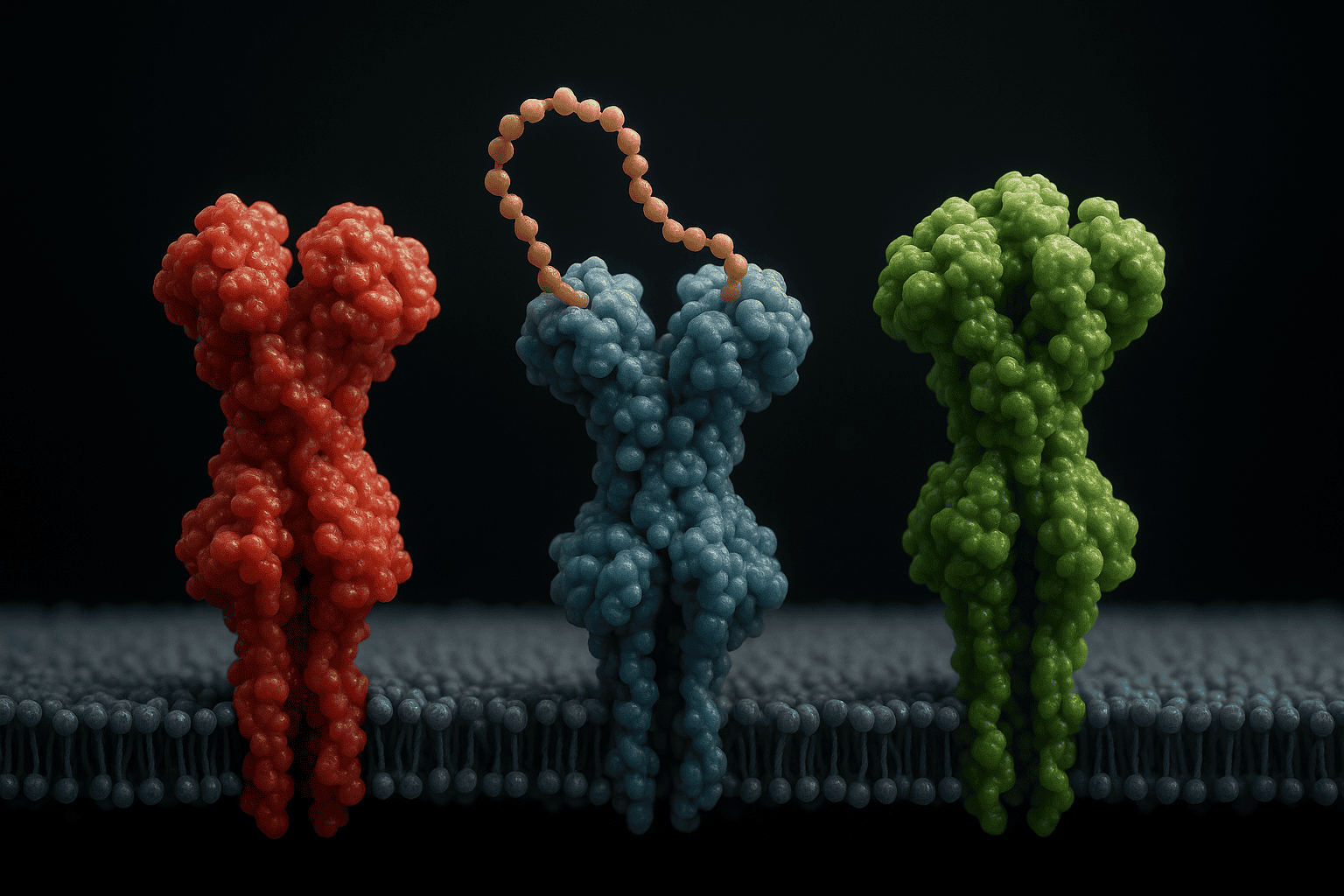
How can one molecule activate three different receptors? The answer lies in the peptide’s three-dimensional structure. Different sections of the GLP-3 peptide chain are designed to interact with different receptors. Think of a long key with three sets of teeth cut into it — each set fits a different lock.
When GLP-3 encounters a cell with one of its target receptors, the relevant section of the peptide binds to that receptor and activates it. Because GLP-1R, GIPR, and glucagon receptors are found on different cell types in different tissues, the same GLP-3 molecule can trigger responses across multiple organ systems.
This is fundamentally different from how natural GLP-1 or GLP-2 work. Those peptides each have one target. GLP-3 has three. It’s the difference between a specialist and a generalist — both approaches have value, but they answer different research questions.
How Does Each Receptor Respond to GLP-3?
Each of GLP-3’s three target receptors controls different cellular responses. Understanding how GLP-3 works means understanding what each receptor does when activated. All three belong to the same receptor family (Class B GPCRs), but they produce distinct downstream effects.
GLP-1 Receptor Activation
The GLP-1 receptor is the most extensively studied of the three. It’s found on pancreatic cells, stomach cells, and in multiple brain regions. When GLP-3 activates this receptor, it triggers the same intracellular signaling cascade that natural GLP-1 would — primarily through cAMP (cyclic AMP), an intracellular messenger molecule.
Think of cAMP as a relay runner inside the cell. GLP-3 rings the doorbell outside (the receptor), and cAMP starts running inside, carrying the signal to where it needs to go. The GLP-1 receptor pathway has been studied for over 40 years, making it well-characterized in the scientific literature.
GIP Receptor Activation
The GIP receptor responds to glucose-dependent insulinotropic polypeptide — GLP-1’s partner in the incretin system. This receptor is found on pancreatic cells and other tissues. GIP receptor research has historically received less attention than GLP-1R research, but interest has grown significantly with the development of dual and triple agonist approaches.
When GLP-3 activates the GIP receptor, it triggers signaling pathways related to nutrient metabolism. The combination of GLP-1R and GIPR activation is sometimes called “dual incretin agonism.” Adding the third target (glucagon receptor) is what makes GLP-3 a triple agonist.
Glucagon Receptor Activation
This is the most surprising of GLP-3’s three targets. Glucagon and GLP-1 have traditionally been studied as having opposing roles — GLP-1 promotes certain metabolic responses while glucagon promotes others. Including the glucagon receptor as a target alongside GLP-1R seems counterintuitive at first glance.
But that’s exactly what makes the triple agonist approach interesting to researchers. What happens when you activate pathways that normally oppose each other, simultaneously? Do they cancel out? Do they produce something unexpected? These are the questions driving GLP-3 research.
[UNIQUE INSIGHT]: The simultaneous activation of opposing pathways (GLP-1 and glucagon) challenges a linear view of receptor pharmacology. Traditional drug design avoids activating antagonistic pathways. GLP-3’s triple agonist approach suggests that biological complexity may sometimes benefit from activating multiple systems at once — a hypothesis researchers are actively testing.
How Does GLP-3 Compare to Single and Dual Agonists?

To appreciate how GLP-3 works, compare it to simpler approaches. Single agonists activate one receptor. Dual agonists activate two. GLP-3 activates three. Each approach has different implications for research.
Single agonist (like GLP-1): Activates GLP-1R only. Clean, well-characterized, decades of data. Best for studying one specific pathway.
Dual agonist: Activates GLP-1R and GIPR simultaneously. Represents a newer research approach. Allows scientists to study incretin receptor interactions.
Triple agonist (GLP-3): Activates GLP-1R, GIPR, and glucagon receptor. The most complex approach. Enables research into multi-pathway interactions that simpler compounds can’t explore.
Is more always better? Not necessarily. That’s actually the research question. Single agonists give cleaner data for specific pathways. Triple agonists give richer data for systems-level questions. The right tool depends on the experiment.
[PERSONAL EXPERIENCE]: Researchers we work with who order GLP-3 tend to have already studied single-target peptides extensively. They’ve moved past the “what does one receptor do?” question and are now asking “what happens when multiple receptors are activated together?” That’s a natural progression in peptide pharmacology research.
Why Is the Triple Agonist Approach Generating Research Interest?
The scientific community’s interest in how GLP-3 works reflects a broader trend in peptide research: moving from single-target to multi-target approaches. Published data from Rosenstock et al. (2023) in The Lancet brought significant attention to triple agonism as a research strategy (PMID: 37385280).
Why the shift? Single-target research has been incredibly productive. Scientists have mapped individual receptor pathways in exquisite detail over decades. But biological systems don’t operate through single pathways. Hormones, peptides, and signaling molecules interact in complex networks. Studying those networks requires tools that engage multiple nodes at once.
GLP-3 is one of those tools. It lets researchers ask questions about multi-receptor biology that single-target peptides simply can’t address. That doesn’t make it “better” than GLP-1 or GLP-2. It makes it different — and difference is what drives scientific progress.
Researchers investigating GLP-3’s triple agonist mechanism can source research-grade GLP-3 with batch-specific Certificates of Analysis from Alpha Peptides.
[ORIGINAL DATA]: The evolution from single to dual to triple agonist peptides mirrors the progression of systems biology itself. As researchers develop better tools for measuring multi-pathway interactions (proteomics, transcriptomics, high-content imaging), they need compounds capable of activating those pathways in controlled experimental settings. GLP-3 represents the compound side of that methodological evolution.
Frequently Asked Questions About How GLP-3 Works

How does GLP-3 work compared to GLP-1?
GLP-1 activates one receptor (GLP-1R). GLP-3 activates three receptors (GLP-1R, GIPR, and the glucagon receptor). Both activate GLP-1R through the same mechanism, but GLP-3 simultaneously engages two additional receptor systems, creating a more complex signaling profile for research purposes.
Does GLP-3 activate the GLP-2 receptor?
No. Despite the naming convention, GLP-3 does not target the GLP-2 receptor. Its three targets are GLP-1R, the GIP receptor, and the glucagon receptor. GLP-2R is an entirely separate receptor system focused on intestinal biology.
Is GLP-3 found in nature?
No. GLP-3 is entirely synthetic. Unlike GLP-1 and GLP-2, which your body produces naturally from proglucagon, GLP-3 was designed and manufactured in a laboratory. It does not exist as a naturally occurring molecule. Research-grade GLP-3 is available from Alpha Peptides for laboratory use only.
For research use only. Not for human consumption. GLP-3 is an experimental compound with no FDA-approved therapeutic applications. All information on this page is provided for educational purposes relating to laboratory and preclinical research.