
· For research use only. Not for human consumption.
For research use only. Not for human consumption.
If you’re researching how glp-2 works, you’re in the right place. You know what GLP-2 is. Now the real question: how does GLP-2 work? What’s actually happening at the molecular level when this gut peptide reaches its target cells? Understanding the mechanism is what separates casual awareness from genuine scientific literacy.
The short answer: GLP-2 works by binding to its own dedicated receptor on cells in the intestinal wall. Think of it as a specific key designed for one specific lock. When GLP-2 turns that lock, the cells on the inside of your gut receive a signal. Researchers have spent decades studying what that signal does in preclinical models.
This guide explains how GLP-2 works step by step. Simple analogies, real citations, no medical claims. For background on what GLP-2 is, start with our companion guide on the GLP-2 peptide.
[INTERNAL-LINK: “the GLP-2 peptide” -> /blog/what-is-glp-2-peptide-introduction/]
TL;DR: GLP-2 works by activating the GLP-2 receptor (GLP-2R) on intestinal cells. Drucker et al. (1996) first demonstrated this mechanism in preclinical models, showing GLP-2’s effects on the intestinal epithelium (PMID: 8598044). The receptor signals through intracellular pathways that researchers are still mapping. For research use only. Not for human consumption.
How Does GLP-2 Work at Its Receptor?
GLP-2 works by binding to a protein called the GLP-2 receptor (GLP-2R). This receptor sits on the surface of specific cells in the intestinal wall. Drucker et al. (1996) were the first to demonstrate this receptor-mediated activity in preclinical models, publishing their findings in PNAS (PMID: 8598044).
Imagine the intestinal wall as a brick wall. Each brick is a cell. Some of these bricks have doorbells on them — those doorbells are GLP-2 receptors. When GLP-2 arrives and rings the doorbell, the cell inside responds. But here’s the catch: GLP-2 can only ring its own doorbell. It won’t activate GLP-1 receptors, glucagon receptors, or any other type. It’s exclusively matched to GLP-2R.
This receptor specificity is one of the things that makes GLP-2 useful in research. Because it only activates one receptor type, scientists can study the effects of GLP-2R signaling without interference from other pathways. It’s a clean experimental tool.
What Is the Intestinal Epithelium and Why Does It Matter?
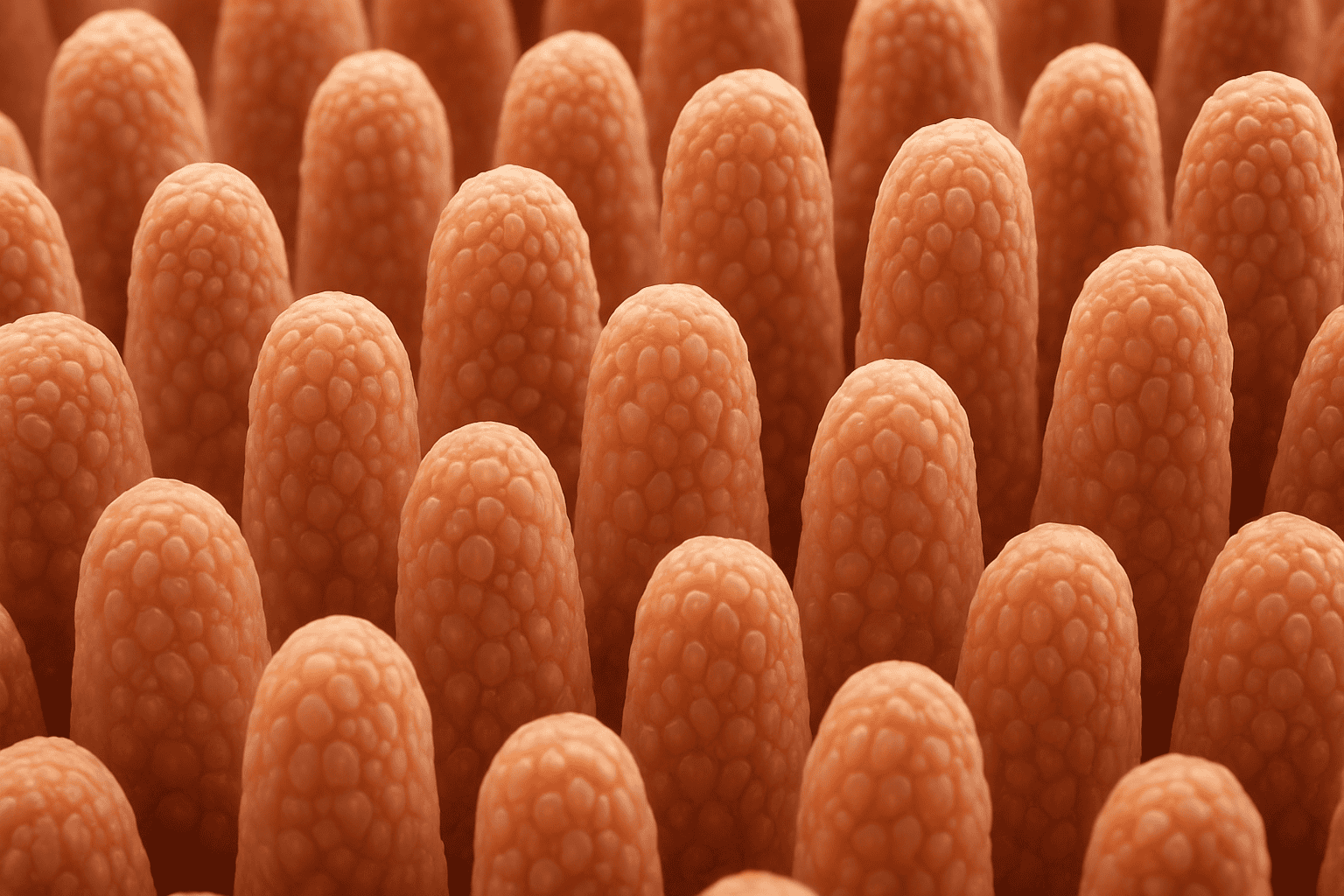
To understand how GLP-2 works, you need to understand where it works. The intestinal epithelium is the thin layer of cells that lines the inside of your intestines. Jeppesen (2012) reviewed its structure and function in a paper examining GLP-2’s relationship with this tissue (PMID: 22895648).
Think of the intestinal epithelium as the wallpaper inside a garden hose. It’s thin — often just one cell thick — but it does critical work. This layer has two main jobs. First, it absorbs nutrients from digested food and passes them into the bloodstream. Second, it acts as a barrier, keeping bacteria and harmful substances inside the gut and out of the rest of the body.
Here’s what makes this tissue remarkable: it replaces itself completely every 3-5 days. That’s one of the fastest turnover rates of any tissue in the body. Old cells are shed, new cells grow in. It’s like replacing the wallpaper in your house every week, without ever leaving a gap in the wall.
GLP-2 receptors are expressed in this intestinal lining. When researchers study how GLP-2 works, they’re largely studying what happens to this rapidly renewing, critically important tissue when GLP-2R gets activated.
[PERSONAL EXPERIENCE]: We’ve noticed that researchers studying GLP-2 often come from intestinal biology backgrounds rather than the metabolic research community that typically studies GLP-1. The peptides attract different scientific audiences because they target different organ systems.
What Happens Inside the Cell When GLP-2 Activates Its Receptor?

When GLP-2 binds to GLP-2R, it triggers a chain of events inside the cell. Like GLP-1R, the GLP-2 receptor belongs to the Class B GPCR family (G protein-coupled receptors). Drucker et al. (1996) established this classification in their foundational research (PMID: 8598044).
GPCRs work like relay systems. The receptor sits in the cell membrane with part of it facing outside (where GLP-2 binds) and part facing inside (where signaling begins). When GLP-2 binds the outside, the inside portion activates a G protein, which then triggers a cascade of molecular messengers.
In simpler terms: GLP-2 knocks on the door. The receptor answers. And then the receptor shouts instructions to a chain of messengers inside the house. Each messenger passes the signal to the next, amplifying it as it goes. By the time the message reaches its final destination inside the cell, a single GLP-2 molecule has triggered a significant cellular response.
Researchers are still mapping the complete details of GLP-2’s intracellular signaling cascade. Some pathways have been well-characterized in preclinical models. Others remain active areas of investigation.
[UNIQUE INSIGHT]: An underappreciated aspect of how GLP-2 works is that its receptor may not be located on the cell types you’d expect. Some research suggests GLP-2R is expressed on subepithelial cells and enteric neurons rather than directly on the epithelial cells themselves. If confirmed, this means GLP-2 may work indirectly — signaling through intermediate cell types that then influence the epithelium. That adds a layer of complexity researchers are still untangling.
How Does GLP-2 Compare to GLP-1 in Terms of Mechanism?
GLP-1 and GLP-2 share structural similarities but work through entirely different receptor systems. Jeppesen (2012) drew clear mechanistic distinctions between the two peptides in a review of the published literature (PMID: 22895648).
Both peptides are released simultaneously from the same L-cells after eating. Both are rapidly destroyed by the same enzyme (DPP-4). Both bind to Class B GPCRs. But the similarities largely end there.
GLP-1 activates receptors on pancreatic cells, stomach cells, and brain cells. Its effects span multiple organ systems. GLP-2 activates receptors in the intestinal wall. Its effects are focused on gut biology.
Here’s an analogy. Imagine two radio signals broadcast from the same tower at the same time. One signal is picked up by car radios across the entire city (that’s GLP-1 — widespread). The other signal is picked up only by radios in one specific neighborhood (that’s GLP-2 — localized). Same tower, same broadcast time, completely different coverage areas.
For researchers, this mechanistic difference means the two peptides answer different questions. GLP-1 is a tool for studying systemic metabolic signaling. GLP-2 is a tool for studying intestinal biology specifically.
What Research Questions Are Scientists Asking About How GLP-2 Works?

GLP-2 research is an active field with several open questions. Scientists have characterized the basic receptor mechanism, but many downstream details remain under investigation.
Barrier Function Signaling
How does GLP-2R activation influence the intestinal barrier? Researchers are studying whether GLP-2 signaling affects the tight junctions between epithelial cells — the molecular “glue” that holds the barrier together. Understanding this could clarify how the gut maintains its protective function.
Indirect Signaling Pathways
Does GLP-2 act directly on epithelial cells, or does it signal through intermediate cell types? Some preclinical evidence suggests GLP-2R is expressed on subepithelial cells rather than the epithelium itself. If so, GLP-2’s mechanism may be more complex than a simple receptor-to-cell pathway.
Interactions with Other Gut Signals
Because GLP-2 is co-released with GLP-1, researchers are exploring whether the two peptides interact at the signaling level. Do they amplify each other’s effects? Counteract them? The co-secretion pattern suggests the body may use them as a coordinated pair, but the details are still being worked out.
Alpha Peptides offers research-grade GLP-2 for investigators exploring these questions. All products include batch-specific Certificates of Analysis.
Frequently Asked Questions About How GLP-2 Works
Does GLP-2 work on the same receptor as GLP-1?
No. GLP-2 has its own dedicated receptor, GLP-2R, which is distinct from GLP-1R. The two receptors are both Class B GPCRs but are structurally different and located on different cell types. GLP-2 cannot activate GLP-1R, and vice versa.
How quickly is natural GLP-2 broken down?
Like GLP-1, natural GLP-2 is rapidly degraded by the enzyme DPP-4. Its half-life is measured in minutes. Researchers working with GLP-2 in laboratory settings must account for this rapid degradation when designing experiments (Jeppesen, 2012).
Where can I source research-grade GLP-2?
Look for suppliers providing HPLC purity above 98% and mass spectrometry verification. Alpha Peptides carries GLP-2 for research use with third-party COAs. All material is for laboratory research only.
For research use only. Not for human consumption. GLP-2 is an experimental compound with no FDA-approved therapeutic applications in its research-grade form. All information on this page is provided for educational purposes relating to laboratory and preclinical research.