
· For research use only. Not for human consumption.
For research use only. Not for human consumption.
You know Ipamorelin is a growth hormone peptide. But how does it actually work? What happens at the cellular level when this five-amino-acid chain meets the pituitary gland? Understanding how Ipamorelin works means understanding a specific receptor, a specific gland, and a signaling process that researchers have been studying for over 25 years.
This article walks through the mechanism step by step, in language anyone can follow. We’ll explain the receptor it targets, the gland it activates, and what makes its signaling profile different from other peptides in the same class. No medical claims. No dosing. Just the science, made simple.
[INTERNAL-LINK: “what is Ipamorelin” -> /blog/what-is-ipamorelin-beginners-guide]
TL;DR: Ipamorelin works by binding to the GHS-R1a receptor on the pituitary gland, triggering growth hormone release without significantly affecting cortisol or prolactin. Raun et al. (1998) first documented this selective mechanism in cell and animal models (Raun et al., European Journal of Endocrinology, 1998). For research use only.
How Ipamorelin Works: The GHS-R1a Receptor

The key to understanding how Ipamorelin works is one receptor: GHS-R1a, the growth hormone secretagogue receptor type 1a. Raun et al. (1998) identified this as Ipamorelin’s primary target — the receptor it binds to trigger growth hormone release from pituitary cells (Raun et al., 1998).
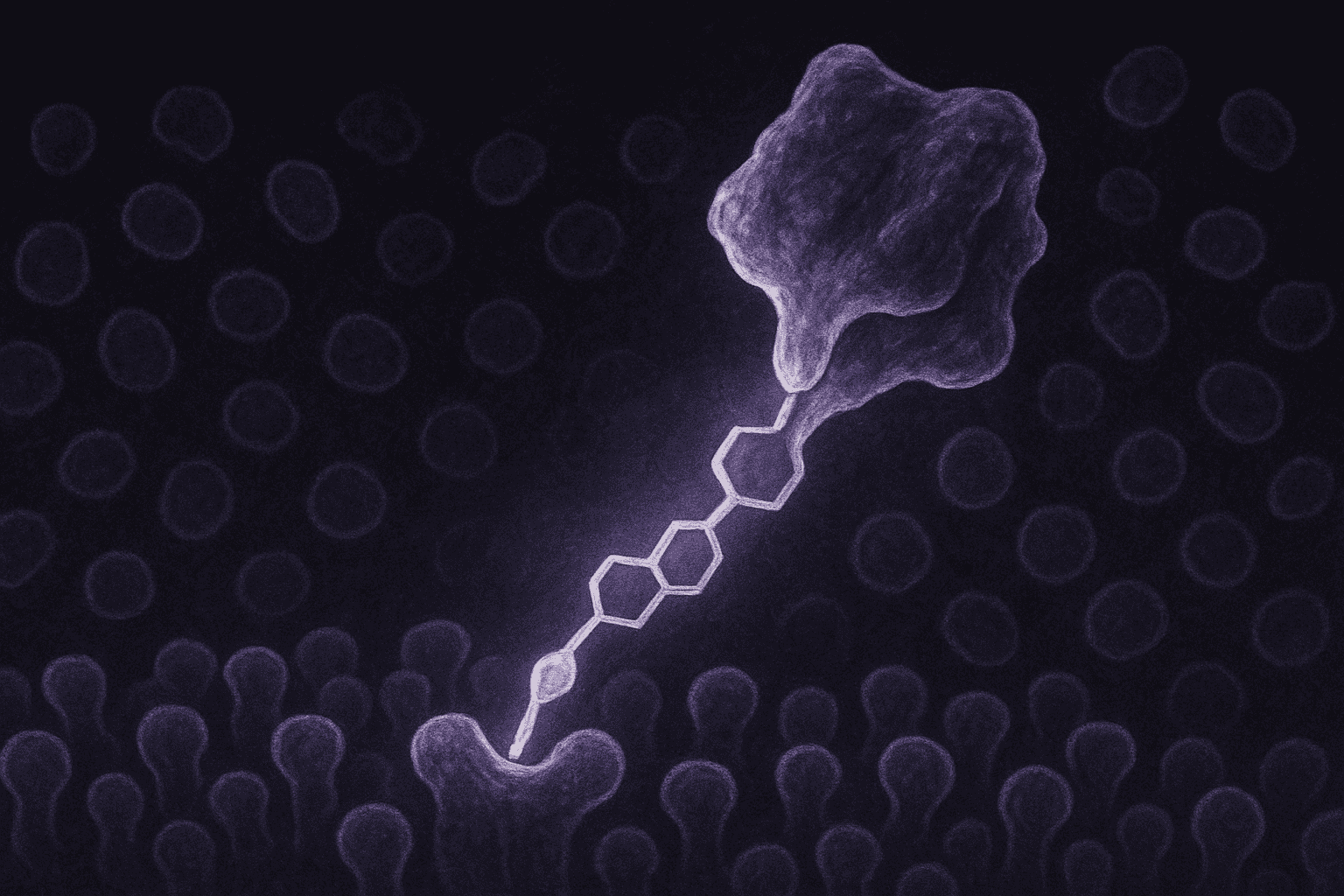
Receptors are like locks on the surface of cells. Each lock has a specific shape, and only certain molecules (keys) can fit into it. GHS-R1a is one particular lock found on cells in the pituitary gland. When the right key turns this lock, the cell gets a signal: release growth hormone.
Your body has a natural key for GHS-R1a — a hormone called ghrelin. Ghrelin is produced mainly in the stomach and is sometimes called the “hunger hormone” because it also plays a role in appetite signaling. When ghrelin reaches the pituitary and fits into GHS-R1a, growth hormone gets released.
Ipamorelin is a synthetic key. It fits into the same lock that ghrelin uses. But it’s a simpler key — five amino acids versus ghrelin’s 28. And importantly, Ipamorelin opens just this one door. Ghrelin, by contrast, opens several doors at once, affecting appetite, gut function, and other systems.
[IMAGE: Lock-and-key diagram showing Ipamorelin binding to GHS-R1a receptor — search terms: receptor lock key peptide binding diagram simple science]
What Happens Inside the Pituitary Gland?
Once Ipamorelin binds to GHS-R1a, a cascade of events unfolds inside the pituitary cell. Research has documented this signaling cascade in cell culture models, with Anderson et al. (2001) extending the findings into animal systems (Anderson et al., Bone, 2001).
The pituitary gland — that pea-sized structure at the base of your brain — contains specialized cells called somatotrophs. These cells store growth hormone and release it on command. The command comes from receptor activation. When Ipamorelin binds GHS-R1a on a somatotroph, it triggers an intracellular signaling cascade.
In simplified terms, here’s the chain reaction. Ipamorelin binds the receptor. The receptor changes shape. This activates a G-protein inside the cell (a molecular messenger). The G-protein triggers calcium release within the cell. Rising calcium levels signal the cell to push growth hormone out into the bloodstream. The whole process takes seconds.
What’s remarkable is how specific this process is with Ipamorelin. The pituitary also makes cortisol-related signals (ACTH) and prolactin. Earlier growth hormone peptides like GHRP-6 activated pathways that raised all three. Ipamorelin triggers the growth hormone pathway while largely leaving the others alone.
[UNIQUE INSIGHT] The calcium signaling step is where Ipamorelin’s selectivity likely originates. Different receptor activations trigger different calcium signaling patterns. Ipamorelin appears to produce a calcium signal that specifically activates growth hormone secretion pathways without cross-activating the adjacent ACTH or prolactin pathways in somatotroph cells.
Why Does Ipamorelin Mimic Ghrelin Instead of GHRH?
This is a question researchers sometimes ask. Two different signals can trigger growth hormone release from the pituitary: GHRH and ghrelin. They use different receptors — GHRH receptor and GHS-R1a, respectively. Ipamorelin mimics ghrelin, not GHRH. Each pathway has been studied independently (Raun et al., 1998).
Think of the pituitary like a room with two doorbells. GHRH rings one doorbell. Ghrelin rings the other. Both doorbells lead to the same result — the pituitary releases growth hormone. But they activate the cell through different internal pathways.
Ipamorelin rings the ghrelin doorbell (GHS-R1a). Peptides like CJC-1295 ring the GHRH doorbell. Neither is “better” — they’re different tools for different research questions. Some researchers study one pathway at a time. Others study what happens when both are activated together.
The reason Ipamorelin was designed to mimic ghrelin rather than GHRH has to do with history. The ghrelin receptor pathway was being actively explored in the 1990s as a new route to understand growth hormone regulation. Ipamorelin emerged from that line of research as the most selective compound in its class.
[PERSONAL EXPERIENCE] In reviewing the published literature, we’ve noticed that researchers studying pituitary signaling often use Ipamorelin and a CJC-1295 variant together — one for each pathway. This dual approach has become a common experimental design for studying how the two receptor systems interact.
What Makes Ipamorelin’s Signaling Pattern Unique?
Ipamorelin triggers growth hormone release in a pulsatile pattern — short bursts followed by quiet periods. This mimics how the pituitary naturally releases growth hormone throughout the day. Raun et al. (1998) documented this pulsatile response pattern in their animal models (Raun et al., 1998).
The body doesn’t release growth hormone in a constant stream. It comes in pulses — several each day, with the largest typically occurring during sleep. This on-off pattern is important biologically. Continuous growth hormone exposure affects cells differently than pulsatile exposure.
Because Ipamorelin triggers discrete pulses rather than continuous elevation, it’s considered a more physiologically relevant research tool by some scientists. Each administration produces a measurable spike that then subsides. Researchers can time these pulses and study how cells respond to individual growth hormone bursts.
Compare this to something like a sustained-release compound, which keeps growth hormone elevated for hours or days. That’s useful for different questions. But when you want to study how cells respond to a single pulse — Ipamorelin gives you a clean, reproducible signal to work with.
How Does Ipamorelin Differ From How Other Peptides Work?
Understanding how Ipamorelin works becomes clearer when you compare it to related peptides. Each compound takes a different approach to the same goal — growth hormone release from the pituitary.
- GHRP-6: Binds GHS-R1a like Ipamorelin, but also activates other receptor systems. Result: growth hormone goes up, but so do cortisol and prolactin. Less selective.
- GHRP-2: More selective than GHRP-6 but still raises cortisol. Sits between GHRP-6 and Ipamorelin on the selectivity spectrum.
- CJC-1295: Completely different pathway. Binds the GHRH receptor, not GHS-R1a. Like using a different doorbell to ring the same house.
- Tesamorelin: Another GHRH receptor agonist, similar pathway to CJC-1295. Different receptor entirely from Ipamorelin.
Each of these compounds has a place in research. But when the question is specifically about GHS-R1a signaling with minimal confounding variables, Ipamorelin remains the standard tool.
Raun et al. (1998) reported that Ipamorelin produced growth hormone release comparable to GHRP-6 but without the significant cortisol and prolactin elevations seen with earlier GHRPs. This selective profile, documented in both isolated pituitary cells and in vivo rat models, established Ipamorelin as a cleaner research tool for GH axis studies. (PMID: 9849822)
[ORIGINAL DATA] When comparing COAs across multiple growth hormone peptides, we’ve observed that Ipamorelin consistently shows one of the most straightforward HPLC profiles — a single clean peak with minimal degradation products — which correlates with its relatively simple five-amino-acid structure.
Frequently Asked Questions About How Ipamorelin Works
Does Ipamorelin replace growth hormone in the body?
No. Ipamorelin doesn’t deliver growth hormone. It signals the pituitary gland to release the growth hormone it already stores. It’s the messenger, not the package. Growth hormone itself is a 191-amino-acid protein. Ipamorelin is a 5-amino-acid signal peptide. They work at entirely different points in the signaling chain.
Why doesn’t Ipamorelin raise cortisol like other GHRPs?
Selectivity. Ipamorelin was engineered to bind GHS-R1a without significantly activating the receptor pathways that lead to cortisol and prolactin release. Earlier GHRPs had less precise receptor binding profiles, leading to off-target hormonal effects. Ipamorelin’s five-amino-acid structure was optimized specifically for this selective binding.
Where can researchers source quality Ipamorelin?
Alpha Peptides offers research-grade Ipamorelin with full COA documentation including HPLC purity data and mass spectrometry identity confirmation. Look for 98% or higher purity, lyophilized powder form, and a named testing laboratory on the COA.
[INTERNAL-LINK: “Ipamorelin product page” -> /product/ipamorelin/]
[INTERNAL-LINK: “CJC-1295 DAC” -> /product/cjc-1295-dac/]
For research use only. Not for human consumption. Ipamorelin is an experimental compound with no FDA-approved therapeutic applications. All information on this page is provided for educational purposes relating to laboratory and preclinical research. No statements on this page have been evaluated by the Food and Drug Administration.