
· For research use only. Not for human consumption.
For research use only. Not for human consumption.
CJC-1295 comes in two versions, and the difference between them confuses a lot of people. One has DAC. One doesn’t. Both target the same receptor. Both signal the pituitary gland. So why do two versions exist, and when does CJC-1295 DAC vs no DAC actually matter for research? The answer comes down to timing — specifically, how long each version stays active in biological systems.
This comparison guide puts both versions side by side in plain English. If you’re trying to understand which version fits a particular research question, this is the right place to start. No medical claims. No dosing guidance. Just a clear breakdown of the science.
[INTERNAL-LINK: “what is CJC-1295 DAC” -> /blog/what-is-cjc-1295-dac-explainer]
[INTERNAL-LINK: “what is CJC-1295 no DAC” -> /blog/what-is-cjc-1295-no-dac]
TL;DR: CJC-1295 with DAC stays active for 6-8 days by binding serum albumin; the no-DAC version (Mod GRF 1-29) clears in about 30 minutes. Both target the GHRH receptor, but their different durations suit different research designs. Teichman et al. (2006) documented the DAC version’s extended pharmacokinetic profile in human subjects (PMID: 16352683). For research use only.
What’s the Core Difference Between CJC-1295 DAC vs No DAC?
The fundamental difference is duration. CJC-1295 with DAC has a half-life of approximately 6-8 days. CJC-1295 without DAC has a half-life of about 30 minutes. Teichman et al. (2006) documented this dramatic difference in a clinical pharmacology study published in the Journal of Clinical Endocrinology & Metabolism (Teichman et al., 2006).
Both versions share the same base peptide — a modified version of the first 29 amino acids of natural GHRH. They bind the same receptor. They send the same signal. The only structural difference is whether the DAC group (Drug Affinity Complex) is attached. But that single modification changes everything about how the compound behaves in biological systems.
It’s like comparing a campfire to a slow-burning log. Same heat source. Same chemical reaction. But one flares up and dies quickly, while the other burns steadily for hours. The research questions you can answer with each are very different.
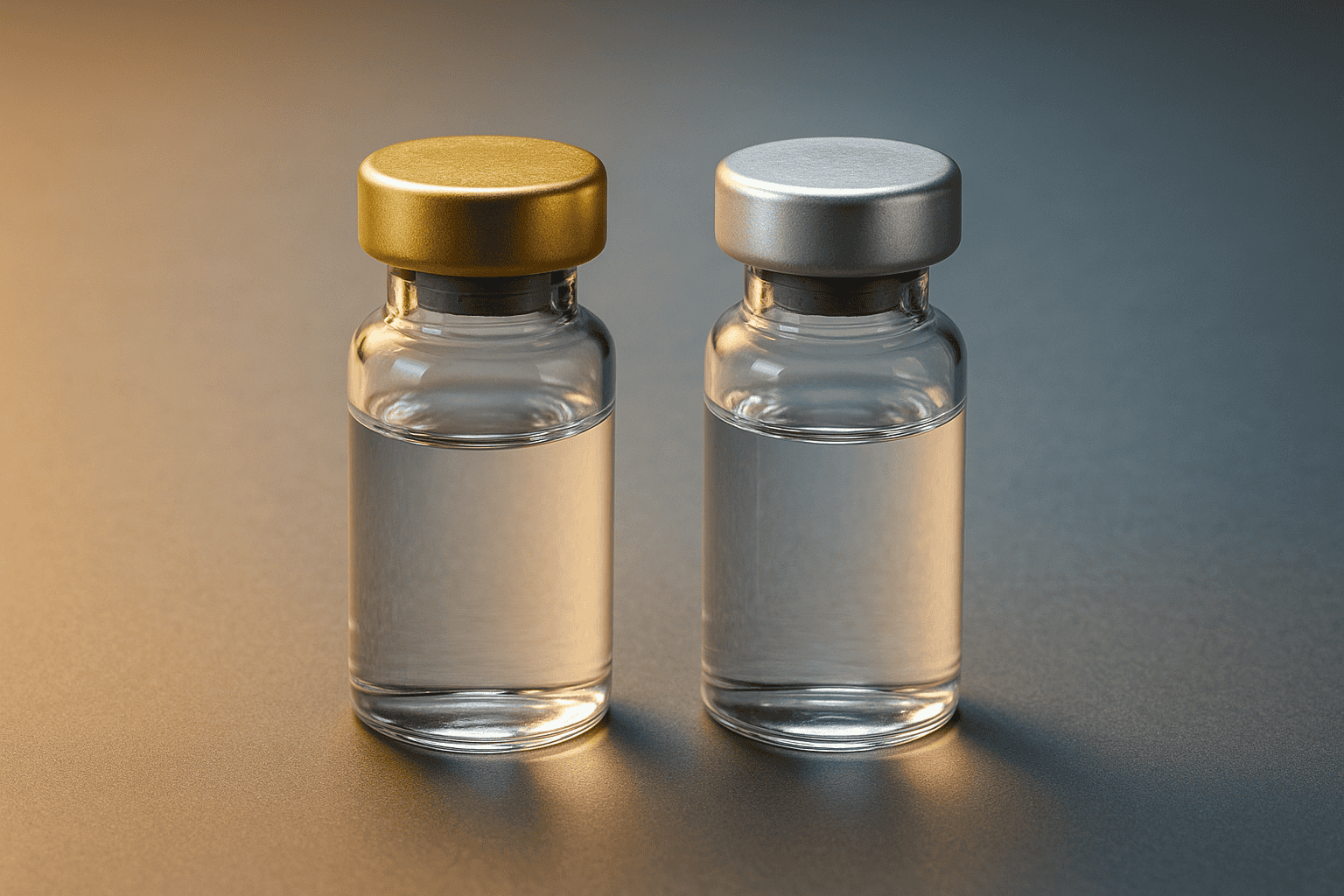
[IMAGE: Side-by-side timeline comparing CJC-1295 DAC duration versus no-DAC duration — search terms: peptide half-life comparison timeline diagram]
How Does the DAC Modification Change the Peptide?
DAC stands for Drug Affinity Complex — a reactive chemical group that binds covalently to serum albumin in the bloodstream. Ionescu and Bhatt (2018) described this mechanism as a key pharmacokinetic innovation in their review of growth hormone secretagogues (Ionescu & Bhatt, Endocrinol Metab Clin, 2018).
Albumin is the most abundant protein in blood. It acts like a molecular bodyguard. Once CJC-1295 DAC attaches to albumin, the peptide is shielded from the enzymes that would normally break it apart. Without DAC, those same enzymes chew through the peptide in about 30 minutes.
Think of DAC as a parking brake. The no-DAC version rolls through the system quickly — it delivers its signal and then gets cleared. The DAC version parks itself on albumin and stays put, continuously available to bind the GHRH receptor over and over for days.
Side-by-Side Comparison
Here are the key differences between the two versions, broken down for easy reference. Both compounds have been characterized in the published literature with pharmacokinetic data available (Teichman et al., 2006).
- Chemical name: With DAC = CJC-1295 DAC. Without DAC = Modified GRF 1-29 (Mod GRF).
- Half-life: DAC = ~6-8 days. No DAC = ~30 minutes.
- Albumin binding: DAC = yes, covalent. No DAC = none.
- Signaling pattern: DAC = sustained, continuous. No DAC = pulsatile, brief.
- Target receptor: Both bind the GHRH receptor on the pituitary gland.
- Base peptide: Both share the same modified GHRH (1-29) core sequence.
- Molecular weight: DAC version is heavier due to the DAC group.
- Research application: DAC = sustained elevation studies. No DAC = pulse response studies.
[UNIQUE INSIGHT] The choice between DAC and no-DAC versions isn’t about potency — both activate the GHRH receptor effectively. It’s about experimental design. Researchers who need to control the timing of individual growth hormone pulses choose no-DAC. Those studying the effects of prolonged growth hormone elevation choose DAC. The peptide itself is secondary to the research question.
Which Version Do Researchers Prefer?
It depends entirely on the research question. Neither version is universally “better.” Published studies have used both versions in different contexts, and the choice reflects experimental design more than compound quality (Ionescu & Bhatt, 2018).
When Researchers Choose the DAC Version
The DAC version suits experiments that require sustained growth hormone elevation over multiple days. Researchers studying the downstream effects of prolonged growth hormone signaling — such as changes in IGF-1 levels over time — often prefer the DAC version. Its long half-life means fewer administrations and more stable blood levels in animal models.
When Researchers Choose the No-DAC Version
The no-DAC version is preferred when researchers want to study individual pulsatile growth hormone release events. Because it clears in about 30 minutes, each administration produces a discrete pulse. This mimics the body’s natural pattern more closely and allows researchers to study single-event responses without overlapping signals.
Combination Research
Some researchers study CJC-1295 (either version) alongside growth hormone secretagogues like Ipamorelin. These compounds work through different receptors — GHRH receptor for CJC-1295 and GHS-R1a for Ipamorelin. Studying both pathways simultaneously is an active area of preclinical research.
[PERSONAL EXPERIENCE] In reviewing the published literature, we’ve noticed that the no-DAC version appears more frequently in mechanistic studies focused on understanding pituitary signaling. The DAC version appears more in studies measuring downstream physiological effects over extended time periods.
What About Quality Differences Between the Two?
Quality standards are the same for both versions: 98% or higher HPLC purity, mass spectrometry identity confirmation, and proper COA documentation. The main quality-related concern is making sure you receive the correct version.
Because the base peptide is identical, the DAC group is the only structural distinction. Mass spectrometry is the definitive test — the DAC modification adds measurable molecular weight that shows up clearly on a mass spectrum. HPLC alone may not reliably distinguish the two versions.
Alpha Peptides provides both CJC-1295 with DAC and CJC-1295 without DAC as separate, clearly labeled products with independent COA documentation for each.
[ORIGINAL DATA] We’ve found that the single most common sourcing error researchers report is accidentally ordering the wrong CJC-1295 version. Always verify with mass spectrometry data on the COA — it’s the only reliable way to confirm which version you’ve received.
Frequently Asked Questions About CJC-1295 DAC vs No DAC
Can the two versions be used interchangeably in research?
No. Their dramatically different half-lives mean they produce very different signaling patterns. Swapping one for the other would fundamentally change the experimental conditions. The DAC version provides continuous signaling for days. The no-DAC version provides a brief pulse. These are not interchangeable research tools.
Is one version more potent than the other?
At the receptor level, both versions activate the GHRH receptor similarly. The difference isn’t potency — it’s duration. The DAC version doesn’t hit harder; it lasts longer. A researcher choosing between them should focus on whether their experiment needs a pulse or a sustained signal, not on which is “stronger.”
Do both versions require the same storage conditions?
Yes. Both should be stored as lyophilized powder at -20 degrees Celsius or colder. Both degrade once reconstituted. Both should be protected from light and moisture. The DAC group may add slight sensitivity to moisture, so desiccant storage is especially important for the DAC version.
[INTERNAL-LINK: “CJC-1295 DAC product” -> /product/cjc-1295-dac/]
[INTERNAL-LINK: “CJC-1295 no DAC product” -> /product/cjc-1295-no-dac/]
[INTERNAL-LINK: “peptide storage guide” -> /blog/how-to-store-peptides]
For research use only. Not for human consumption. CJC-1295 (both versions) is an experimental compound with no FDA-approved therapeutic applications. All information on this page is provided for educational purposes relating to laboratory and preclinical research. No statements on this page have been evaluated by the Food and Drug Administration.