
· For research use only. Not for human consumption.
For research use only. Not for human consumption.
CJC-1295 with DAC is one of the most discussed peptides in growth hormone research. But unless you’ve got a background in endocrinology, the name alone raises questions. What does CJC-1295 actually do? What’s DAC? And why does it matter for laboratory research? If you’ve been wondering what is CJC-1295 DAC, this guide breaks it all down in plain language.
CJC-1295 is a synthetic version of a natural hormone your body already makes. DAC is a molecular modification that changes how long the peptide stays active. Together, they form a compound that has attracted serious attention from researchers studying the growth hormone axis. Let’s walk through the science, one concept at a time. This is particularly relevant for what is cjc-1295 dac research.
[INTERNAL-LINK: “CJC-1295 without DAC comparison” -> /blog/what-is-cjc-1295-no-dac]
TL;DR: CJC-1295 with DAC is a synthetic analog of growth hormone-releasing hormone (GHRH) with a Drug Affinity Complex that extends its half-life. In a clinical pharmacology study, Teichman et al. reported that CJC-1295 DAC increased growth hormone levels for 6 or more days after a single administration in human subjects (Teichman et al., Journal of Clinical Endocrinology & Metabolism, 2006). For research use only.
What Is CJC-1295 DAC?
CJC-1295 DAC is a modified version of growth hormone-releasing hormone (GHRH), the natural signal your pituitary gland uses to control growth hormone output. Teichman et al. (2006) demonstrated that the DAC modification extends the compound’s active period to approximately 6-8 days in human pharmacokinetic studies (Teichman et al., J Clin Endocrinol Metab, 2006).
Let’s unpack that piece by piece. GHRH is a hormone your brain naturally produces. It travels from the hypothalamus (a control center in the brain) to the pituitary gland (a pea-sized gland at the brain’s base). When GHRH reaches the pituitary, it tells it to release growth hormone. Simple signal, big effect.
The problem for researchers? Natural GHRH breaks down in minutes. It’s like writing a message in sand — the waves wash it away almost immediately. CJC-1295 was developed as a synthetic version that lasts longer. And the DAC modification takes that even further.
[IMAGE: Diagram comparing natural GHRH duration versus CJC-1295 DAC duration — search terms: peptide half-life comparison diagram GHRH research]
What Does DAC Mean and What Does It Do?
DAC stands for Drug Affinity Complex. It’s a chemical addition attached to the CJC-1295 peptide that dramatically extends how long the compound remains active. According to Ionescu and Bhatt (2018), the DAC modification enables CJC-1295 to bind to serum albumin — a protein circulating in blood — which shields it from rapid breakdown (Ionescu & Bhatt, Endocrinology and Metabolism Clinics, 2018).
Here’s an analogy. Imagine the peptide is a message in a bottle. Without DAC, you toss the message into the ocean and it sinks quickly. With DAC, you tie the bottle to a buoy. Now it floats on the surface much longer, giving the message more time to be found and read.
In biochemical terms, DAC is a reactive chemical group (a maleimido derivative) that forms a covalent bond with albumin once the peptide enters the bloodstream. Albumin is like a molecular taxi — one of the most abundant proteins in blood. By hitching a ride on albumin, CJC-1295 DAC avoids the enzymes that would normally break it down within minutes.
The result in research models: instead of a peptide that disappears in 30 minutes, you get one that stays detectable for days. That’s a significant difference for researchers designing experiments around growth hormone signaling.
[UNIQUE INSIGHT] The DAC technology represents an important principle in peptide research — that modifying a peptide’s pharmacokinetic profile (how long it lasts) can be as scientifically valuable as modifying its pharmacodynamic profile (what it does). For growth hormone axis studies, duration of signaling is itself a variable worth studying.
How Does CJC-1295 DAC Interact With the Pituitary Gland?
CJC-1295 DAC works by binding to the GHRH receptor on the pituitary gland — the same receptor that natural GHRH uses. Teichman et al. (2006) showed that this binding triggers the pituitary to release growth hormone in a sustained manner over multiple days, unlike the brief pulses triggered by natural GHRH (Teichman et al., 2006).
The pituitary gland is worth understanding. It’s a structure about the size of a pea, sitting at the base of the brain. Despite its small size, it controls some of the most important hormones in the body. Growth hormone is one of them. The pituitary releases growth hormone in response to signals — primarily GHRH from the hypothalamus and ghrelin from the stomach.
CJC-1295 DAC mimics the GHRH signal. It fits into the GHRH receptor like a key in a lock. Once it’s bound, the pituitary responds by releasing growth hormone. Because the DAC modification keeps the peptide circulating longer, the signal persists longer than it would with natural GHRH.
An important distinction: CJC-1295 DAC doesn’t replace growth hormone. It tells the pituitary to produce its own. It works upstream in the signaling chain — sending the message rather than delivering the product itself.
What Has Published Research Found?
CJC-1295 DAC has an unusually strong evidence base for a research peptide because it’s one of the few that has been studied in human clinical pharmacology settings. The 2006 Teichman study enrolled human subjects and measured pharmacokinetic and pharmacodynamic responses — a level of data that many research peptides lack (Teichman et al., 2006).
The 2006 Teichman Study
This study measured growth hormone, IGF-1, and the compound’s own blood levels after administration. The researchers found sustained elevation of growth hormone over several days. IGF-1 levels also increased. The study documented the pharmacokinetic profile that has become CJC-1295 DAC’s defining characteristic in the research literature.
The 2018 Review
Ionescu and Bhatt (2018) reviewed CJC-1295 DAC within the broader context of growth hormone secretagogues and GHRH analogs. Their review in Endocrinology and Metabolism Clinics placed CJC-1295 DAC among the most characterized compounds in its class, noting both its extended half-life profile and the available pharmacokinetic data (Ionescu & Bhatt, 2018).
In a clinical pharmacology study, CJC-1295 DAC produced sustained growth hormone elevation lasting 6 or more days after single administration, with concurrent IGF-1 increases. This represents one of the longest-acting GHRH analog profiles documented in human subjects. (PMID: 16352683)
[PERSONAL EXPERIENCE] In reviewing the CJC-1295 DAC literature, we’ve found that the 2006 Teichman study remains the most cited source by a wide margin. This is unusual — for most research peptides, the foundational literature is spread across many smaller studies rather than anchored by a single well-designed pharmacokinetic trial.
What Should Researchers Know About Sourcing CJC-1295 DAC?
Research-grade CJC-1295 DAC requires careful quality verification. The DAC modification adds synthesis complexity, which means purity can vary more between suppliers than simpler peptides. A proper COA should confirm both the peptide identity by mass spectrometry and purity of 98% or higher by HPLC.
Storage is also important. CJC-1295 DAC should be stored as a lyophilized powder at -20 degrees Celsius or colder. The DAC group can be sensitive to moisture and temperature, so proper storage directly affects research reliability.
Alpha Peptides offers research-grade CJC-1295 DAC with complete COA documentation. Review available certificates at /coas/.
[INTERNAL-LINK: “CJC-1295 DAC product page” -> /product/cjc-1295-dac/]
[INTERNAL-LINK: “COA library” -> /coas/]
[INTERNAL-LINK: “DAC vs no DAC comparison” -> /blog/cjc-1295-dac-vs-no-dac]
Frequently Asked Questions About CJC-1295 DAC
Is CJC-1295 DAC the same as GHRH?
Not exactly. CJC-1295 is a synthetic analog of GHRH — it mimics the natural hormone but has been modified for longer stability. The DAC addition further extends its active life by allowing it to bind serum albumin. Natural GHRH breaks down in minutes. CJC-1295 DAC remains detectable for days in research models.
What’s the difference between CJC-1295 with DAC and without DAC?
The version without DAC (sometimes called Modified GRF 1-29 or Mod GRF) has the same base peptide but lacks the albumin-binding modification. Without DAC, the half-life is much shorter — roughly 30 minutes instead of days. Some researchers prefer the shorter-acting version for studies requiring pulsatile signaling patterns. For a detailed comparison, see our DAC vs no DAC guide.
What form does CJC-1295 DAC come in for research?
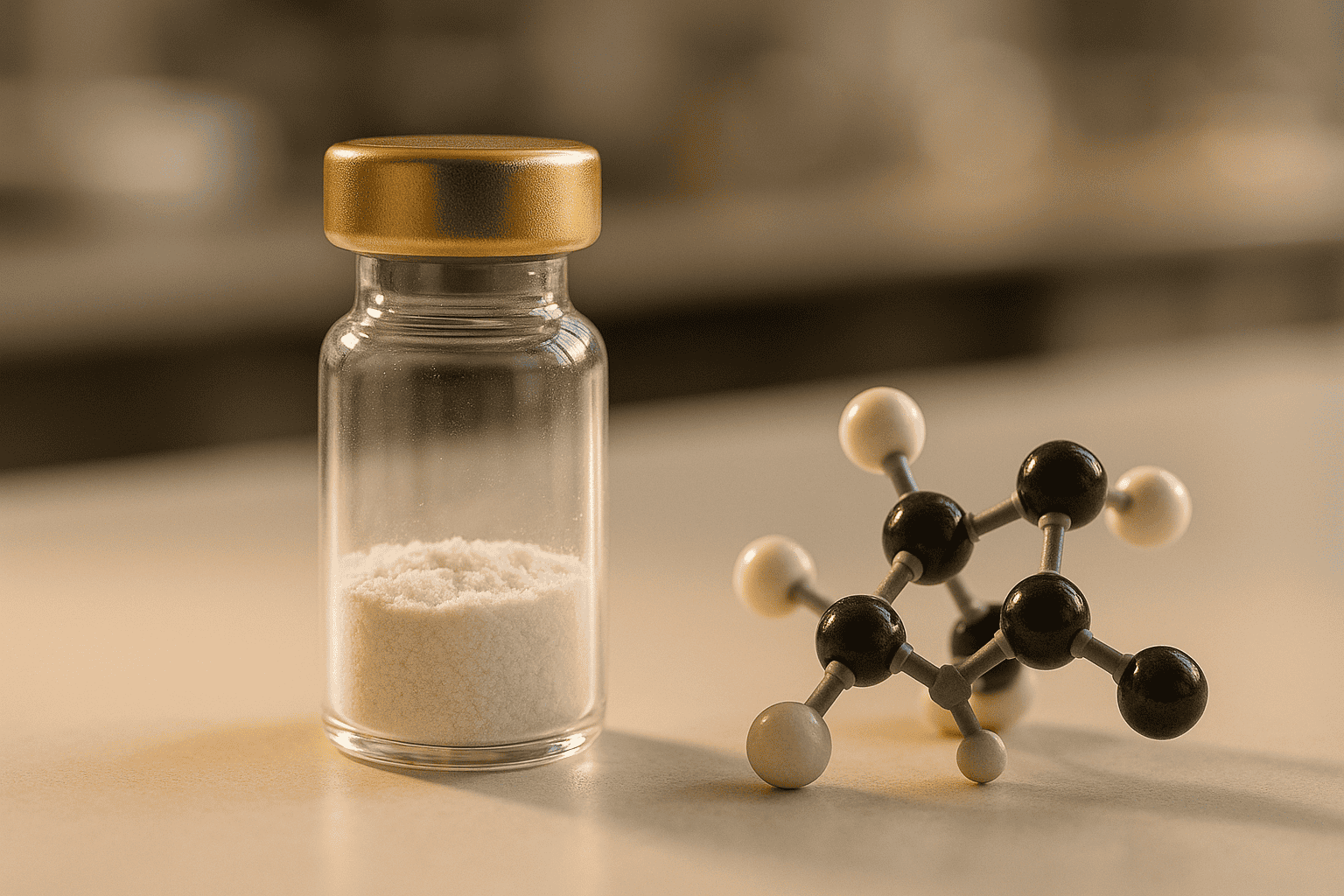
Research-grade CJC-1295 DAC is supplied as a lyophilized (freeze-dried) white powder in sealed vials. Researchers reconstitute it with bacteriostatic water or an appropriate buffer before use in laboratory applications. It should not be purchased in pre-dissolved form, as solution stability decreases significantly after reconstitution.
For research use only. Not for human consumption. CJC-1295 DAC is an experimental compound with no FDA-approved therapeutic applications. All information on this page is provided for educational purposes relating to laboratory and preclinical research. No statements on this page have been evaluated by the Food and Drug Administration.