
· For research use only. Not for human consumption.
For research use only. Not for human consumption.
Peptide half-life is one of the most important numbers in research compound data sheets, and one of the least understood by people reading them for the first time. The concept itself is straightforward: half-life is the amount of time it takes for half of a compound to disappear from a biological system. But what that number actually means for research design and why peptides tend to have such short half-lives — those parts need some explaining.
Most unmodified peptides have half-lives measured in minutes, not hours or days. The body’s enzymes are remarkably efficient at chopping up amino acid chains. That is why peptide chemists have developed an entire toolkit of modifications to extend half-life, and why understanding peptide half-life is essential for anyone working with these compounds in a research setting.
This guide explains half-life in plain language and covers the specific challenges peptides face. For related concepts, see our bioavailability guide and our overview of how peptides are synthesized.
TL;DR: Peptide half-life is the time for half of a compound to be eliminated from a biological system. Most unmodified peptides have very short half-lives (minutes) because enzymes break down amino acid chains rapidly. Modifications like D-amino acid substitutions, PEGylation, and cyclization can extend half-life from minutes to hours or even days. CJC-1295 DAC, for example, has a half-life of several days due to its albumin-binding modification. For research use only. Not for human consumption.
What Does Peptide Half-Life Actually Mean?
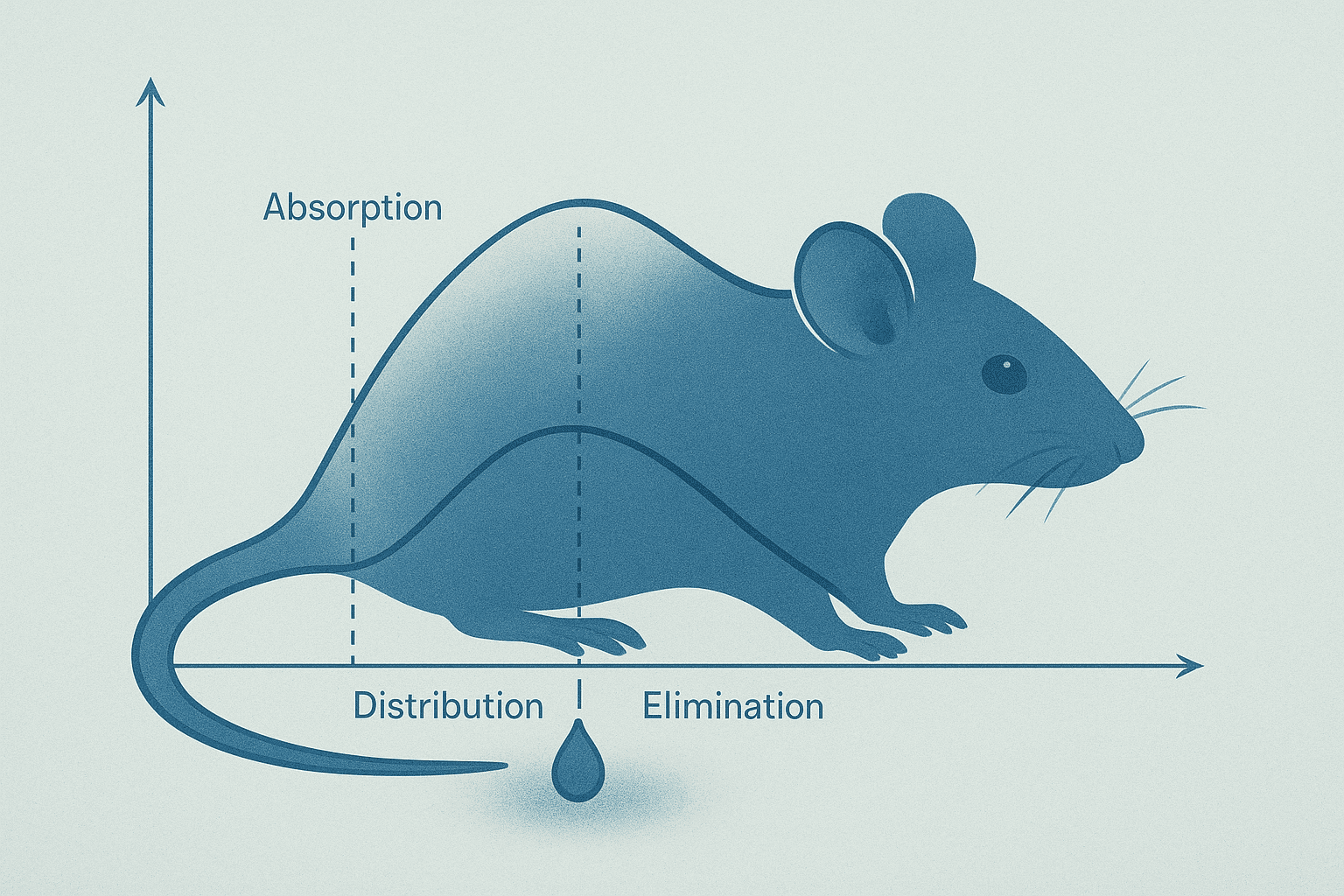
Half-life is the time it takes for half of a compound to be broken down or cleared from a system. If you start with 100 molecules of a peptide and after 10 minutes only 50 remain, that peptide has a half-life of 10 minutes. After another 10 minutes, 25 remain. After another 10, about 12. The amount keeps getting cut in half at regular intervals.
This pattern — called exponential decay — is the same math used to describe radioactive decay, but the mechanism is completely different. Radioactive atoms decay randomly. Peptides get broken down by enzymes, filtered by kidneys, or cleared by the liver. The math happens to follow the same curve, which is why scientists use the same term.
For researchers, the half-life number tells you how quickly a compound disappears from the experimental system. A peptide with a 5-minute half-life is essentially gone within 30 minutes (after 6 half-lives, less than 2 percent remains). A peptide with a 6-hour half-life maintains measurable concentrations for a full day. This directly affects how often a compound needs to be administered in an experimental protocol and how long effects can be observed.
Why Do Most Peptides Have Such Short Half-Lives?
The answer is enzymes. Specifically, proteases — enzymes that evolved to break peptide bonds. The human body contains hundreds of different proteases in the blood, tissues, kidneys, liver, and gastrointestinal tract. Their entire job is to find amino acid chains and cut them into smaller pieces.
Peptides are essentially food to these enzymes. The same biochemistry that lets your body digest a steak works on research peptides. The proteases do not know or care whether a chain of amino acids came from dinner or from a laboratory vial. If it has peptide bonds, it gets attacked.
Natural GHRH (growth hormone-releasing hormone) is a classic example. This 44-amino-acid peptide has a half-life of only about 7 minutes in blood. An enzyme called dipeptidyl peptidase IV (DPP-IV) cuts it almost immediately. Seven minutes. That is how fast the body can dismantle an amino acid chain. This rapid breakdown is why researchers developed modified analogs like CJC-1295 — to get more time for experiments.
Kidney filtration adds another clearance route. Many peptides are small enough to pass through the kidney’s glomerular filtration barrier. Once filtered, they get excreted in urine. Small peptides face both enzymatic breakdown and kidney clearance simultaneously, which is why their effective half-lives can be so dramatically short.
How Do Modifications Extend Peptide Half-Life?
Peptide chemists have developed several strategies to make amino acid chains last longer in biological environments. These modifications work by making the peptide harder for enzymes to recognize, harder for kidneys to filter, or both. Here are the most common approaches studied in preclinical research.
D-amino acid substitutions. Natural amino acids come in an “L” configuration (left-handed). Proteases are built to recognize L-amino acids. Swapping one or more positions to “D” configuration (right-handed, the mirror image) makes the peptide invisible to many enzymes. The enzyme tries to grab the amino acid but cannot get a grip because it is the wrong handedness. SS-31 uses a D-amino acid in its sequence — one reason this synthetic tetrapeptide resists enzymatic degradation.
PEGylation. Attaching polyethylene glycol (PEG) chains to a peptide creates a molecular “shield.” The large PEG polymer surrounds the peptide and physically blocks enzymes from reaching the peptide bonds. PEGylation also increases the peptide’s effective size, which slows kidney filtration. The tradeoff is that PEGylated peptides are bulkier and may have altered receptor interactions.
Cyclization. Connecting the head of a peptide chain to its tail creates a circular structure. Circular peptides resist protease attack because most proteases need a free end to start cutting — they cannot get a grip on a ring. Cyclization can extend half-life significantly while maintaining the peptide’s ability to bind its target receptor.
Albumin binding. Some modifications allow a peptide to attach to albumin, the most abundant protein in blood. CJC-1295 DAC (Drug Affinity Complex) uses this strategy. The DAC modification causes CJC-1295 to bind to circulating albumin, which protects it from enzymatic degradation and slows kidney clearance. The result is a half-life of several days compared to the minutes-long half-life of unmodified GHRH.
Real Examples: From Minutes to Days
The contrast between modified and unmodified peptide half-lives is dramatic. Here are some examples from the preclinical and research literature that illustrate the range.
Natural GHRH: approximately 7 minutes. Rapidly degraded by DPP-IV in the bloodstream. This is the unmodified baseline.
CJC-1295 (no DAC): approximately 30 minutes. A modified GHRH analog with amino acid substitutions that resist DPP-IV. Better, but still relatively short.
CJC-1295 DAC: approximately 6 to 8 days. The albumin-binding DAC modification extends half-life dramatically. Same core peptide, but the modification changes it from a minutes-long compound to a days-long one.
SS-31: a few hours in preclinical models. Its D-amino acid and small size contribute to its resistance to degradation. Mitchell et al. (2020) studied SS-31 in aged mouse models and documented its sustained interaction with the inner mitochondrial membrane (PMID: 32273339).
These examples show that half-life is not a fixed property of peptides as a class — it is specific to each compound and can be deliberately engineered. The same core sequence can have radically different half-lives depending on what modifications are applied.
Mitchell et al. (2020) investigated SS-31 in aged mouse skeletal muscle, demonstrating sustained effects on mitochondrial proteome organization. The synthetic tetrapeptide’s engineered amino acid sequence, including a D-amino acid substitution, contributes to its resistance to rapid enzymatic degradation observed with unmodified peptides. Published in eLife. (PMID: 32273339)
Why Half-Life Matters for Research Design
Understanding peptide half-life shapes almost every practical decision in a preclinical experiment. A peptide with a 5-minute half-life requires very different experimental timing than one with a 6-day half-life. Sampling windows, administration frequency, concentration measurements, and even the choice of animal model are all influenced by this single number.
Half-life also affects how researchers interpret their results. If a peptide has a short half-life, any observed effects must occur rapidly — within the window when the compound is still present. If effects appear hours after the peptide has been cleared, something more complex is happening (like downstream signaling cascades that outlast the compound itself). Knowing the half-life helps researchers distinguish between direct effects and indirect ones.
For anyone sourcing research peptides, understanding half-life helps with planning. Alpha Peptides provides research-grade compounds with documented purity and identity. Browse the full research catalog or review third-party testing data on our Certificates of Analysis page.
Frequently Asked Questions
Is a longer half-life always better for research?
Not necessarily. A longer half-life means the compound stays in the system longer, which is useful for some experiments but creates challenges for others. If a researcher needs precise control over when a peptide is present and when it is gone, a shorter half-life can actually be advantageous. The ideal half-life depends entirely on the experimental design and the research question.
Does storage affect peptide half-life?
Storage affects stability, not biological half-life. A peptide stored properly (lyophilized, sealed, at -20 degrees Celsius) maintains its structural integrity for extended periods. Biological half-life is measured once the peptide enters a living system and faces enzymatic degradation and clearance. Proper storage ensures the peptide enters the experiment intact.
Why is natural GHRH’s half-life only 7 minutes?
Because a blood enzyme called dipeptidyl peptidase IV (DPP-IV) cleaves it almost immediately. DPP-IV specifically targets the amino acid sequence at the front end of GHRH. This is why modified analogs like CJC-1295 were developed — they change the amino acids at the DPP-IV cleavage site, making the enzyme unable to cut the chain.
How is half-life measured in research?
Researchers administer a known amount of peptide to an animal model and then take blood or tissue samples at regular time intervals. They measure the concentration of intact peptide at each time point using analytical methods like HPLC or mass spectrometry. By plotting concentration against time, they can calculate the half-life from the resulting decay curve.
For research use only. Not for human consumption. This article is intended for informational purposes and does not constitute medical advice, dosing guidance, or therapeutic recommendations.