
· For research use only. Not for human consumption.
For research use only. Not for human consumption.
The peptide vs protein question is one of the first things that trips people up when they start reading about research compounds. Both are made of amino acids. Both show up constantly in biology textbooks and research papers. But they are not the same thing, and understanding the difference matters if you want to follow what scientists are actually studying.
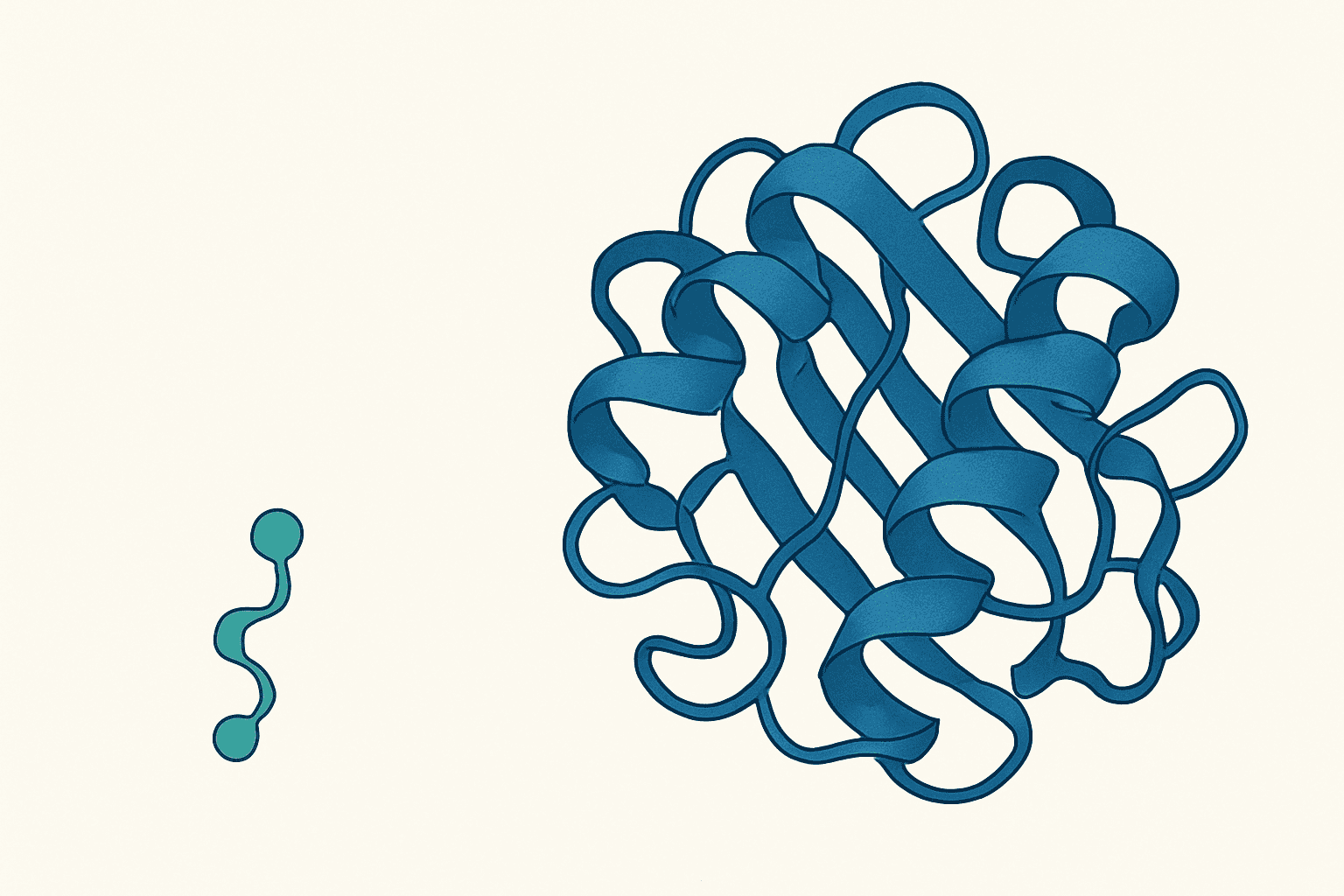
Here is the simplest version: peptides are short chains of amino acids, typically fewer than 50 linked together. Proteins are longer chains, usually more than 50 amino acids, and they fold into complex three-dimensional shapes that give them specific functions. That size cutoff is not a hard rule carved in stone, but it is the convention most researchers use when they classify these molecules.
This guide breaks down the peptide vs protein distinction in everyday language. No chemistry background needed. If you want to explore specific research peptides after reading this, check out our guide to BPC-157 or browse the full research compound catalog.
TL;DR: Peptides are short amino acid chains (typically under 50 amino acids) that stay relatively simple in structure. Proteins are longer chains (50+ amino acids) that fold into complex 3D shapes to perform specialized jobs. Both are built from the same 20 building blocks, but their size and structure determine what they can do. For research use only. Not for human consumption.
What Is the Actual Peptide vs Protein Size Difference?
Size is the most straightforward way to tell them apart. Amino acids are the individual building blocks. When you string a few of them together — anywhere from 2 to about 50 — you get a peptide. When the chain grows beyond roughly 50 amino acids, scientists generally start calling it a protein.
To put this in perspective, BPC-157 is a peptide made of 15 amino acids. It is a short chain that researchers can synthesize in a lab relatively easily. Insulin, on the other hand, has 51 amino acids and is usually classified as a small protein (though some textbooks call it a large peptide — it sits right at the border). Hemoglobin, the molecule that carries oxygen in blood, contains 574 amino acids. Nobody would call that a peptide.
Think of it like words and sentences. A peptide is like a short word — maybe three to ten letters. A protein is like a full paragraph. Both use the same alphabet (amino acids), but the length changes everything about what they can express and do.
Why Does Folding Matter So Much?
Length alone does not explain the whole peptide vs protein story. The really important part is folding. Proteins do not just sit around as flat, straight chains. They twist, loop, and fold into specific three-dimensional shapes. That shape is what makes a protein functional. Change the shape, and the protein stops working.
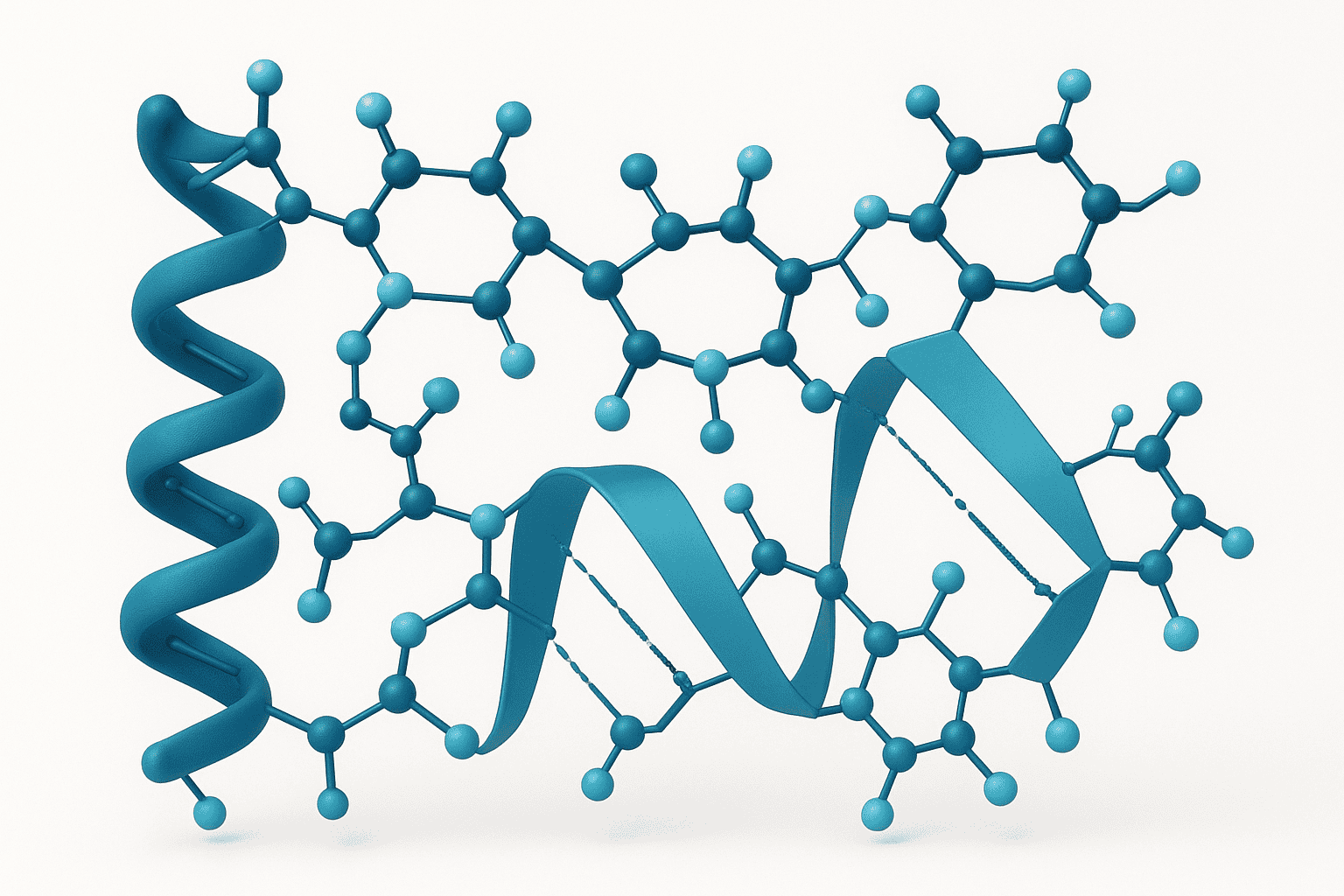
Imagine a sheet of paper. Lying flat, it is just a sheet — simple, flexible, not very interesting. Now fold that paper into an origami crane. Suddenly it has structure, form, and a recognizable shape. Proteins are like origami. The amino acid chain is the paper. The folding pattern is what turns it into something that can actually do a specific job inside a cell.
Peptides generally do not fold into these elaborate shapes. They are too short. A chain of 15 amino acids does not have enough material to create the kind of complex architecture that proteins develop. Peptides tend to remain relatively flexible and linear, which is part of why they behave differently in research settings.
This folding difference also means proteins are more fragile in a sense. If you heat a protein too much or change the chemical environment around it, it can unfold — a process called denaturation. That is what happens when you cook an egg. The heat unfolds the egg white proteins, changing them from clear and runny to white and solid. Peptides, being simpler, are generally more resistant to this kind of structural disruption.
How Do Peptides and Proteins Function Differently?
Because of their size and folding differences, peptides and proteins tend to do different kinds of work. Proteins are the heavy lifters of biology. They serve as enzymes that speed up chemical reactions, structural components that hold cells together, antibodies that recognize foreign invaders, and transporters that shuttle molecules around the body.
Peptides tend to act more like messengers. Many naturally occurring peptides function as signaling molecules — they carry instructions from one cell to another. Hormones like oxytocin (9 amino acids) are peptides. So are certain antimicrobial compounds the body produces to fight bacteria. Their small size lets them move quickly through tissues and interact with specific receptors on cell surfaces.
In research contexts, this functional difference is significant. Scientists studying BPC-157, for example, are interested in how a short 15-amino-acid chain interacts with growth factor signaling pathways. Gwyer et al. (2019) reviewed the preclinical literature on BPC-157 and documented its effects across multiple tissue types in animal models (PMID: 30915550). A protein would interact with those same systems in a completely different way because of its size and structure.
Gwyer et al. (2019) published a systematic review of BPC-157 preclinical studies, examining the peptide’s documented effects across musculoskeletal, gastrointestinal, and neural tissue models in animals. The review highlighted BPC-157 as a 15-amino-acid peptide fragment, illustrating how short chains can produce measurable effects in laboratory settings. (PMID: 30915550)
Examples That Make the Peptide vs Protein Distinction Clear
Sometimes the best way to understand a concept is to look at specific examples. Here are some well-known molecules sorted by category to show where the line falls.
Peptides (short chains, under ~50 amino acids):
- BPC-157 — 15 amino acids. A research peptide originally isolated from gastric juice proteins.
- Oxytocin — 9 amino acids. A naturally occurring signaling peptide.
- MOTS-c — 16 amino acids. A mitochondrial-derived peptide studied in metabolic research. Lee et al. (2015) first identified it as encoded within mitochondrial DNA (PMID: 25738459).
- SS-31 — 4 amino acids. A synthetic tetrapeptide designed for mitochondrial membrane research.
Proteins (longer chains, complex folding):
- Hemoglobin — 574 amino acids. Carries oxygen in red blood cells.
- Collagen — over 1,000 amino acids. Provides structural support in connective tissues.
- Antibodies — roughly 1,300 amino acids. Part of the immune system’s defense.
- Albumin — 585 amino acids. The most abundant protein in blood plasma.
Notice the size gap. The largest peptide on that list has 16 amino acids. The smallest protein has 574. That is not a small difference — it is an entirely different scale of molecular architecture.
Why Does This Distinction Matter for Research?
Understanding the peptide vs protein difference has practical consequences for anyone working in a research setting. Peptides are easier to synthesize in a laboratory. A chemist can build a 15-amino-acid chain using solid-phase peptide synthesis in a matter of days. Building a 500-amino-acid protein from scratch? That is orders of magnitude more difficult and usually requires living cells to produce.
Storage and handling differ too. Peptides are typically sold as lyophilized (freeze-dried) powders that remain stable for extended periods at low temperatures. Proteins often require more careful handling — specific buffer solutions, precise temperature ranges, and protection from physical agitation that could cause them to unfold.

Purity verification also works differently. Peptide purity is commonly verified using HPLC (high-performance liquid chromatography) and mass spectrometry. These same techniques apply to proteins, but protein analysis is more complex because there is more molecule to characterize. For a closer look at how purity testing works, see our guide to HPLC and our Certificates of Analysis page.
Whether you are sourcing peptides for laboratory work or simply trying to understand the science behind these compounds, knowing where peptides end and proteins begin is foundational. Alpha Peptides carries a full line of research-grade peptides with third-party purity verification. Browse the complete research catalog or review testing documentation on our COA page.
Frequently Asked Questions
Is insulin a peptide or a protein?
Insulin sits right at the boundary. With 51 amino acids, it is sometimes called a small protein and sometimes called a large peptide. Most biochemistry references classify it as a protein because it has a defined three-dimensional structure held together by disulfide bonds. But you will see it described both ways depending on the source.
Can a peptide become a protein?
Not on its own. A peptide does not grow into a protein. They are separate molecules made from separate genetic instructions. However, some proteins are initially produced as longer chains that get cut into smaller peptide fragments by enzymes. BPC-157, for instance, is a fragment derived from a larger gastric protein. The peptide did not “grow” — it was cut from something bigger.
Why are research peptides so much smaller than proteins?
Their small size is actually an advantage in research settings. Short chains are easier to synthesize, easier to purify, and easier to characterize using standard analytical methods like HPLC and mass spectrometry. Smaller molecules also tend to be more stable in storage and simpler to handle in laboratory experiments.
Do peptides and proteins use the same amino acids?
Yes. Both are built from the same set of 20 standard amino acids. The difference is not in the building blocks but in how many are linked together and how the resulting chain folds. A peptide uses fewer blocks and stays relatively flat. A protein uses more blocks and folds into a complex shape.
For research use only. Not for human consumption. This article is intended for informational purposes and does not constitute medical advice, dosing guidance, or therapeutic recommendations.