
· For research use only. Not for human consumption.
For research use only. Not for human consumption.
Choosing the right peptide supplier can make or break your research. With dozens of companies competing for your business, each claiming to offer the best quality and service, how do you separate the reliable suppliers from the questionable ones? You need a peptide supplier checklist.
We have put together ten specific questions that you should ask any supplier before placing an order. These questions cover everything from documentation and testing to shipping practices and compliance. Whether you are ordering your first research peptide or switching from a supplier that has let you down, this checklist will help you make a more informed decision.
Each question targets a specific aspect of supplier quality. A company that can answer all ten confidently and transparently is far more likely to deliver a product you can trust. Let us walk through them one at a time, starting with the most fundamental: documentation.
TL;DR: Before ordering from any peptide supplier, ask these 10 questions: Do they provide batch-specific COAs? Is there third-party testing? Can you see HPLC traces? Is mass spec confirmation included? Do they test for endotoxins? Are they U.S.-based? Do they maintain proper cold chain shipping? Is labeling clear and accurate? Do they comply with “for research use only” regulations? Is customer support responsive? A supplier that scores well on all 10 is worth your business.
For research use only. Not for human consumption.
Question 1: Do They Provide Batch-Specific COAs?
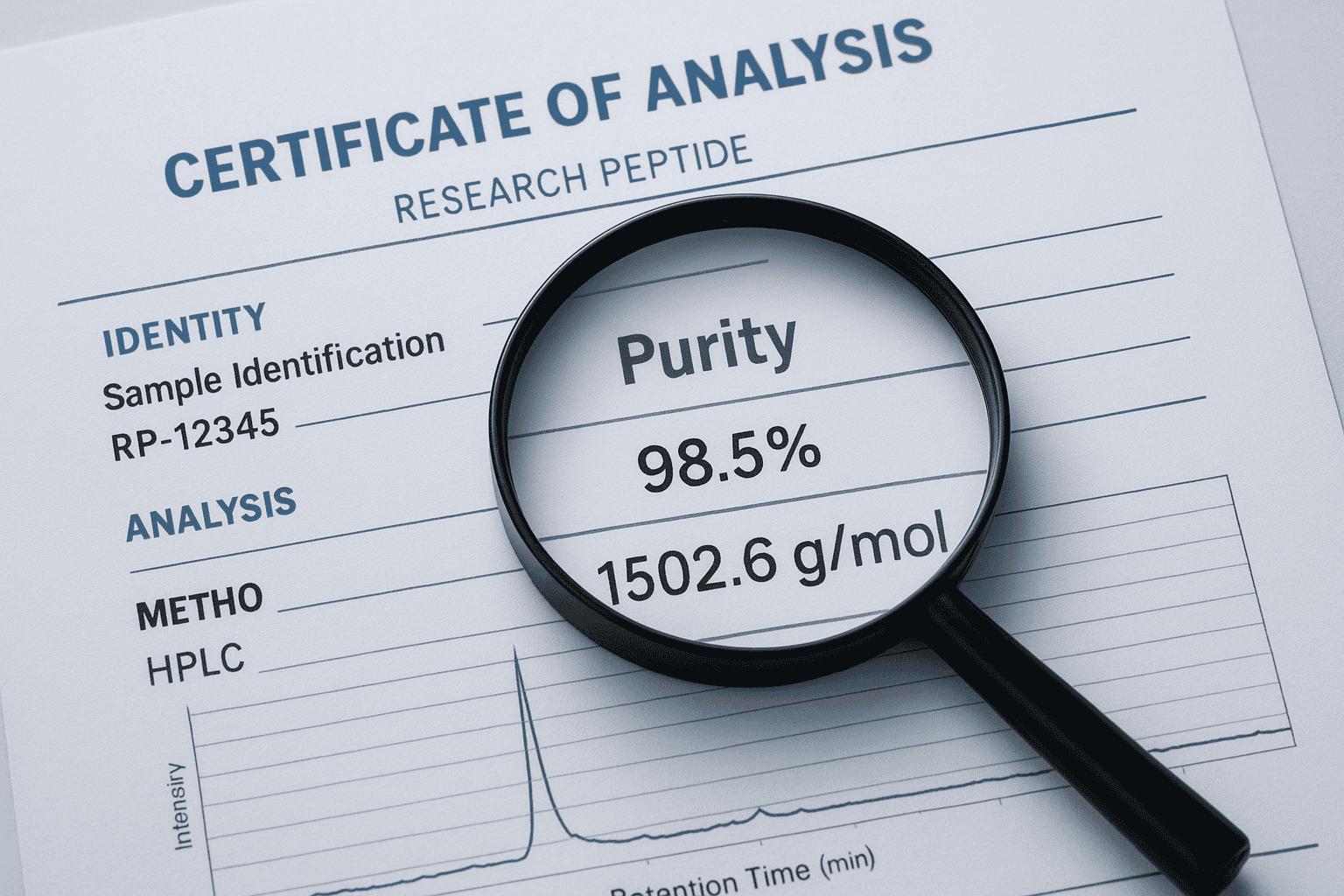
A Certificate of Analysis (COA) is the single most important document a peptide supplier can provide. But not all COAs are equal. The key phrase here is “batch-specific.” Every manufacturing run produces a distinct batch with its own quality characteristics. A legitimate COA should reference a specific lot number tied to the exact product you are receiving.
If a supplier provides a generic COA that looks identical for every order, or if they cannot produce a COA at all, that is a major red flag. You should be able to trace your product back to a specific production and testing event.
Question 2: Is There Third-Party Testing?
Internal quality control is good. Independent third-party testing is better. When a company sends its products to an outside laboratory for analysis, it removes the conflict of interest inherent in self-testing. Ask whether the testing was performed in-house, by an independent lab, or both. The best suppliers do both.
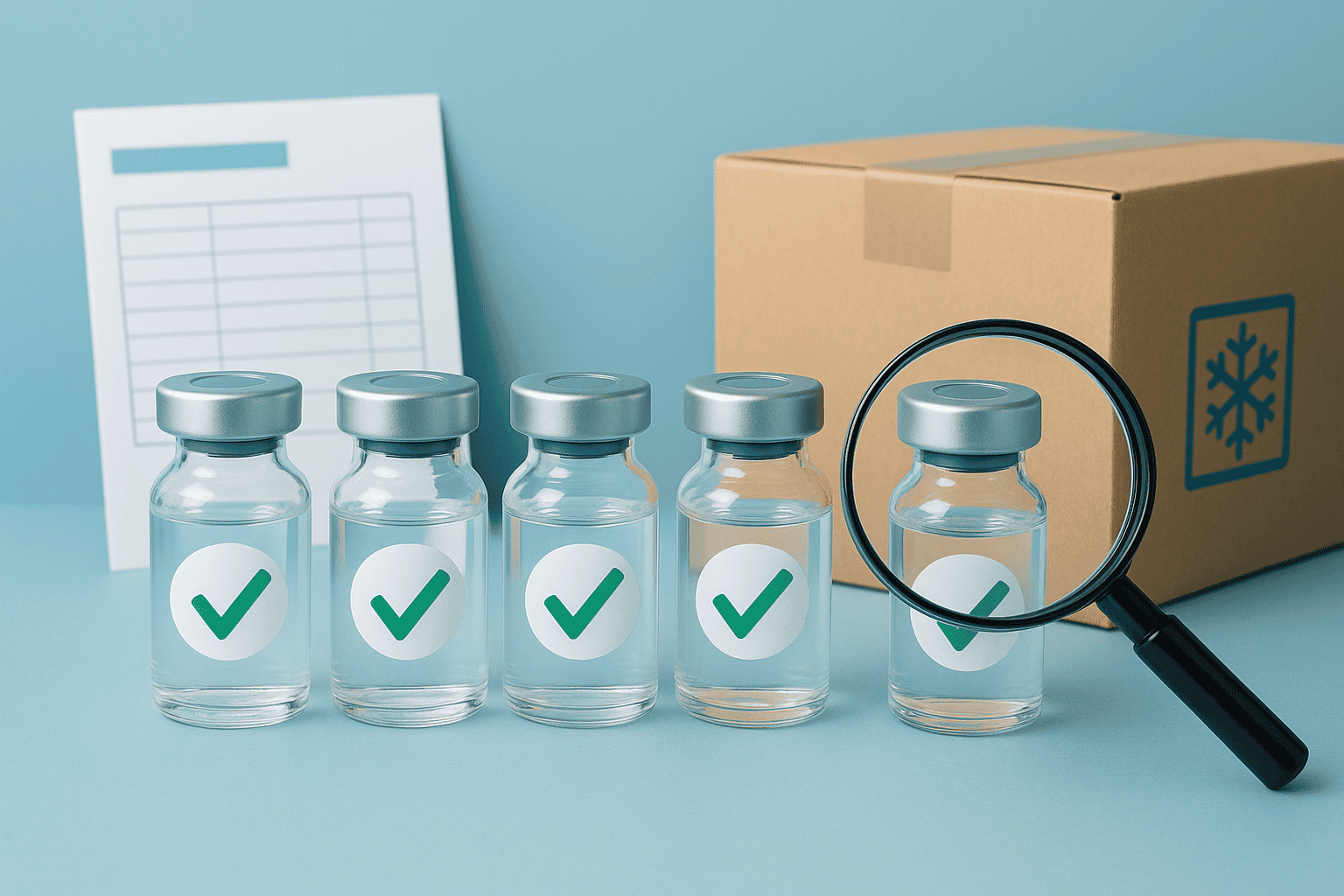
Question 3: Can You See the Actual HPLC Traces?
A purity number without supporting data is just a claim. Ask to see the actual HPLC chromatogram, the graph showing the separation of your peptide from impurities. A real chromatogram will show a clear main peak with baseline resolution. This is a quick way to assess whether the supplier is providing genuine analytical data or just putting numbers on a page.
Question 4: Is Mass Spectrometry Confirmation Included?
HPLC tells you how pure the sample is, but mass spectrometry (mass spec) confirms that the main component is actually the correct peptide. It does this by measuring the molecular weight and comparing it to the theoretical weight calculated from the amino acid sequence. Without mass spec, you might have a very pure sample of the wrong peptide. Ask if mass spec data is included with every product.
Question 5: Do They Test for Endotoxins?
Endotoxins are bacterial cell wall fragments that can contaminate peptide products and confound biological research. Standard HPLC testing does not detect them. Ask whether the supplier performs endotoxin testing (typically using the LAL assay). This is especially important if you are using peptides in cell-based research systems.
Question 6: Are They Based in the United States?
A U.S.-based supplier offers several practical advantages: faster shipping, easier communication, accountability under U.S. business regulations, and no customs delays or import complications. Knowing where a company is physically located also makes it easier to verify their legitimacy. Check for a real street address, not just a PO box.
Alpha Peptides, for example, is headquartered at 84 W Broadway, STE 200, Derry, NH 03038, with all operations based in the United States.
Question 7: Do They Maintain Proper Cold Chain Shipping?
Many peptides are sensitive to temperature. Exposure to heat during shipping can degrade the product before it reaches your lab. Ask how the supplier handles shipping. Do they use insulated packaging? Cold packs or dry ice? What carriers do they work with? A supplier that ships peptides in a plain envelope during summer is not taking product integrity seriously.
Question 8: Is Labeling Clear and Accurate?
Every product should arrive with clear labeling that includes the peptide name or sequence, lot number, quantity, purity, storage instructions, and the “for research use only” designation. Vague or incomplete labeling makes it difficult to manage inventory and maintain proper laboratory records.
Question 9: Do They Comply with Research-Use Regulations?
Legitimate research peptide suppliers clearly label their products as “for research use only” and do not make claims about human applications. This compliance is not just good practice; it is a legal and regulatory requirement. A supplier that markets peptides with implied or explicit non-research uses is operating outside proper boundaries and puts your institution at risk.
Question 10: Is Customer Support Responsive?
Before placing a large order, test the supplier’s customer support. Send an email or make a phone call with a question about a product. How quickly do they respond? Is the response knowledgeable and helpful? A company that is difficult to reach before you buy will be even harder to reach if something goes wrong with your order.
At Alpha Peptides, customer support is available at cs@alpha-peptides.com or by phone at +1 (978) 219-0404.

Putting Your Peptide Supplier Checklist to Work
No single question on this list is a silver bullet. The value is in the complete picture. A supplier that checks all ten boxes demonstrates a comprehensive commitment to quality, transparency, and customer service. One that fails on multiple questions should give you pause.
Alpha Peptides is designed to meet every item on this checklist. We provide batch-specific COAs with HPLC and mass spectrometry data from third-party testing. We are U.S.-based in Derry, New Hampshire, with proper shipping protocols and full research-use compliance. Browse our catalog at alpha-peptides.com/shop.
Frequently Asked Questions
What is the most important question on this checklist?
Batch-specific COAs are arguably the most fundamental requirement. Without documentation, every other quality claim is unverifiable. A COA with HPLC and mass spec data provides the baseline proof of product identity and purity.
Why does it matter if a supplier is U.S.-based?
U.S.-based suppliers offer faster domestic shipping, no customs delays, accountability under U.S. laws, and easier communication. They are also simpler to verify as legitimate businesses through public records.
How can I verify a supplier’s claims?
Request COAs and review the data. Check the company’s physical address. Call their customer support. Cross-reference molecular weight data on the COA against known databases. Read reviews from other researchers.
Does Alpha Peptides meet all 10 checklist items?
Yes. Alpha Peptides provides batch-specific COAs, third-party HPLC and mass spec testing, U.S.-based operations (Derry, NH), proper cold chain shipping, clear labeling, full research-use compliance, and responsive customer support via email and phone.
Should I use this checklist for every supplier?
Absolutely. Even if you have been using the same supplier for years, periodically re-evaluating them against these criteria is good practice. Standards and quality can change over time.
For research use only. Not for human consumption. This article is provided for educational and informational purposes. Alpha Peptides products are intended solely for in vitro research and laboratory use. Always consult applicable regulations and institutional guidelines before purchasing research materials.