
· For research use only. Not for human consumption.
For research use only. Not for human consumption.
A heptapeptide is a peptide made of exactly seven amino acids linked together in a chain. That’s it. The prefix “hepta” comes from Greek and means seven, just like a heptagon is a seven-sided shape. If you understand that a peptide is a short chain of amino acids, and “hepta” means seven, then you already know the core concept. The rest is details.
But those details matter if you want to understand why some of the most studied peptides in neuroscience happen to be heptapeptides. Selank and Semax, for example, are both seven-amino-acid chains developed by Russian scientists for preclinical research. Their size isn’t accidental. It turns out that seven amino acids hits a sweet spot in peptide science — long enough to interact with biological systems in meaningful ways, short enough to be stable and practical for laboratory work.
This guide covers what a heptapeptide is, how scientists name peptides by their amino acid count, why seven is an interesting number in peptide chemistry, and what this means for research. No science background required. For more on specific heptapeptides, see our Selank research overview and our guide on Semax’s ACTH fragment origins.
[INTERNAL-LINK: “Selank research overview” -> /blog/selank-nootropic-research-overview/]
[INTERNAL-LINK: “Semax’s ACTH fragment origins” -> /blog/semax-acth-fragment-explained/]
TL;DR: A heptapeptide is a peptide composed of exactly seven amino acids. The name comes from the Greek prefix “hepta” (seven). Selank and Semax are both heptapeptides studied in preclinical neuroscience. Seredenin et al. (1998) characterized the heptapeptide Selank’s properties in behavioral models (PMID: 9583175), while Dolotov et al. (2006) studied the heptapeptide Semax’s effects on BDNF expression (PMID: 16996037). Both are sold for research use only.
What Is a Heptapeptide? The Basics
Let’s start with the building blocks. Amino acids are small molecules that serve as the basic units of peptides and proteins. Think of them like letters of the alphabet. Just as individual letters combine to form words, individual amino acids combine to form peptides. The human body uses 20 different amino acids, and the order in which they’re arranged determines what the peptide does.
A heptapeptide is a “word” that’s exactly seven “letters” long. It’s one specific size category in a larger naming system that scientists use to classify peptides by length. This system is straightforward once you learn the prefixes, and it works the same way for every peptide regardless of which amino acids are involved.
What makes a heptapeptide different from, say, a pentapeptide or a decapeptide? Simply the number of amino acids in the chain. A pentapeptide has five. A heptapeptide has seven. A decapeptide has ten. The name tells you the size. The amino acid sequence tells you what it does.
The Heptapeptide Naming System: Counting Amino Acids
Scientists don’t just call everything a “peptide.” They use Greek and Latin prefixes to specify exactly how many amino acids are in the chain. Here’s the full counting system, starting from the smallest:
- Dipeptide — 2 amino acids (like a two-letter word)
- Tripeptide — 3 amino acids (like a three-letter word)
- Tetrapeptide — 4 amino acids (tuftsin, Selank’s parent molecule, is a tetrapeptide)
- Pentapeptide — 5 amino acids
- Hexapeptide — 6 amino acids
- Heptapeptide — 7 amino acids (Selank and Semax are both heptapeptides)
- Octapeptide — 8 amino acids
- Nonapeptide — 9 amino acids
- Decapeptide — 10 amino acids
Once you get past about 50 amino acids, scientists typically stop using these prefix names and start calling the molecule a “protein” instead. The boundary between a peptide and a protein isn’t perfectly sharp, but the naming convention gives researchers a quick way to communicate size.
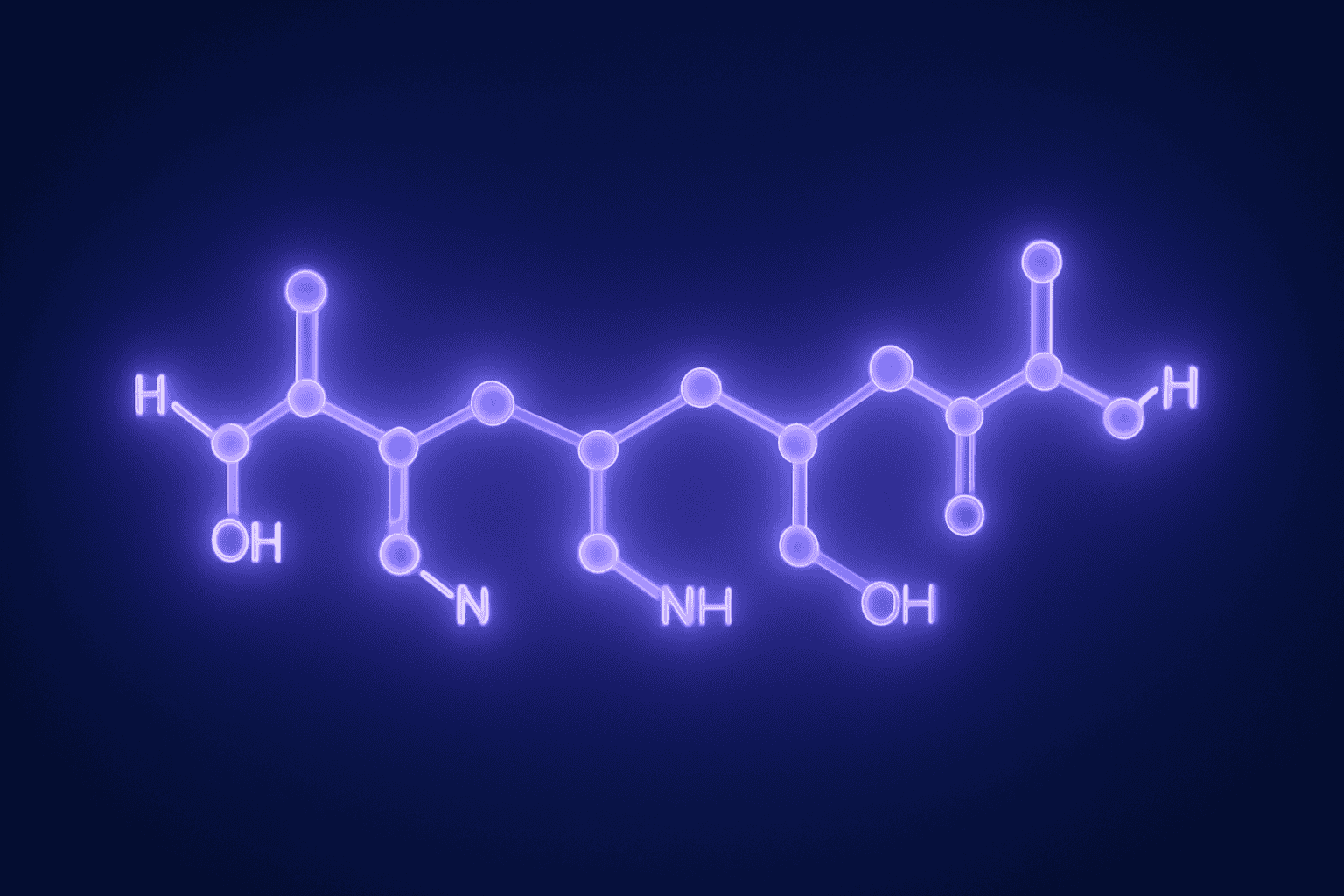
Notice something interesting in the list above. Tuftsin — the natural immune peptide that Selank is built from — is a tetrapeptide (four amino acids). Scientists added three more amino acids (Pro-Gly-Pro) to create Selank, turning a tetrapeptide into a heptapeptide. The naming system tells you exactly what happened: 4 + 3 = 7.
Why Selank Is a Heptapeptide and Why That Matters
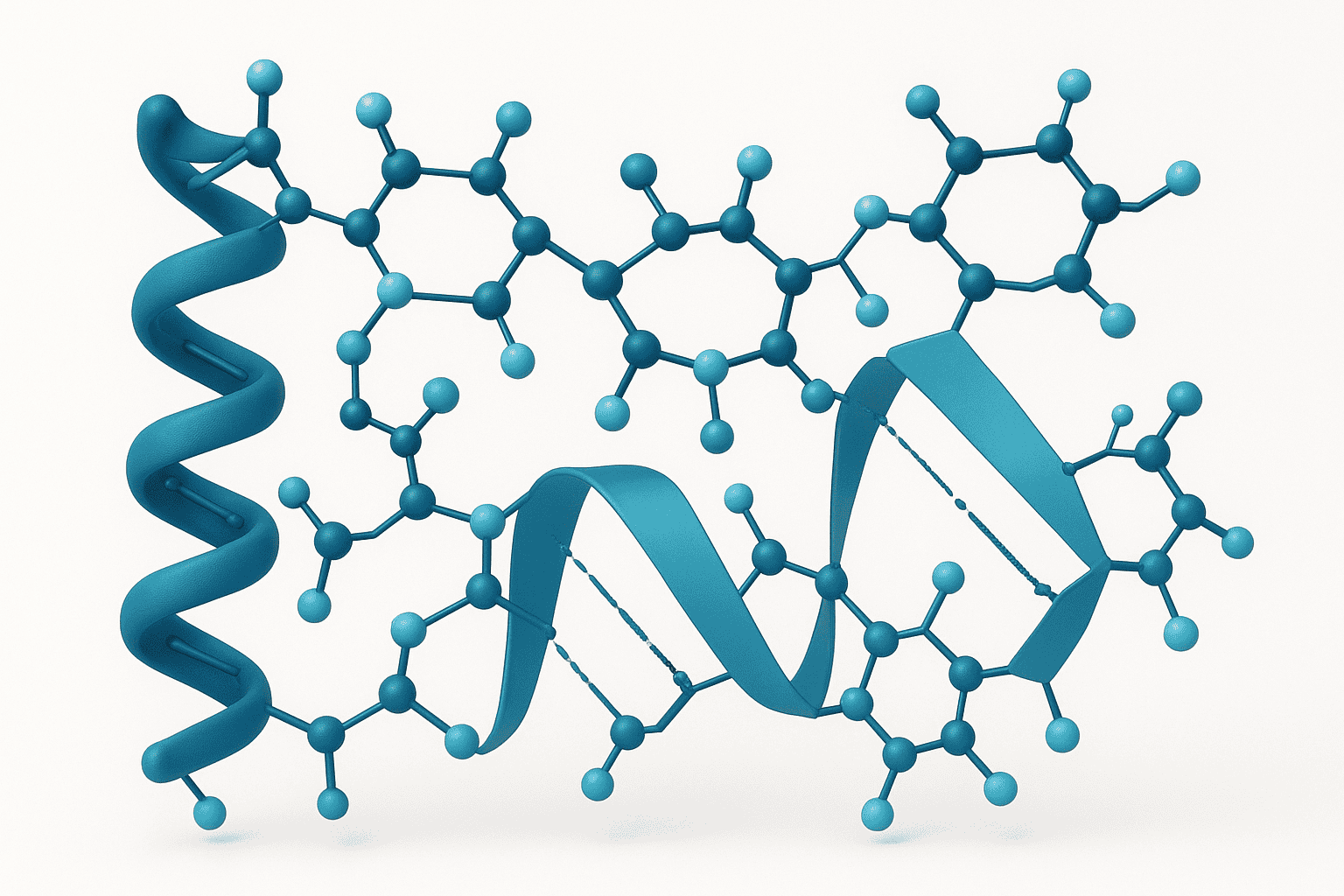
Selank’s full amino acid sequence is Thr-Lys-Pro-Arg-Pro-Gly-Pro. Count them: threonine, lysine, proline, arginine, proline, glycine, proline. Seven amino acids. That makes it a heptapeptide by definition. Seredenin et al. (1998) were among the first to characterize this heptapeptide’s properties in preclinical behavioral models (PMID: 9583175).
Semax follows the same pattern. Its sequence is Met-Glu-His-Phe-Pro-Gly-Pro. Again, seven amino acids. Again, a heptapeptide. Dolotov et al. (2006) studied this heptapeptide’s effects on BDNF and trkB expression in rat brain tissue (PMID: 16996037). Both compounds share the same length but have entirely different amino acid sequences, which is why they interact with different biological systems.
The heptapeptide size matters for practical reasons. At seven amino acids, these compounds are small enough to be synthesized efficiently in a laboratory, stable enough to survive in biological environments (especially with the Pro-Gly-Pro tail), and large enough to have specific interactions with receptors and signaling pathways. If they were much shorter, they might not have enough structural complexity to interact meaningfully with biological targets. If they were much longer, they’d be harder to synthesize and potentially less stable.
Seredenin et al. (1998) characterized the heptapeptide Selank (Thr-Lys-Pro-Arg-Pro-Gly-Pro), a tuftsin analog with seven amino acids, in preclinical behavioral models. The study documented anxiolytic-like properties, establishing this seven-amino-acid compound as a subject of sustained scientific investigation. (PMID: 9583175)
Size Versus Function: Does the Number of Amino Acids Determine What a Heptapeptide Does?
Here’s a question that comes up often: does having seven amino acids make a heptapeptide behave a certain way? The short answer is no. The number of amino acids determines the size category and influences certain physical properties (like how quickly enzymes can break it down), but it’s the specific sequence of amino acids that determines function.
Think about it this way. The English words “kitchen” and “blanket” are both seven letters long. They’re both “heptawords,” if such a term existed. But they mean completely different things because the letters are arranged differently. The same is true for heptapeptides. Selank and Semax are both seven amino acids, but their sequences are different, so they interact with different receptors and show up in different categories of research.
Kozlovskaya et al. (2003) demonstrated this principle by studying Selank alongside other peptides of the tuftsin family. Even among peptides with similar lengths and related sequences, small changes in the amino acid order produced different research outcomes (PMID: 14969422). The sequence is what matters. The length is just a convenient way to categorize.
How Does a Heptapeptide Compare to Larger Peptides and Proteins?
Seven amino acids is tiny by biological standards. For comparison, insulin is a 51-amino-acid protein. Hemoglobin, the protein that carries oxygen in your blood, contains 574 amino acids. The largest known proteins have tens of thousands of amino acids. A heptapeptide is to these proteins what a sticky note is to a novel.
But small doesn’t mean unimportant. In peptide science, size affects several key properties. Smaller peptides are generally easier and cheaper to synthesize in the lab. They tend to have simpler three-dimensional structures. They can sometimes pass through biological barriers that larger molecules can’t. And they are typically broken down faster by enzymes, which is exactly why the Pro-Gly-Pro tail was added to Selank and Semax — to slow down that degradation.

For researchers, heptapeptides occupy a useful middle ground. They’re complex enough to serve as meaningful research tools for investigating receptor interactions and signaling pathways. Yet they’re simple enough to synthesize with high purity and study under controlled laboratory conditions. That balance is part of what makes heptapeptides like Selank and Semax practical for preclinical research. For more on how these compounds are used in current investigations, see our brain peptide research 2026 overview.
[INTERNAL-LINK: “brain peptide research 2026 overview” -> /blog/brain-peptide-research-2026/]
Dolotov et al. (2006) studied the heptapeptide Semax (Met-Glu-His-Phe-Pro-Gly-Pro) and documented its effects on BDNF and trkB expression in rat brain tissue. This research demonstrated that a seven-amino-acid chain could produce measurable changes in neurotrophic factor signaling, highlighting the functional significance of heptapeptides in neuroscience research. (PMID: 16996037)
Where Can Researchers Source Heptapeptides Like Selank?
Research-grade heptapeptides require verified purity documentation. Look for a supplier providing third-party HPLC purity data (minimum 98%), mass spectrometry confirmation of the correct molecular weight, and batch-specific Certificates of Analysis from an independent laboratory.
Alpha Peptides carries research-grade Selank and Semax — both heptapeptides — with publicly available COAs. You can review documentation on our Certificates of Analysis page or browse the full research catalog.
[INTERNAL-LINK: “Certificates of Analysis page” -> /coas/]
[INTERNAL-LINK: “research catalog” -> /shop/]
Frequently Asked Questions
What does heptapeptide mean?
A heptapeptide is a peptide made of exactly seven amino acids. The prefix “hepta” comes from Greek and means seven. It’s a size classification, not a description of function. Two heptapeptides can have completely different amino acid sequences and completely different research applications.
Is Selank a heptapeptide?
Yes. Selank’s amino acid sequence is Thr-Lys-Pro-Arg-Pro-Gly-Pro — seven amino acids total. It was created by extending the tetrapeptide tuftsin (four amino acids) with a Pro-Gly-Pro tail (three amino acids). Seredenin et al. (1998) characterized this heptapeptide in preclinical behavioral research (PMID: 9583175).
What is the difference between a peptide and a protein?
Both are chains of amino acids. The general convention is that shorter chains (roughly 2-50 amino acids) are called peptides, while longer chains are called proteins. A heptapeptide, with its seven amino acids, falls firmly in the peptide category. The boundary is not perfectly rigid, but the distinction helps scientists communicate about molecular size.
Why are some research peptides exactly seven amino acids long?
Seven amino acids represents a practical balance for laboratory research. The chain is long enough to have specific biological interactions but short enough to be synthesized with high purity and efficiency. In the case of Selank and Semax, the seven-amino-acid length resulted from adding a three-amino-acid stabilizing tail (Pro-Gly-Pro) to four-amino-acid parent fragments.

For research use only. Not for human consumption. All peptides referenced in this article are intended exclusively for laboratory and preclinical research purposes. Nothing on this page constitutes medical advice, dosing guidance, or a recommendation for personal use. All information is provided for educational purposes relating to peptide chemistry and laboratory research practice.