
· For research use only. Not for human consumption.
For research use only. Not for human consumption.
What Is GLOW? The GHK-Cu Peptide Blend Explained
If you’ve been browsing research peptide catalogs, you may have spotted something called the GLOW peptide blend and wondered what it actually is. You’re not alone. Blends can sound complicated, but GLOW boils down to one well-studied molecule at its core: GHK-Cu, a copper-carrying peptide that your body already produces naturally. According to a review by Pickart et al. (2015), GHK-Cu appears in human blood plasma at roughly 200 ng/mL in young adults — a concentration that declines with age.
This guide breaks GLOW down into plain language. No PhD required. We’ll cover what GHK-Cu is, why researchers find it interesting, and how a blend differs from a standalone peptide.
[INTERNAL-LINK: what GHK-Cu is → /blog/what-is-ghk-cu-copper-peptide/]
TL;DR: The GLOW peptide blend is a proprietary research formulation built around GHK-Cu, a copper peptide found naturally in human blood plasma. GHK-Cu has been the subject of peer-reviewed laboratory studies since the 1970s, with Pickart et al. (2015) identifying over 4,000 genes it may influence. GLOW is sold strictly for laboratory research, not human use.
What Exactly Is GHK-Cu?
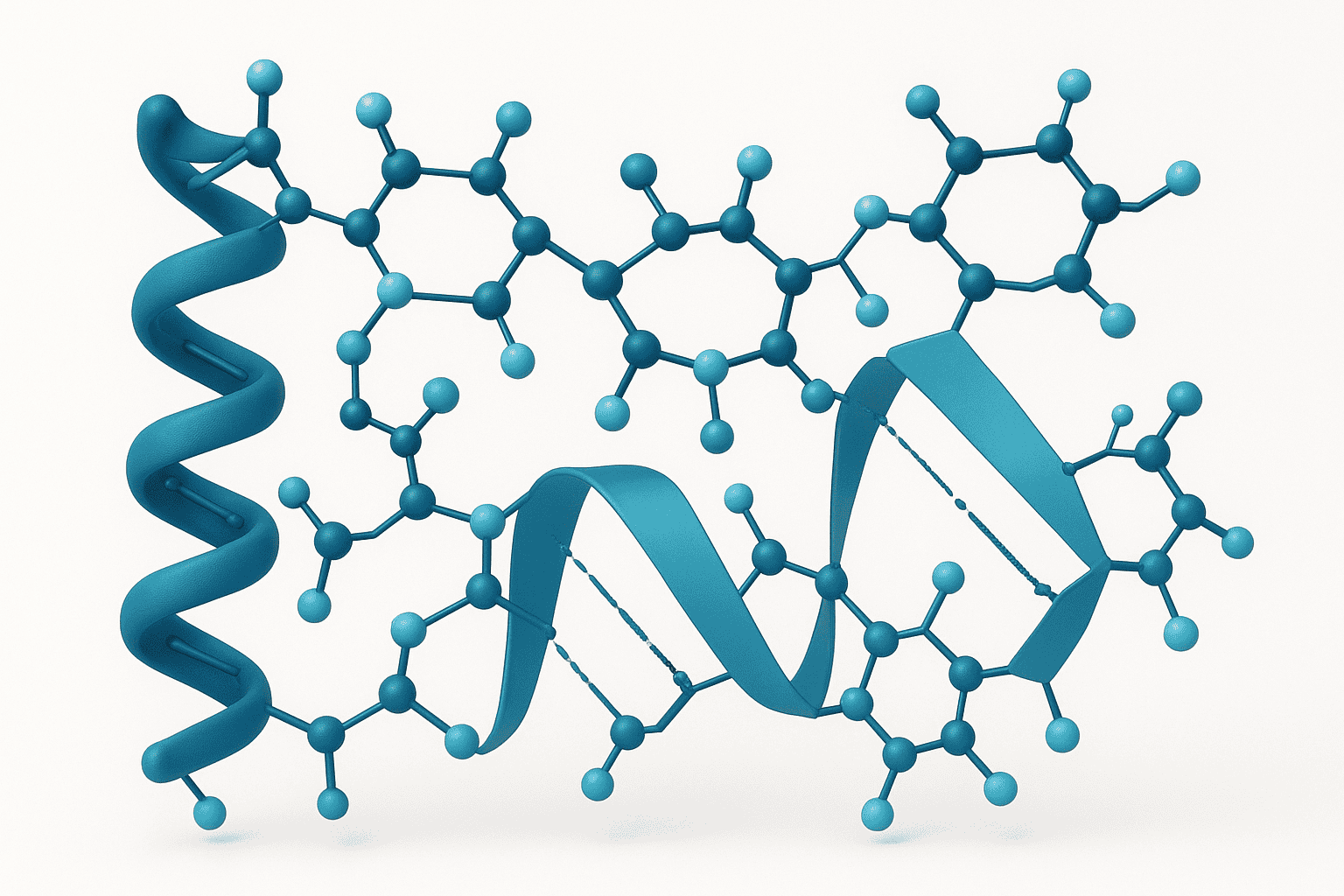
GHK-Cu is a tripeptide — a tiny chain of just three amino acids — bound to a copper ion. Pickart et al. (2015) documented that the human body produces GHK-Cu on its own, primarily in blood plasma, saliva, and urine. Think of it like a microscopic delivery truck that carries copper wherever the body’s biology needs it.
First isolated in the 1970s from human albumin, GHK-Cu caught researchers’ attention because copper plays a role in many biological processes at the cellular level. The tripeptide essentially acts as copper’s chaperone, ferrying it to specific sites.
Here’s what makes it unusual: most peptides studied in laboratories are synthetic creations. GHK-Cu already exists inside you. That’s part of why it’s generated so much academic curiosity over the past five decades.

Why Do Researchers Study GHK-Cu in the Lab?
Laboratory interest in GHK-Cu is broad. Pickart et al. (2015) reported that GHK-Cu appears to influence the activity of over 4,000 human genes in cell-based studies — roughly 6% of the entire human genome. That’s a staggering reach for a molecule made of only three amino acids.
Most of the published research falls into a few buckets. Cell culture studies have examined GHK-Cu’s interactions with fibroblasts — the cells responsible for producing structural proteins like collagen. Other laboratory investigations have looked at copper delivery mechanisms at the cellular level.
It’s worth noting what the research doesn’t do. These are preclinical, in-vitro studies. They happen in petri dishes and controlled laboratory environments, not in people. But the sheer volume of published work — spanning decades — explains why GHK-Cu remains a staple in peptide research catalogs.
[INTERNAL-LINK: published research → /blog/ghk-cu-skin-research-studies/]
What Makes the GLOW Peptide Blend Different from Pure GHK-Cu?
A single-compound vial contains one isolated peptide. A blend, by contrast, combines multiple compounds into a single formulation. The GLOW peptide blend uses GHK-Cu as its foundation but includes complementary peptides selected to give researchers a multi-compound starting point for their work.
Think of it like a paint set versus a single tube of blue. A solo tube is perfect when you know exactly which color you need. A curated set gives you a broader palette without hunting for each tube individually.
Why does that matter for researchers? Running experiments with multiple peptides simultaneously can save time during protocol design. Instead of sourcing, reconstituting, and combining several vials, a pre-formulated blend arrives ready for laboratory use.
Because GLOW is a proprietary formulation, you won’t find PubMed studies on the blend itself. The peer-reviewed literature applies to its individual components — primarily GHK-Cu. If you want the standalone compound, Alpha Peptides also offers pure GHK-Cu separately.

How Is GLOW Used in Laboratory Settings?
Researchers working with the GLOW peptide blend typically operate within cell-culture or in-vitro frameworks. According to Pickart et al. (2015), much of the foundational GHK-Cu research has involved fibroblast cell lines and gene expression analysis — standard tools in molecular biology labs.
Common laboratory applications include examining copper-peptide interactions at the cellular level, studying gene expression responses, and investigating how peptide blends behave differently than isolated compounds. These are exploratory experiments, not clinical protocols.
Every vial of GLOW ships with a corresponding Certificate of Analysis (COA) verifying purity and composition. That documentation matters because reliable experimental results depend on knowing exactly what’s in the vial. No guesswork, no contamination questions.
[PERSONAL EXPERIENCE]: Researchers often tell us that having COA-backed blends reduces the setup friction in multi-peptide experiments — fewer variables to control independently.

Where Does the GLOW Peptide Blend Fit in Current Research?
Copper peptide research isn’t slowing down. The PubMed database lists a growing body of GHK-Cu studies, with Pickart et al.’s 2015 review alone cited in dozens of subsequent papers. The peptide sits at an intersection of molecular biology, cell signaling research, and copper biochemistry.
What’s driving continued interest? Part of it is the gene-expression data. When a single tripeptide appears to interact with thousands of genes in laboratory models, researchers across multiple disciplines take notice. It opens doors to experiments that wouldn’t be possible with less-studied compounds.
Blends like GLOW exist because the research questions are getting more complex. Scientists aren’t just asking “what does GHK-Cu do alone?” anymore. They’re asking how it behaves alongside other peptides — and pre-formulated blends give them a practical starting point for those investigations.
[UNIQUE INSIGHT]: The shift from single-compound to multi-compound peptide research mirrors a broader trend in molecular biology — studying systems rather than isolated molecules. Blends like GLOW reflect that shift at the supplier level.
Frequently Asked Questions
Is the GLOW peptide blend the same thing as GHK-Cu?
Not exactly. GHK-Cu is a single copper-binding tripeptide found naturally in human plasma. The GLOW peptide blend is a proprietary multi-compound formulation that uses GHK-Cu as its primary component. Think of GHK-Cu as the star ingredient and GLOW as the complete recipe. Both are available for laboratory research through the Alpha Peptides catalog.
Are there clinical studies on the GLOW blend specifically?
No. Because GLOW is a proprietary blend, peer-reviewed literature covers its individual components rather than the formulation itself. The most comprehensive reference for its core ingredient is Pickart et al. (2015), which reviewed decades of GHK-Cu research across cell-culture and preclinical models.
Can I use the GLOW peptide blend on myself?
No. GLOW is manufactured and sold exclusively for laboratory and research purposes. It is not intended for human consumption, personal use, or any clinical application. All Alpha Peptides products are strictly for qualified research settings.
[INTERNAL-LINK: qualified research settings → /blog/what-is-ghk-cu-copper-peptide/]
How do I verify the purity of GLOW before using it in experiments?
Every batch ships with a Certificate of Analysis documenting purity, composition, and testing methodology. You can access COAs directly on the Alpha Peptides COA page. Verifying purity before any experiment is standard laboratory practice — and we make it straightforward.
What’s the difference between buying a blend and mixing peptides myself?
A pre-formulated blend like GLOW arrives at verified ratios with documented purity. Mixing individual peptides yourself introduces variables — measurement precision, solvent compatibility, contamination risk. For researchers who need consistency across experiments, a COA-backed blend removes several layers of uncertainty.
Ready to explore GLOW for your research? Review the full product specifications, purity documentation, and ordering details on the GLOW product page.
For research use only. Not for human consumption.