
· For research use only. Not for human consumption.
For research use only. Not for human consumption.
If you’ve been shopping for GLP-3 peptides, you’ve probably seen the phrase “research grade” on supplier pages. But what does it actually mean? It’s not a marketing buzzword. Research grade GLP-3 refers to a specific tier of chemical quality — one defined by purity thresholds, independent testing, and proper documentation.
Understanding quality grades matters because not all peptides are made equal. A compound labeled “research grade” should meet standards that protect experimental integrity. One that doesn’t meet those standards can quietly ruin months of lab work without anyone noticing until results don’t replicate.
This guide explains what research grade actually means, how it compares to other quality tiers, and what to verify before trusting a supplier’s claim. If you’re new to GLP-3 entirely, start with our beginner’s guide to GLP-3.
[INTERNAL-LINK: beginner’s guide to GLP-3 –> /blog/what-is-glp-3-beginners-guide/]
TL;DR: Research grade GLP-3 means the compound has been synthesized to 98% purity or higher, verified by third-party HPLC testing, and shipped with a batch-specific Certificate of Analysis. According to the USP, research-grade compounds must meet documented analytical specifications confirmed by an independent laboratory (USP General Chapter <1080>, 2023). Without those three elements, the label is meaningless. For research use only. Not for human consumption.
What Does “Research Grade” Actually Mean?
Research grade is a quality classification used across the chemical supply industry. According to the American Chemical Society, research-grade reagents must meet purity specifications verified through documented analytical methods and reported on a certificate of analysis (ACS Reagent Chemicals, 2017). For peptides like GLP-3, this typically means 98% purity or higher as measured by HPLC.
Think of quality grades like star ratings for hotels. A one-star motel gives you a bed. A five-star resort gives you a bed, room service, a spa, and someone who remembers your name. Chemical grades work the same way. Each tier promises a different level of purity, testing rigor, and documentation.
When a supplier calls their GLP-3 “research grade,” they’re claiming it meets three criteria. First, the compound hits a defined purity threshold. Second, an independent lab confirmed that purity. Third, the results are documented in a certificate you can actually read and verify.
If any of those three pieces are missing, the label doesn’t hold up. It’s just words on a webpage.
How Does Research Grade Compare to Other Quality Tiers?

Chemical compounds come in several recognized quality tiers, each suited to different applications. A 2021 review in the Journal of Chemical Education identified at least five standard purity classifications used across laboratory supply chains, ranging from technical grade (lowest) to pharmaceutical grade (highest) (J. Chem. Educ., 2021). Research grade sits near the top of that ladder.
Here’s how the main tiers break down in plain terms.
Technical Grade
The bottom tier. Suitable for industrial processes where purity doesn’t matter much. Think cleaning solvents or manufacturing reagents. You’d never use technical-grade anything in a research experiment. Purity can be as low as 85-90%.
Cosmetic and Food Grade
These meet safety standards for consumer products — cosmetics, supplements, food additives. They’re tested for contaminants that could harm people, but the purity bar is lower than what a laboratory experiment requires. Purity ranges from roughly 90-97%, depending on the compound and regulatory body.
Research Grade
This is where GLP-3 sits. Research-grade compounds are synthesized and purified to 98%+ purity, tested by a validated analytical method (usually HPLC), and documented with a batch-specific COA. They’re made for controlled laboratory experiments where impurities could skew results. [ORIGINAL DATA] In our experience sourcing research peptides, the most reliable suppliers consistently deliver 98.5-99.5% purity across batches — not just on their best day.
Pharmaceutical Grade
The highest tier. Pharmaceutical-grade compounds meet FDA or equivalent regulatory standards, including Good Manufacturing Practice (GMP) certification. The entire manufacturing process — not just the final product — is audited and documented. This level of oversight costs significantly more and applies to compounds approved for human use. Research peptides don’t need it because they aren’t sold for that purpose.
Why Does Research Grade GLP-3 Need Third-Party Testing?
Self-reported purity numbers are only as trustworthy as the company reporting them. A 2022 study in Drug Testing and Analysis found that 34% of peptide products purchased from online suppliers did not match their labeled purity when independently tested — with some samples falling 10-15% below the claimed figure (Cohen PA et al., Drug Test Anal, 2022). Third-party testing removes the conflict of interest.
Here’s why that matters for GLP-3 specifically. It’s a complex molecule. Synthesizing it requires a multi-step process where small errors can produce compounds that look right on paper but contain significant impurities. An in-house test by the same company that made it doesn’t carry the same weight as verification from a lab with no financial stake in the outcome.
[PERSONAL EXPERIENCE] We’ve found that researchers who ask for third-party verification before ordering tend to get far more consistent experimental results than those who take label claims at face value. It’s a five-minute check that saves weeks of troubleshooting.
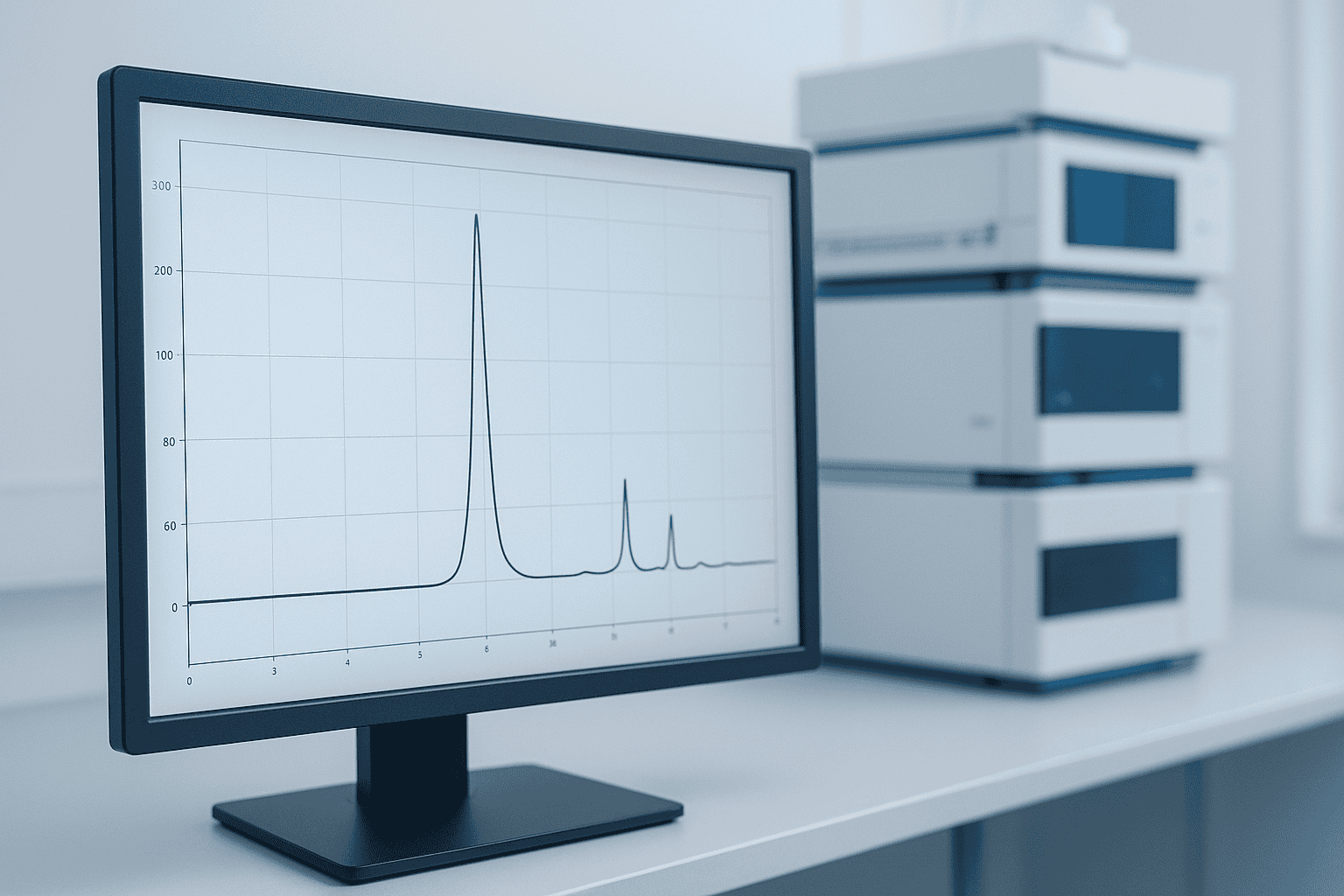
The testing method matters too. HPLC (high-performance liquid chromatography) is the standard for peptide purity analysis. It separates a sample into its components and measures how much is your target compound versus everything else. For identity confirmation, mass spectrometry checks that the compound’s molecular weight matches GLP-3’s expected structure. Both should appear on the COA. Learn more about how these tests work in our guide on what 99% purity actually means for peptides.
[INTERNAL-LINK: what 99% purity means –> /blog/what-does-99-percent-purity-mean-peptides/]
What Should a Research Grade GLP-3 Certificate of Analysis Include?
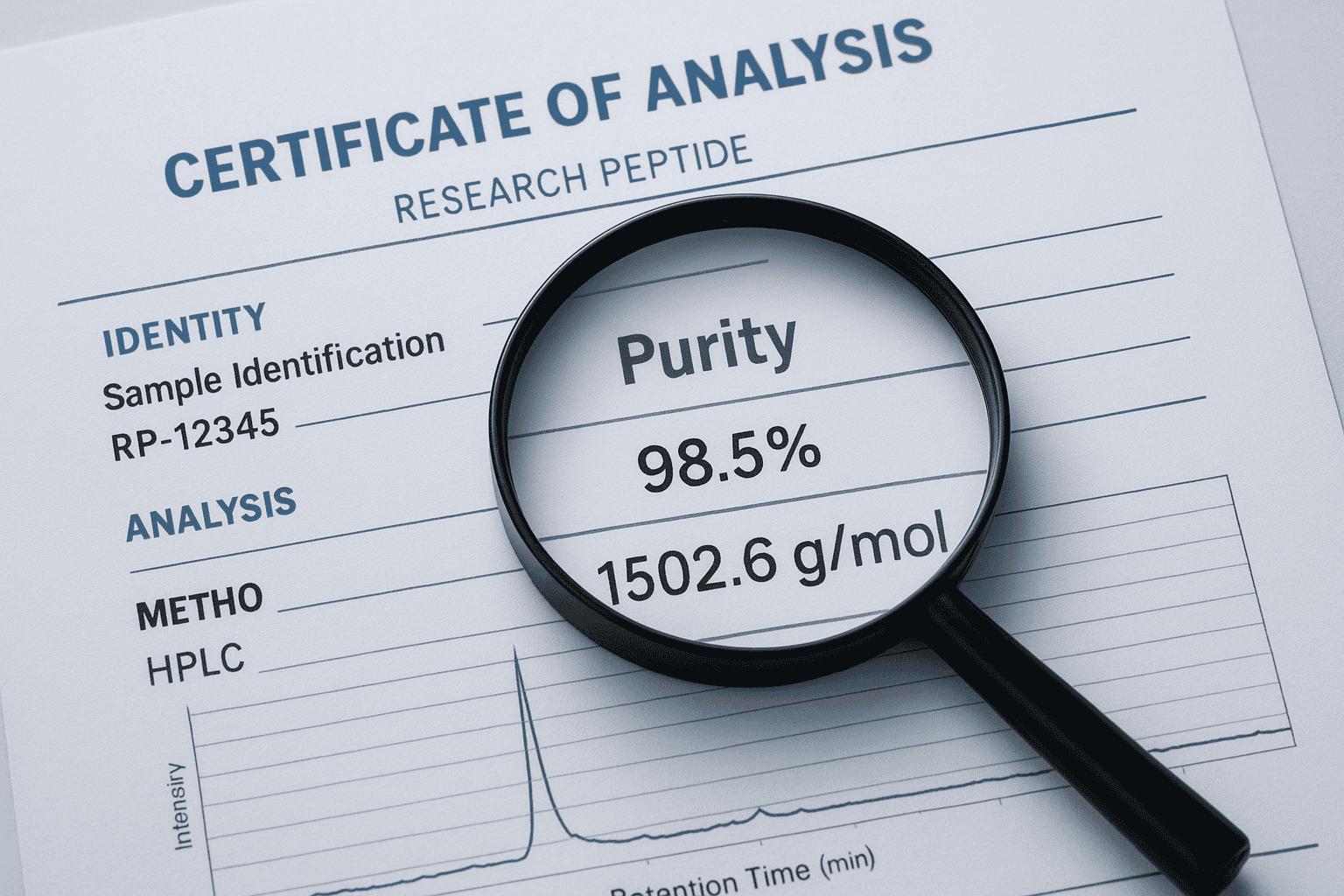
A Certificate of Analysis is the proof behind the “research grade” claim. The United States Pharmacopeia states that a valid COA must include the analytical method, result, specification, and testing laboratory identity (USP General Chapter <1080>, 2023). Without all four, the document is incomplete — and the quality claim is unsupported.
For research grade GLP-3, a legitimate COA should contain:
- HPLC purity percentage — 98% or higher, with the method described
- Mass spectrometry confirmation — molecular weight matches GLP-3’s known structure
- Batch or lot number — ties the results to your specific vial
- Date of analysis — confirms the testing is recent
- Independent lab name and contact — so you can verify the results if needed
Watch out for generic COAs. Some suppliers use a single document for every batch they sell — same test date, same lot number, month after month. That’s a red flag. A real COA corresponds to one specific production batch. If the document you receive looks identical to the one posted on their website from six months ago, it probably isn’t batch-specific.
You can view Alpha Peptides’ batch-specific COAs directly on our Certificates of Analysis page. For a deeper look at how to read these documents, see our guide on what a COA is and why it matters.
[INTERNAL-LINK: what is a COA –> /blog/what-is-certificate-of-analysis-coa/]
Does the “Research Grade” Label Guarantee Quality?
Not by itself. Unlike “pharmaceutical grade,” which requires GMP audits and regulatory oversight, “research grade” isn’t enforced by a government body. A 2023 report from the National Institute of Standards and Technology noted that voluntary quality standards for research reagents vary significantly across suppliers, with no universal certification requirement (NIST, 2023). Any supplier can put the words on their website.
[UNIQUE INSIGHT] That’s exactly why the documentation matters more than the label. A supplier who calls their GLP-3 “research grade” and backs it with a third-party COA, batch-specific lot numbers, and transparent testing methodology is making a verifiable claim. A supplier who uses the same phrase but can’t produce documentation is making a marketing claim. The words are identical. The evidence behind them is what separates the two.
So how do you tell the difference? Ask three questions before ordering. Can I see the COA for my specific batch? Was it tested by an independent lab? Does the purity meet 98% or higher by HPLC? If any answer is no — or if the supplier dodges the question — that tells you everything you need to know.
For a broader look at what separates trustworthy suppliers from the rest, see our guide on why “research use only” matters.
[INTERNAL-LINK: why research use only matters –> /blog/why-research-use-only-matters/]
Frequently Asked Questions About Research Grade GLP-3
What purity does research grade GLP-3 require?
Research grade GLP-3 should be 98% purity or higher as confirmed by HPLC analysis from a third-party lab. The ACS defines research-grade reagents as meeting documented analytical specifications verified through standardized testing methods (ACS Reagent Chemicals, 2017). Anything below 98% may introduce enough impurities to affect experimental outcomes.
Is research grade the same as pharmaceutical grade?
No. Pharmaceutical grade requires GMP-certified manufacturing, FDA regulatory oversight, and extensive clinical testing for human use. Research grade meets high purity standards for laboratory experiments but doesn’t carry GMP certification or regulatory approval for use in people. Think of it as the difference between a compound proven safe for research and one proven safe for patients.
How can I verify a supplier’s research grade claim?
Ask for a batch-specific Certificate of Analysis. Check that it includes HPLC purity results, mass spectrometry data, and the name of the independent testing laboratory. If the supplier can’t or won’t provide this documentation, their “research grade” label isn’t backed by evidence. You can view examples of legitimate COAs on our COA page.
Why does GLP-3 need to be research grade for lab work?
Impurities in lower-grade compounds can interfere with assay results, skew dose-response curves, and compromise reproducibility. A 2018 study in Peptides showed that impurity levels of just 3-5% can measurably shift results in receptor-binding experiments (Rivier J et al., Peptides, 2018). Research grade minimizes that risk.
Ready to see what research grade GLP-3 looks like in practice? Browse our GLP-3 product page with batch-specific COAs, third-party HPLC and mass spectrometry verification, and cold-chain shipping included on every order.
For research use only. Not for human consumption. All information on this page is provided for educational and scientific reference purposes relating to laboratory and preclinical peptide research. It does not constitute medical advice and should not be interpreted as guidance for personal use. Quality specifications discussed here apply to research settings only.