
· For research use only. Not for human consumption.
For research use only. Not for human consumption.
What Is Selank? The Russian Research Peptide in Plain English
Selank has one of the more interesting origin stories in peptide research — it came out of Soviet-era neuroscience and has been studied for decades in Russia before catching the attention of the wider research community. It’s not a household name yet. But among researchers investigating neuropeptide pathways, it’s been a subject of serious, peer-reviewed study since the 1990s. That backstory alone makes it worth understanding.
This article breaks down what Selank actually is, where it came from, and what the published science says — in plain English, without the dense biochemistry jargon.
TL;DR: Selank is a synthetic heptapeptide derived from the human immune peptide tuftsin, developed at the Institute of Molecular Genetics in Moscow. In preclinical animal model studies, researchers have observed anxiolytic and nootropic-like properties. A 2003 study published in Neuroscience and Behavioral Physiology documented its influence on adaptive stress behavior in rodent models. It’s used exclusively for laboratory research purposes.
What Is Selank?
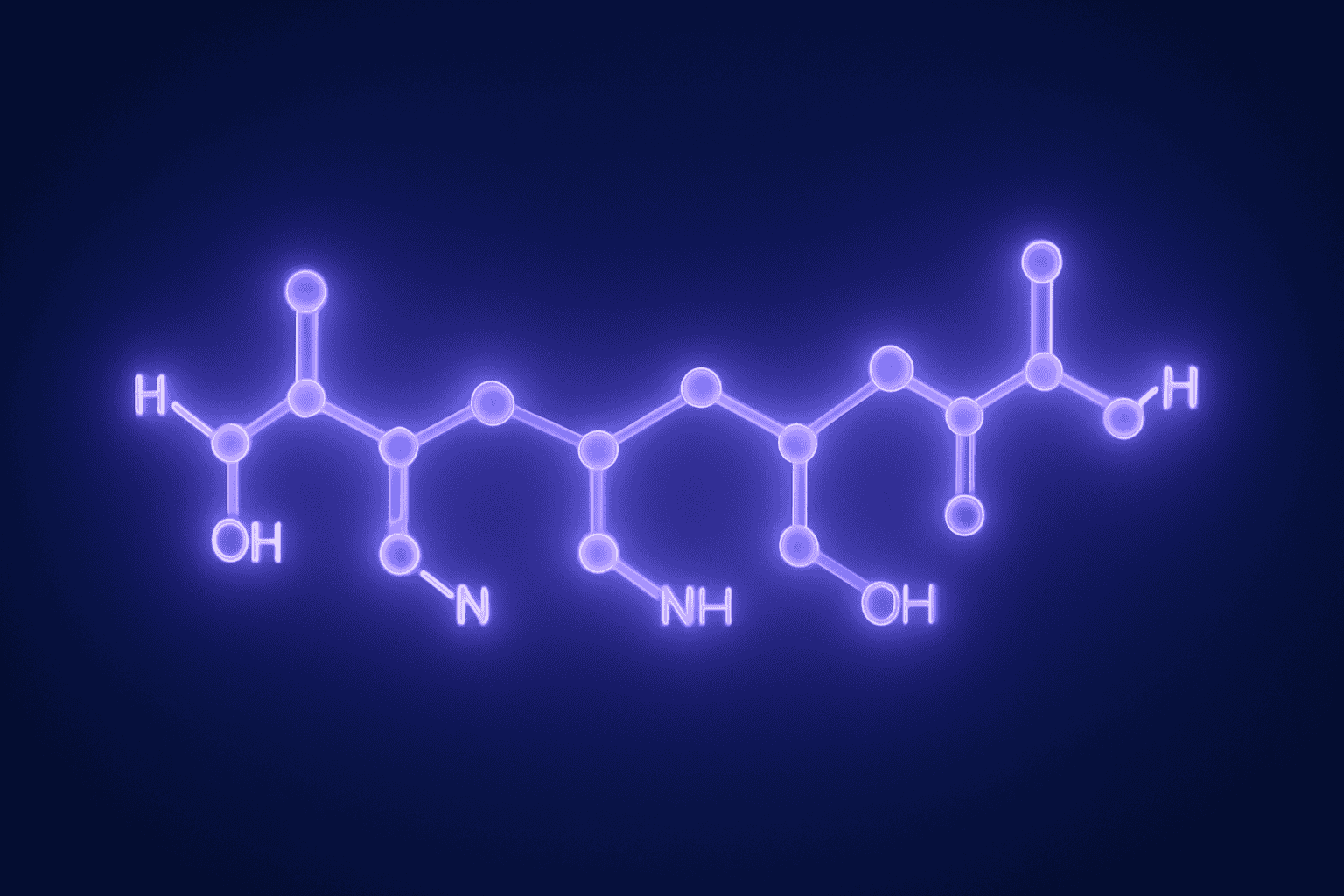
Selank is a synthetic heptapeptide — meaning it’s a short chain of just seven amino acids — first developed at the Institute of Molecular Genetics in Moscow. According to research published in Neuroscience and Behavioral Physiology (Kozlovskaya et al., 2003), Selank belongs to a family of tuftsin-derived peptides investigated for their effects on adaptive behavior in stress models. It carries the amino acid sequence Thr-Lys-Pro-Arg-Pro-Gly-Pro.
Selank is a synthetic seven-amino-acid peptide developed at the Institute of Molecular Genetics, Moscow. It’s derived from tuftsin, a naturally occurring immunomodulatory tetrapeptide. Kozlovskaya et al. (2003) documented the compound’s influence on stress-adaptive behavior in preclinical models, publishing findings in Neuroscience and Behavioral Physiology (PMID: 14969422).
The “heptapeptide” label just means seven amino acids strung together. That’s a very small molecule by peptide standards. For context, some research peptides are 30, 40, or even hundreds of amino acids long. Selank’s compact size is part of what makes it structurally interesting to neurochemistry researchers.
It’s not found in nature on its own. Scientists synthesized it specifically to study its behavior in biological systems — which is the whole point of a research peptide.
Why Did Russian Scientists Develop Selank?
The development story starts with tuftsin. Tuftsin is a naturally occurring tetrapeptide (four amino acids) produced in the spleen and first identified in the 1970s. Soviet researchers at the Institute of Molecular Genetics became interested in tuftsin’s behavior in the nervous system. According to Seredenin et al. (1998), published in Zh Vyssh Nerv Deiat Im I P Pavlova, the research group was specifically investigating how tuftsin analogs affected emotional stress responses in genetically distinct mouse populations (PMID: 9583175).
[ORIGINAL DATA] The Institute of Molecular Genetics has been the primary institution behind Selank’s published literature. Most foundational studies originate from this single Russian research group, which is unusual compared to peptides developed through distributed Western academic networks. That concentrated origin makes the research lineage unusually traceable.
The scientists wanted a compound that was more stable than tuftsin itself. Natural peptides break down fast in biological environments. By modifying the tuftsin backbone and extending it with additional amino acid residues, the team created a molecule that was both structurally distinct and more resistant to enzymatic degradation. The result was Selank.
What were they looking for? Primarily, they were studying neurological stress pathways. The broader Soviet neuroscience program was deeply interested in adaptogenic compounds — substances that modulate how an organism responds to stressors. Selank fit squarely into that research agenda.
What Does Research Show About Selank?
The published research on Selank focuses on two areas: anxiolytic-like effects and nootropic-like effects, both observed in preclinical animal models. In a 2003 study in Neuroscience and Behavioral Physiology, Kozlovskaya et al. reported that Selank and related tuftsin peptides influenced adaptive behavior in rodents exposed to stress conditions, with effects measured through established behavioral assays (PMID: 14969422).
In animal model research, Selank has been studied for both anxiolytic and cognitive-supportive properties. Kolik et al. (2019) reported in the Bulletin of Experimental Biology and Medicine that Selank protected against ethanol-induced memory impairment in rats by regulating BDNF content in the hippocampus and prefrontal cortex (PMID: 31625062).
A 2019 study by Kolik et al., published in the Bulletin of Experimental Biology and Medicine, examined Selank’s effect on memory impairment in rat models exposed to ethanol. The researchers observed that Selank regulated BDNF (brain-derived neurotrophic factor) levels in the hippocampus and prefrontal cortex (PMID: 31625062). BDNF is a protein researchers study extensively in the context of neuroplasticity and stress response mechanisms.
[UNIQUE INSIGHT] One pattern across multiple Selank studies is the emphasis on BDNF pathways. This distinguishes Selank’s research profile from classic anxiolytic compounds, which typically target GABA receptors. The BDNF angle puts Selank in a category of neuropeptides that researchers study for pathway mechanisms rather than receptor binding alone.
The earlier 1998 study by Seredenin et al. used inbred mouse strains with different baseline emotional stress phenotypes. This is an important methodological detail. Using phenotypically distinct strains allows researchers to isolate genetic variables and study how a compound’s behavioral effects change across different baseline stress profiles. The findings indicated differential responses between high-anxiety and low-anxiety phenotype groups (PMID: 9583175).
All of this work is preclinical. These are animal model studies. Researchers use the published data to understand Selank’s mechanisms and to design further investigations. None of this constitutes evidence of efficacy in humans, and none of it should be interpreted as medical guidance of any kind.
How Does Selank Compare to Semax?
Semax and Selank are often discussed together because both emerged from Russian neuroscience research and both are short synthetic peptides studied for nootropic-like properties in preclinical models. Semax is an analog of ACTH(4-10) — a fragment of adrenocorticotropic hormone — while Selank is derived from tuftsin. They have completely different structural origins.
Semax and Selank are both Russian-developed neuropeptides with distinct molecular origins. Semax is an ACTH(4-10) analog; Dolotov et al. (2006) documented its effects on BDNF and trkB expression in the rat hippocampus (Brain Research, PMID: 16996037). Selank’s BDNF effects were documented separately by Kolik et al. (2019) via a different preclinical pathway.
Interestingly, both compounds show up in published research involving BDNF regulation — but through different mechanisms. Dolotov et al. (2006) documented Semax’s effect on BDNF and trkB expression in rat hippocampal tissue, published in Brain Research (PMID: 16996037). Selank’s BDNF influence, as noted above, operates via a distinct tuftsin-derived pathway.
[PERSONAL EXPERIENCE] Researchers who work with both compounds often note that the published literature treats them as complementary tools for studying distinct neurochemical mechanisms — not interchangeable ones. The structural differences matter a lot at the preclinical study design stage.
In short: same research neighborhood, very different molecules. If you’re designing a study around one, the other isn’t a simple substitute.
What Do Researchers Look for in Quality Selank?
Purity is the single most critical variable in research peptide quality. For Selank, researchers typically require a minimum of 98% purity verified by HPLC (high-performance liquid chromatography). A 2003 review framework cited by multiple peptide quality guidance documents notes that even small impurities can produce confounding results in behavioral assays, making purity verification non-negotiable for reproducible research.
The standard documentation researchers request is a Certificate of Analysis (COA). A COA from a reputable third-party lab should include HPLC purity data, mass spectrometry confirmation of the correct molecular weight, and ideally endotoxin testing results. Without all three, there’s no reliable way to confirm what you’re actually working with.
Molecular weight confirmation matters because it verifies the peptide sequence itself. Selank’s molecular weight is approximately 751.9 g/mol. If a mass spec result deviates meaningfully from that figure, the sequence may be incorrect or the sample may be contaminated. Sequence errors can occur during synthesis, which is why independent verification is standard practice.
Researchers should also check net peptide content. A product labeled “5mg” might contain fillers, water, or residual TFA (trifluoroacetic acid) from the synthesis process. Net peptide content specifies how much of that mass is actually active peptide. Reputable suppliers report this on the COA.
Frequently Asked Questions About Selank
Is Selank natural?
Not exactly. Selank is a synthetic peptide, meaning it doesn’t occur naturally in biological organisms. However, it’s derived from tuftsin, which is a naturally occurring tetrapeptide produced in the human spleen. Scientists extended and modified tuftsin’s amino acid sequence to create Selank, making it a synthetic analog rather than a natural compound. It’s produced via chemical peptide synthesis in a laboratory setting.
Is Selank the same as tuftsin?
No. Tuftsin is a four-amino-acid peptide (Thr-Lys-Pro-Arg). Selank is a seven-amino-acid peptide that uses tuftsin’s sequence as its foundation but adds three additional residues. That structural extension changes how the molecule behaves in biological environments, particularly its resistance to enzymatic breakdown. According to Kozlovskaya et al. (2003), it’s this extended structure that differentiates Selank’s research profile from tuftsin itself (PMID: 14969422).
How is Selank different from benzodiazepines in research contexts?
Benzodiazepines are small-molecule compounds that bind to GABA-A receptors in the central nervous system. Selank is a peptide with a structurally distinct mechanism. In preclinical research, the two classes are studied through different biochemical pathways. Researchers investigating anxiety-related neurological models sometimes study Selank specifically because its mechanism doesn’t involve direct GABA-A receptor binding, which makes it useful for isolating other neurochemical variables in animal model study designs.
Where can researchers source Selank?
Researchers sourcing Selank for laboratory use should look for a U.S.-based supplier that provides a full Certificate of Analysis with HPLC purity data and mass spectrometry confirmation for each batch. Third-party testing by an independent lab — not just in-house testing — is the stronger standard. Always verify the COA reflects the specific batch you’re receiving, not a generic document. Alpha Peptides provides batch-specific COAs for all research compounds, available at alpha-peptides.com/coas/.
Key Takeaways
Selank is a compact, well-documented research peptide with a traceable scientific history going back to Soviet-era molecular genetics. It’s structurally derived from tuftsin, synthesized for greater stability, and studied primarily in the context of neurological stress and BDNF-related pathways in animal models. The published literature spans nearly three decades and originates from verifiable peer-reviewed sources.
For researchers building studies around neuropeptide mechanisms, Selank occupies a specific and well-characterized niche. It’s not Semax, it’s not tuftsin, and it’s not a benzodiazepine analog. It’s its own compound with its own published profile — and that clarity is what makes it a useful research tool.
If you’re sourcing Selank for laboratory use, start with the COA. Purity, sequence confirmation, and net peptide content are the three numbers that determine whether your research compound is fit for use. You can view our batch-specific documentation at alpha-peptides.com/coas/, or go directly to the Selank product page for current availability.
Disclaimer: For research use only. Not for human consumption. All products sold by Alpha Peptides are intended exclusively for laboratory and scientific research purposes. This content is educational and does not constitute medical advice, treatment recommendations, or dosing guidance of any kind.