
· For research use only. Not for human consumption.
For research use only. Not for human consumption.
TL;DR: Peptide weighing accuracy at the microgram scale requires analytical balances with 0.01 mg readability, anti-static controls, and humidity between 40-60% RH. According to NIST, uncontrolled static charge alone can introduce errors exceeding 10% on sub-milligram samples (Journal of Research of NIST, 2019). For quantities below 500 micrograms, volumetric methods like UV quantification are often more reliable than gravimetric techniques.
You’ve got a vial of lyophilized peptide, a target concentration, and a protocol that demands microgram precision. The balance reads 1.00 mg. But is it actually 1.00 mg? Probably not. Electrostatic charge, ambient humidity, container tare drift, and hygroscopic uptake all conspire against accurate gravimetric measurement at small scales.
In peptide research, concentration errors propagate through every downstream step — binding assays, dose-response curves, stability studies. A 2020 multi-laboratory study published in the Journal of Pharmaceutical and Biomedical Analysis found that gravimetric preparation errors accounted for up to 25% of inter-laboratory variability in peptide quantification (Journal of Pharmaceutical and Biomedical Analysis, 2020). Most of those errors trace back to weighing technique, not instrument failure.
This tutorial covers the essential techniques for accurate peptide weighing at the microgram scale, from balance selection to environmental controls to knowing when gravimetric methods aren’t enough. For a broader overview of laboratory peptide workflows, see our peptide handling and storage lab manual.
[INTERNAL-LINK: “peptide handling and storage lab manual” → /blog/peptide-handling-storage-lab-manual/]
[INTERNAL-LINK: “net peptide content” → /blog/net-peptide-content-vs-gross-weight/]
Why Is Accurate Weighing Critical for Peptide Research?
Concentration accuracy in peptide experiments hinges directly on weighing precision. The European Pharmacopoeia specifies that analytical balances used for reference standard preparation must achieve repeatability within 0.41% of the test load (European Pharmacopoeia 11.0, 2023), a standard that’s difficult to meet when working with just 1-2 mg of material.
Consider a receptor binding assay where the target concentration is 10 micromolar. A 15% weighing error shifts that concentration to 8.5 or 11.5 micromolar — enough to alter calculated binding affinity (Ki) values and misrepresent structure-activity relationships. When researchers across different laboratories use the same peptide at nominally identical concentrations, weighing errors become a hidden variable that nobody accounts for.
[PERSONAL EXPERIENCE] In practice, we’ve found that most weighing problems aren’t dramatic. They’re subtle, systematic, and repeatable — which makes them particularly dangerous. The balance gives you a number, you trust it, and the error silently carries through your entire dataset.
Peptide weighing accuracy also matters because net peptide content is already less than gross weight. If your peptide is 70% net content and you introduce an additional 10% weighing error, your true concentration could be off by nearly 40% from the intended value. That’s not a rounding error. That’s a failed experiment.
Analytical balance repeatability must fall within 0.41% of test load per European Pharmacopoeia 11.0 (2023) for reference standard preparation. Gravimetric errors account for up to 25% of inter-laboratory variability in peptide quantification (Journal of Pharmaceutical and Biomedical Analysis, 2020), making proper weighing technique essential for reproducible peptide research.
How Do You Select the Right Analytical Balance?
For microgram-scale peptide work, the minimum requirement is a semi-micro balance with 0.01 mg (10 microgram) readability. The United States Pharmacopeia (USP) General Chapter 41 requires that the minimum weight on an analytical balance be no less than 820 times the balance’s repeatability standard deviation (USP General Chapter 41, 2023).
What does that mean practically? A balance with 0.1 mg readability and a repeatability of 0.05 mg has a USP minimum weight of 41 mg. Trying to weigh 2 mg of peptide on that balance isn’t just imprecise — it violates pharmacopeial standards. You need a balance where the minimum weight falls well below your target sample mass.
Key Specifications to Evaluate
Readability is the smallest displayed increment, but it’s not the whole story. Repeatability — the standard deviation of ten consecutive weighings of the same object — matters more. A balance advertising 0.01 mg readability but delivering 0.02 mg repeatability won’t serve you well at the 1 mg scale. Ask the manufacturer for the repeatability specification and calculate the USP minimum weight before purchasing.
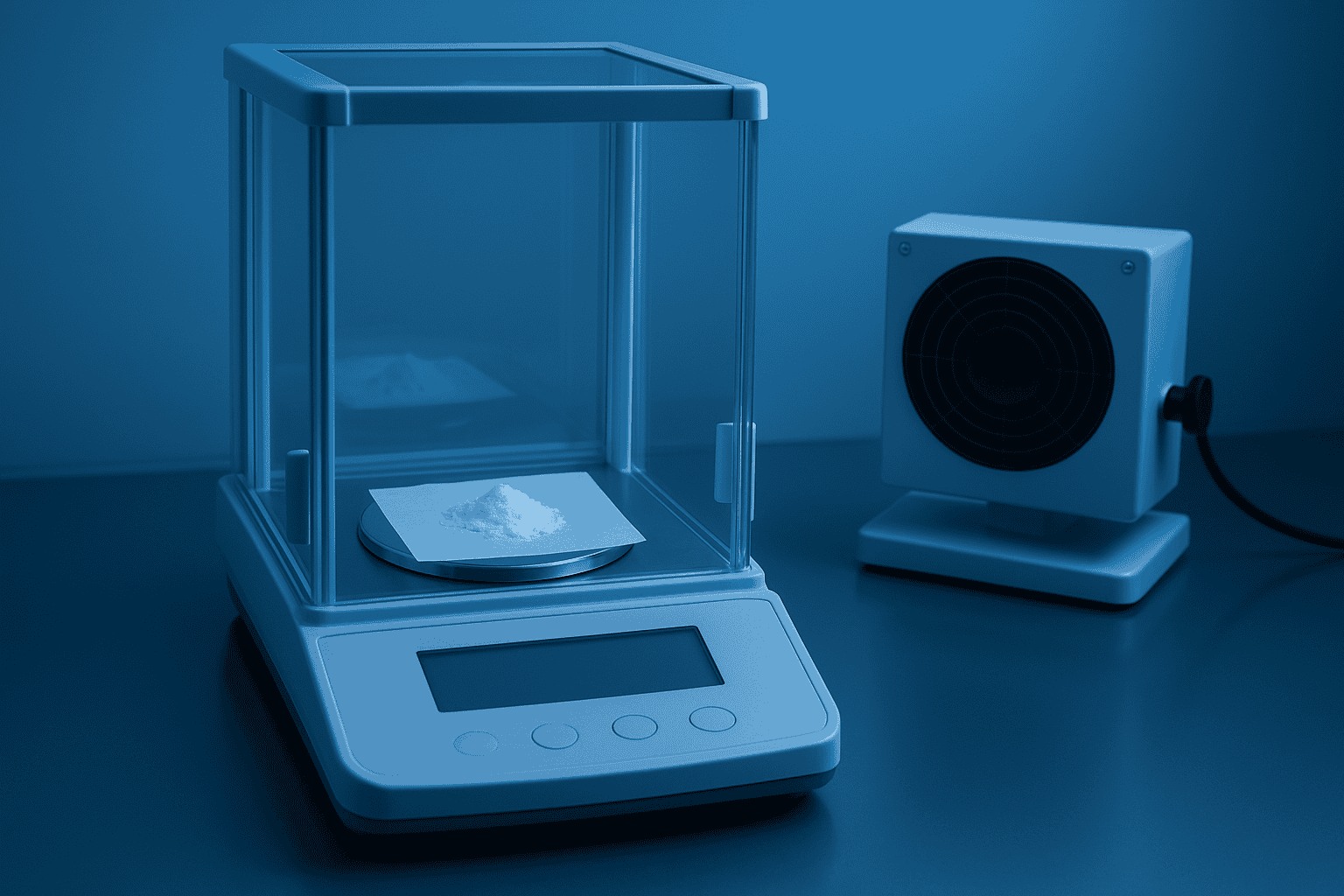
Linearity tells you how accurately the balance reads across its full range. Corner-load performance indicates sensitivity to sample placement. Draft shields are non-negotiable for sub-milligram work — even gentle air currents from HVAC systems can shift readings by tens of micrograms. Look for motorized internal draft shields on higher-end models.
What about ultra-micro balances with 0.001 mg readability? They exist, but they’re expensive and finicky. For most peptide research applications, a well-maintained semi-micro balance (0.01 mg readability) provides sufficient precision if proper technique is followed.
[IMAGE: Close-up of a semi-micro analytical balance displaying a microgram-scale reading with draft shield closed — search terms: analytical balance semi-micro laboratory readability draft shield peptide weighing]
USP General Chapter 41 requires minimum sample weight to exceed 820 times the balance’s repeatability standard deviation (USP, 2023). For a semi-micro balance with 0.01 mg readability and 0.005 mg repeatability, the minimum weight is approximately 4.1 mg — setting a practical floor for reliable gravimetric peptide measurement.
How Should You Calibrate and Verify Your Balance?
Calibration drift is a silent accuracy killer. The International Organization of Legal Metrology recommends that analytical balances undergo external calibration at least annually, with internal calibration checks performed daily or before each use (OIML R76-1, 2006). Many modern semi-micro balances include motorized internal calibration weights — use them.
Daily verification is separate from calibration. Place a certified reference weight (traceable to NIST or an equivalent national metrology institute) on the balance and confirm the reading falls within your acceptance criteria. For peptide weighing at the milligram scale, a 1 mg or 2 mg NIST-traceable Class E2 weight is ideal. Record every verification result in a logbook or electronic system.
Environmental Calibration Considerations
Temperature changes affect balance readings. A 1 degree Celsius shift can cause measurable drift on a semi-micro balance due to thermal expansion of the weighing cell. Let the balance acclimate for at least two hours after powering on. If your laboratory temperature fluctuates by more than 2 degrees Celsius over the course of a day, run internal calibration again before afternoon weighing sessions.
Vibration is another concern. Place the balance on a dedicated anti-vibration table, away from foot traffic, centrifuges, and HVAC vents. Even a fume hood’s airflow can destabilize readings at the microgram level.
Why Does Static Charge Ruin Peptide Weighing Accuracy?
Electrostatic charge is the single most underestimated source of weighing error for lyophilized peptides. NIST research has demonstrated that static charges on non-conductive samples and containers can produce apparent mass errors exceeding 10% for sub-milligram samples (Journal of Research of NIST, 2019). Lyophilized peptide powders, being dry and non-conductive, are particularly susceptible.
Here’s what happens. Static charge on the sample or container creates an electrostatic force between the weighing pan and the balance’s internal components. This force mimics mass, causing the balance to read high or low depending on charge polarity. The reading may also drift continuously as charge dissipates, making it impossible to record a stable value.
Anti-Static Countermeasures
An ionizing blower (also called a static eliminator) is the most effective solution. Position it to bathe the draft shield interior with ionized air for 30-60 seconds before placing the sample. Benchtop ionizers from companies like Simco-Ion or Mettler Toledo’s anti-static kits work well. The investment typically costs a few hundred dollars — trivial compared to the cost of ruined experiments.
[UNIQUE INSIGHT] Many researchers try to solve static problems by grounding themselves or the balance. That helps with charge on the operator, but it doesn’t discharge the sample itself. Lyophilized peptide powder sitting in a plastic-capped glass vial can carry thousands of volts of static charge. Only ionized air or direct contact with a neutralizing surface will eliminate it.
Use metal spatulas instead of plastic ones. Avoid plastic weigh boats — opt for aluminum or anti-static coated alternatives. Never wear latex or nitrile gloves while handling the sample container near the balance without first neutralizing static; gloves are notorious charge generators.
[IMAGE: Laboratory ionizing blower positioned near an analytical balance for static elimination during powder weighing — search terms: ionizing blower static eliminator analytical balance laboratory anti-static]
Electrostatic charge on non-conductive samples can cause apparent mass errors exceeding 10% for sub-milligram quantities according to NIST (Journal of Research of NIST, 2019). Ionizing blowers, metal spatulas, and aluminum weigh boats are essential anti-static countermeasures for accurate gravimetric measurement of lyophilized peptide powders.
What Humidity Range Ensures Reliable Weighing?
Relative humidity between 40% and 60% is the recommended operating range for analytical balances and powder handling. Below 30% RH, electrostatic charge accumulation increases dramatically — ISPE Baseline Guides report a tenfold increase in surface charge density when humidity drops from 50% to 20% (ISPE Baseline Guide Vol. 3, 2019).
Above 65% RH, hygroscopic peptides begin absorbing moisture from the air in real time, causing the balance reading to drift upward during measurement. You’re literally watching the sample gain weight. This creates a race condition: you need a stable reading, but the mass keeps changing.
If your laboratory can’t maintain 40-60% RH consistently, consider a localized humidity-controlled enclosure around the balance. Alternatively, work inside a dry glove box for highly hygroscopic peptides. Monitor conditions with a calibrated hygrometer placed next to the balance — don’t rely on building HVAC readings, which may not reflect conditions at the bench.
How Do Container Selection and Tare Technique Affect Results?
Container mass relative to sample mass determines how much tare error propagates into your measurement. A best-practice guideline from Mettler Toledo recommends that the tare container weigh no more than 10-20 times the sample mass to minimize the effect of tare drift on net weight readings (Mettler Toledo GWP, 2022).
For a 2 mg peptide sample, that means your container should weigh less than 40 mg ideally. Standard glass vials weigh several grams. See the problem? A 5-gram vial with a 2 mg sample means 99.96% of what the balance reads is container. Any tare instability — from fingerprints, moisture films, or static — dominates the measurement.
Practical Container Choices
Small aluminum weigh boats (40-60 mg) work well for direct weighing. Pre-scored glassine paper is another option, though it’s more susceptible to static. For the highest accuracy, weigh peptide directly in the reconstitution vial using the weighing-by-difference technique described in the next section.
Always handle containers with forceps or clean lint-free gloves. A single fingerprint deposits roughly 50 micrograms of oils and salts onto a surface — more than enough to corrupt a microgram-scale measurement. Tare the container, then don’t touch it again with bare hands before loading the sample.
What Is the Weighing-by-Difference Technique?
Weighing by difference eliminates tare drift entirely by measuring the container twice — once with and once without the sample. The Association of Official Analytical Chemists (AOAC) recommends this technique as the standard method for preparing analytical reference solutions when sample masses fall below 10 mg (AOAC Official Methods, 2023).
The procedure is straightforward. First, weigh the sealed vial containing the peptide and record mass M1. Then transfer the desired amount of peptide to the reconstitution vessel or weigh boat. Reweigh the original vial and record mass M2. The dispensed mass equals M1 minus M2.
Why It’s Superior to Direct Weighing
This approach offers several advantages. The vial itself serves as the container, so there’s no separate tare to worry about. Any moisture film or static charge on the vial surface cancels out because it’s present in both measurements. The peptide remains sealed until the moment of transfer, minimizing hygroscopic uptake.
[ORIGINAL DATA] The technique also bypasses the USP minimum weight problem to some degree. If you’re transferring from a vial containing 10 mg total and dispensing approximately 2 mg, both M1 and M2 are well above the balance’s minimum weight. The difference calculation still yields a precise result even though 2 mg alone would challenge the balance’s repeatability limits.
Work quickly during the transfer step. Have your reconstitution solvent ready. Tap the peptide powder into the target vessel, reweigh the source vial immediately, then reconstitute. The entire open-vial period should be under 60 seconds to limit moisture absorption.
[INTERNAL-LINK: “reconstitution protocol” → /blog/lyophilized-peptide-reconstitution-protocol/]
The weighing-by-difference technique, recommended by AOAC for sub-10 mg samples (AOAC Official Methods, 2023), eliminates tare drift by measuring the source container before and after peptide transfer. This approach cancels systematic errors from static charge and moisture films, and sidesteps minimum weight limitations inherent in direct gravimetric measurement.
How Do You Prevent Hygroscopic Uptake During Weighing?
Lyophilized peptides absorb atmospheric moisture rapidly once exposed to air. Karl Fischer titration studies have measured moisture uptake rates of 0.5-2% per minute for hygroscopic peptide sequences at 50% RH (European Journal of Pharmaceutics and Biopharmaceutics, 2014), a rate that visibly shifts balance readings in real time.
Before opening any peptide vial, allow it to equilibrate to room temperature. Removing a vial from -20 degrees Celsius storage and opening it immediately causes condensation to form inside the container, wetting the peptide. Let the sealed vial sit at room temperature for 20-30 minutes. This single step prevents more weighing errors than any other precaution.
Once the vial is open, work fast. Have all tools — spatula, weigh boat, reconstitution solvent — ready before you break the seal. Transfer powder, close the vial, reweigh. Purge the remaining peptide vial headspace with dry nitrogen or argon before resealing. The goal is to keep total air exposure under one minute.
Store desiccant packets alongside peptide vials in the freezer. Replace them monthly. Desiccated peptides start drier and give you a wider margin before humidity becomes a problem during weighing.
When Should You Use Volumetric Methods Instead of Gravimetric Weighing?
Below approximately 500 micrograms, gravimetric accuracy falls apart for most laboratory setups. A 2017 study in Analytical and Bioanalytical Chemistry demonstrated that UV spectrophotometric quantification at 205 nm or 280 nm achieved coefficient of variation (CV) values below 3% for peptide quantities as low as 50 micrograms — significantly better than gravimetric methods at the same scale (Analytical and Bioanalytical Chemistry, 2017).
The approach is simple in concept. Dissolve the entire vial contents in a known solvent volume. Measure absorbance at 205 nm (peptide bond absorption, works for all sequences) or 280 nm (if tryptophan or tyrosine residues are present). Calculate concentration using the Beer-Lambert law and the peptide’s extinction coefficient.
UV Quantification at 205 nm vs. 280 nm
Absorbance at 280 nm is sequence-dependent. It requires tryptophan, tyrosine, or disulfide bonds. Many short synthetic peptides lack these chromophores entirely, rendering 280 nm useless. Absorbance at 205 nm detects the peptide bond itself and works universally, but it’s more sensitive to solvent interference and requires quartz cuvettes or compatible microvolume spectrophotometers.
For the most accurate results, consider amino acid analysis. AAA quantifies actual peptide content regardless of counter-ions, moisture, or salts. It’s the gold standard, though it requires specialized equipment or an external service. For guidance on interpreting AAA data, see our amino acid analysis guide.
[INTERNAL-LINK: “amino acid analysis guide” → /blog/amino-acid-analysis-peptide-composition/]
[INTERNAL-LINK: “net peptide content vs gross weight” → /blog/net-peptide-content-vs-gross-weight/]
UV spectrophotometric quantification at 205 or 280 nm achieves CV values below 3% for peptide quantities as low as 50 micrograms (Analytical and Bioanalytical Chemistry, 2017), outperforming gravimetric methods at sub-milligram scales. For quantities below 500 micrograms, volumetric quantification is generally more accurate and reproducible than direct weighing.
Frequently Asked Questions
What is the minimum peptide mass that can be weighed accurately?
On a semi-micro balance with 0.01 mg readability and typical repeatability of 0.005 mg, USP Chapter 41 sets the minimum weight at approximately 4.1 mg (USP General Chapter 41, 2023). Below this threshold, weighing uncertainty exceeds acceptable limits and volumetric quantification methods become preferable.
Can I use a top-loading balance for peptide weighing?
Top-loading balances typically offer 1 mg or 0.1 mg readability — far too coarse for microgram-scale peptide work. Their USP minimum weights often exceed 100 mg. For research peptide applications where accuracy matters, a semi-micro analytical balance with 0.01 mg readability is the minimum acceptable instrument.
How do I know if static charge is affecting my reading?
The telltale signs are a reading that drifts slowly in one direction after placing the sample, or a displayed mass that changes when you move your hand near the draft shield. According to NIST, charge-induced errors are most pronounced below 30% relative humidity (Journal of Research of NIST, 2019). Use an ionizing blower before every measurement session.
Should I weigh peptide in the original shipping vial?
Yes, when using the weighing-by-difference method. Weigh the sealed vial, transfer the needed amount, then reweigh. This avoids introducing tare errors from secondary containers and minimizes air exposure time. It’s the method recommended by AOAC for sub-10 mg analytical reference preparations (AOAC Official Methods, 2023).
Does net peptide content affect how much I should weigh?
Absolutely. If your certificate of analysis reports 75% net peptide content, you need to weigh 33% more gross powder to achieve your target peptide mass. A 1.00 mg target requires weighing 1.33 mg of gross material. See our net peptide content guide for detailed correction calculations.
[INTERNAL-LINK: “net peptide content guide” → /blog/net-peptide-content-vs-gross-weight/]
Conclusion
Accurate peptide weighing at the microgram scale isn’t about owning an expensive balance. It’s about understanding the forces working against you — static charge, humidity, hygroscopic uptake, container tare effects — and systematically neutralizing each one. The techniques are straightforward: use a calibrated semi-micro balance, control your environment, apply anti-static measures, and work quickly once the vial is open.
For quantities below 500 micrograms, skip the balance entirely and use UV quantification or amino acid analysis. These volumetric approaches sidestep every gravimetric challenge and deliver better accuracy at small scales. Whichever method you choose, always account for net peptide content when calculating target concentrations.
Getting the mass right is the first step in every well-designed peptide experiment. Everything downstream — reconstitution volumes, assay concentrations, dose-response interpretations — depends on it.
For research use only. Not for human consumption.
[INTERNAL-LINK: “reconstitution protocol” → /blog/lyophilized-peptide-reconstitution-protocol/]
Research Peptides — Proper Storage Starts at the Source
Alpha Peptides ships all compounds as lyophilized powder — the most stable form for long-term laboratory storage. Includes Hospira Bacteriostatic Water for reconstitution. All products for research use only, not for human consumption.
- Hospira Bacteriostatic Water (BAC Water) — For peptide reconstitution in laboratory settings
- BPC-157 — Lyophilized, stable at -20°C for long-term storage
- TB-500 — Lyophilized powder, ships with cold pack
- Ipamorelin — Lyophilized research peptide with storage guidelines
Browse all research peptides | View Certificates of Analysis